Gold’s ceremonial status spans ancient civilizations with jaw-dropping consistency. Egyptian pharaohs flaunted it as Ra’s flesh, while Indian brides wore it to channel Lakshmi’s blessings. Greek Olympians rocked those sweet laurel wreaths, and Ashanti leaders wielded golden staffs dripping with spiritual swagger. From Mesoamerican masks to temple offerings, gold wasn’t just bling – it was humanity’s hotline to the divine. The deeper you go into gold’s ritual roots, the more these cosmic connections shine.

Throughout human history, gold’s seductive shimmer has done way more than just catch the eye – it’s grabbed cultures by their spiritual cores and refused to let go. From the sun-drenched temples of ancient Egypt to the misty mountains of Mesoamerica, this precious metal has woven itself into humanity’s most sacred rituals, becoming the ultimate status symbol of divinity and power.
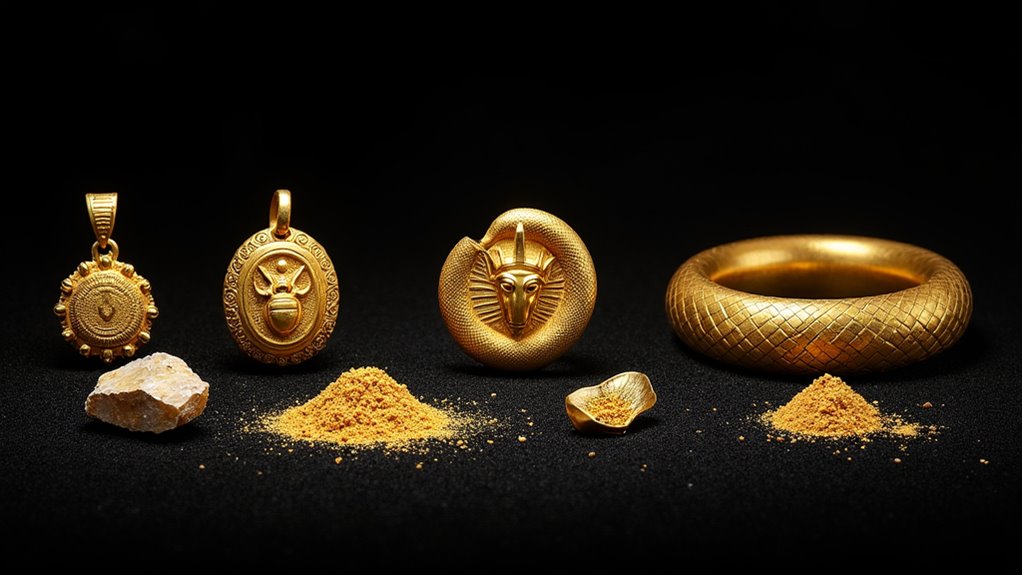
The ancient Egyptians really knew how to rock their gold, didn’t they? They went all-in believing it was literally the flesh of their sun god Ra (talk about high stakes jewelry). Their pharaohs wouldn’t be caught dead – pun intended – without their golden burial masks and amulets. Those iconic pieces, like Tutankhamun’s death mask, weren’t just fancy face covers; they were cosmic insurance policies for the afterlife, studded with lapis lazuli and turquoise for extra spiritual oomph. This belief system highlights how gold in ancient religious art served as a tangible representation of their connection to the divine, as it was often used in royal symbolism to signify the pharaoh’s divine right to rule. Moreover, the extraction of this gold often involved ethically sourced materials to ensure that the spiritual symbolism was not tainted by conflict.
Ancient Egypt’s obsession with gold wasn’t just for show – it was their cosmic connection to Ra, wrapped in gleaming divine metal.
Meanwhile, over in ancient India, gold wasn’t just precious – it was practically a direct hotline to the divine. Every intricate piece of bridal jewelry and temple offering carried the blessing of Lakshmi, the goddess of wealth. And let’s be real, when you’re literally wearing the symbols of divine fortune, you’re definitely doing something right.

The Greeks had their own golden obsession going on. Those laurel wreaths weren’t just fashion statements – they were the original Olympic medals, marking victories in sacred games. And when it came to sucking up to the gods, nothing said “please don’t smite me” quite like a solid gold votive offering to Apollo or Zeus.
In West Africa, particularly among the Ashanti, gold wasn’t just about looking fancy – it was pure spiritual energy made metal. Those ceremonial swords and staffs weren’t just showing off; they were channeling divine authority through every golden detail. Even their trade weights were pulling double duty as spiritual symbols.
The Mesoamericans took gold worship to new heights, crafting mind-blowing masks and ornaments that’d make modern jewelers weep. These weren’t just accessories – they were portals to the divine, worn by rulers who straddled the line between earthly and godly power. Every pendant and figurine told a story of cosmic significance, connecting the wearer to the sacred forces of their universe. In many cultures, gold became a common element in religious artifacts that reflected sacredness and spiritual value.
What’s crystal clear is that across continents and millennia, humans have been consistently creative in finding ways to turn this shiny metal into something transcendent. Whether it was crafting protective amulets, forging divine connections, or ensuring a cushy afterlife, gold has been humanity’s go-to material for making the sacred tangible and the divine accessible.

And honestly? We’re still just as enchanted by its glow today as our ancestors were – we just tend to worship it on trading floors instead of temples.
Frequently Asked Questions
How Do Modern Artisans Recreate Ancient Gold Ceremonial Techniques?
Modern artisans blend ancient goldsmithing techniques with cutting-edge tech to recreate ceremonial masterpieces.
They’re wielding laser welders for precise granulation work, while CAD software perfects those mind-bending filigree patterns.
Lost-wax casting’s getting a 3D printing makeover, and traditional repoussé work now benefits from advanced hammering tools.

It’s like watching history high-five innovation – these craftspeople are basically time-traveling metalheads preserving ancient wisdom with modern muscle!
What Security Measures Protect Gold Ceremonial Objects in Museums Worldwide?
Museums worldwide deploy multi-layered security to protect precious gold artifacts. High-tech systems like AI surveillance cameras and RFID tracking work alongside traditional measures – bulletproof glass, motion sensors, and 24/7 armed guards.
Biometric access control limits who can enter restricted areas, while international partnerships with Interpol help recover stolen pieces. Vault storage during off-hours and rigorous staff background checks add extra protection against both external threats and insider jobs.
Can Ceremonial Gold Objects Be Legally Bought and Sold Today?
The legal trade of ceremonial gold objects exists but operates under strict regulations.
Modern pieces crafted for personal use can typically be bought and sold freely.

However, historically significant or ancient artifacts face heavy restrictions – many countries flat-out ban their sale.
Legit dealers must provide extensive documentation proving an object’s clean provenance.
The black market unfortunately thrives, but authorized channels do exist for ethical transactions through museums and licensed dealers.
How Do Scientists Date Ancient Gold Ceremonial Artifacts Without Damaging Them?
Scientists employ several non-destructive techniques to date ancient gold artifacts.
Electrochemical methods analyze corrosion patterns through voltammetric curves, while isotope analysis tracks radioactive decay in helium, uranium, and thorium content.
Spectroscopic approaches like XRF identify trace elements that match specific historical mines.
These high-tech methods work alongside traditional stylistic analysis – examining patterns and tool marks that reveal an object’s age without ever touching the precious metal.
What Alternatives Did Cultures Use When Gold Wasn’t Available for Ceremonies?
When precious gold wasn’t an option, cultures got seriously creative!
Bronze became the rockstar substitute in ancient Chinese and Greek ceremonies, while copper dazzled in Native American rituals.

Silver stepped up as gold’s elegant understudy, bringing its own spiritual vibe.
Some groups went totally organic – carved wood, polished bones, and vibrant textiles took center stage.
Even humble clay and stone transformed into powerhouse ritual objects that packed serious symbolic punch.