Gold’s mythological status transcends mere wealth – it’s the stuff of divine power and immortal pursuit. Ancient civilizations from Greece to the Aztecs saw it as the sun’s earthly manifestation, weaving epic tales of heroic quests and moral lessons. The metal’s incorruptible nature made it perfect for religious ceremonies, while stories like Jason’s Golden Fleece highlighted humanity’s complex relationship with precious wealth. There’s more to this gleaming metal’s legendary significance than meets the eye.

While precious metals have captivated humans throughout history, gold stands as mythology‘s undisputed rockstar, stealing the spotlight in countless divine tales and epic quests. The yellow metal’s incorruptible nature and radiant luster made it the perfect poster child for divinity across ancient civilizations, each weaving their own narrative around its celestial origins and sacred significance.
Ancient cultures weren’t subtle about their gold obsession – they straight-up personified it. The Greeks gave us Chrysus, literally a deity of gold itself, born to Delos and linked to the sun god Helios. Talk about taking things to the next level! Meanwhile, the Aztecs went full poetic, calling gold “the sun’s sweat” and making it central to their worship of Huitzilopochtli. These folks weren’t messing around when it came to their precious metal mythology. Gold was also extensively used in ceremonial objects, reflecting its importance in various cultural rituals, and it often symbolized spiritual wealth that transcended mere material value. In fact, gold’s significance was mirrored in the Roman Empire, where it was crucial for economic expansion and served to solidify the Empire’s cultural identity.
From gods of gold to the sun’s sacred sweat, ancient cultures elevated their metallic obsession straight into their pantheons.
The quest for gold drove some of mythology’s greatest hits. Take Jason and his Argonauts, chasing after that sweet Golden Fleece with its resurrection powers – ancient Greece’s version of a cosmic treasure hunt. The Norse gods couldn’t resist getting in on the action either, with Loki constantly stirring up drama over golden artifacts. These weren’t just fetch quests; they were epic sagas about divine favor and ultimate truth.

Gold’s connection to immortality is practically mythology’s worst-kept secret. Those golden apples in the Garden of Hesperides? Totally about eternal life. Hindu traditions took it even further, seeing gold as truth incarnate, something that laughs in the face of decay. The Egyptians were so convinced of gold’s immortal properties, they packed their pharaohs’ tombs with enough bling to make a rapper jealous. In fact, Egyptians saw gold as a divine association that linked the material with the sacrosanct, emphasizing its sacred role in tombs and temples.
The sun-gold connection runs deep through mythological traditions like a golden thread (see what we did there?). From Hindu’s Surya to the Greek’s Helios cruising in his golden chariot, ancient cultures saw gold as solar energy made metal. The Aztecs took this relationship super seriously, incorporating gold into their sun-worship rituals with a dedication that would make modern gold bugs look casual.
Perhaps the most fascinating aspect of gold in mythology is how it represents both spiritual enlightenment and straight-up greed. These stories often pack a punch with moral lessons about wealth’s corrupting influence – ironic, considering gold’s supposedly incorruptible nature. It’s like the ancient storytellers were throwing shade at humanity’s materialism while simultaneously celebrating gold’s divine attributes. Pretty meta, when you think about it.
Through myths and legends, gold transcended its role as a mere precious metal to become something far more profound – a bridge between the mortal and divine domains, a symbol of eternal truth, and occasionally, a massive headache for heroes on quests. No wonder we’re still obsessed with it today!
Frequently Asked Questions
How Did Ancient Civilizations Determine the Purity of Their Gold?
Ancient civilizations weren’t messing around when it came to gold purity! They developed four killer methods: fire assay (the real MVP), specific gravity testing (thanks, Archimedes!), the salt process (Lydians nailed this one), and some seriously impressive chemical techniques.
Fire assay was the gold standard – pun totally intended – where they’d burn off base metals and use nitric acid to get that final pure-gold goodness. Pretty genius for ancient times, tbh!
What Role Did Gold Play in Native American Creation Myths?

Gold played a multifaceted role in Native American creation myths, serving as a powerful symbol of divine authority and spiritual connection.
It’s often portrayed as a gift from celestial beings, particularly in Navajo traditions where it’s linked to the Sun-God. The metal’s luminescent qualities represented spiritual enlightenment, while its presence in sacred artifacts bridged human and divine domains.
Native Americans saw gold as deeply intwined with Earth’s creation, reflecting nature’s sacred abundance.
Why Was Gold Considered Sacred in Some Cultures but Cursed in Others?
Gold’s sacred-or-cursed duality reflects fascinating cultural divides.
In sun-worshipping societies like Egypt and the Incas, gold’s radiance symbolized divine power and immortality.

But Norse and Greek myths? Total plot twist. There, gold sparked tales of destruction and moral corruption – think Midas’s golden touch disaster.
The difference often boiled down to whether cultures emphasized gold’s celestial connections or its ability to corrupt human nature through greed.
Which Mythological Figure Is Most Commonly Associated With Turning Objects Into Gold?
King Midas reigns supreme as mythology’s most famous gold-transforming figure. His legendary “Midas touch” – a gift-turned-curse from Dionysus – let him turn anything to gold with just a finger tap.
Talk about a metal mishap! While other myths feature golden transformations, none pack the punch of Midas’s tale.

Even today, his name’s synonymous with that golden money-making magic (though hopefully minus the whole turning-your-daughter-into-a-statue part).
How Did Different Cultures Explain the Natural Formation of Gold Deposits?
Ancient cultures spun wild tales about gold’s origins!
Greeks saw it trapped in legendary fleeces, while Mesopotamians linked it straight to their sun god Shamash.
Chinese myths got creative – they thought gold came from dying stars’ tears (how poetic, right?).
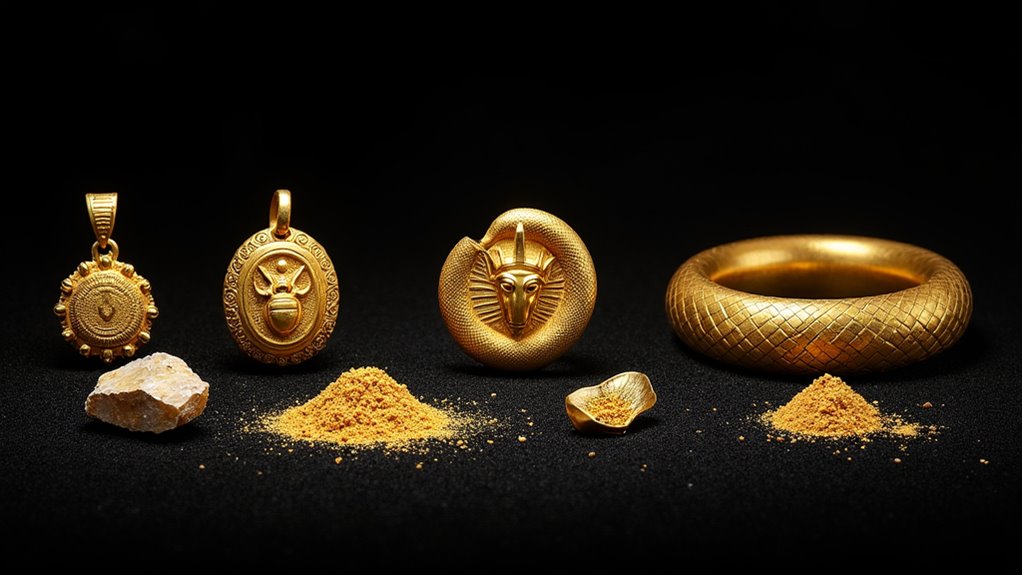
Meanwhile, Indian traditions went all-in on divine alchemy, claiming those shiny nuggets were actually solidified sunlight.
Underground rivers of gold? That’s what Siberian and North American legends swore by!