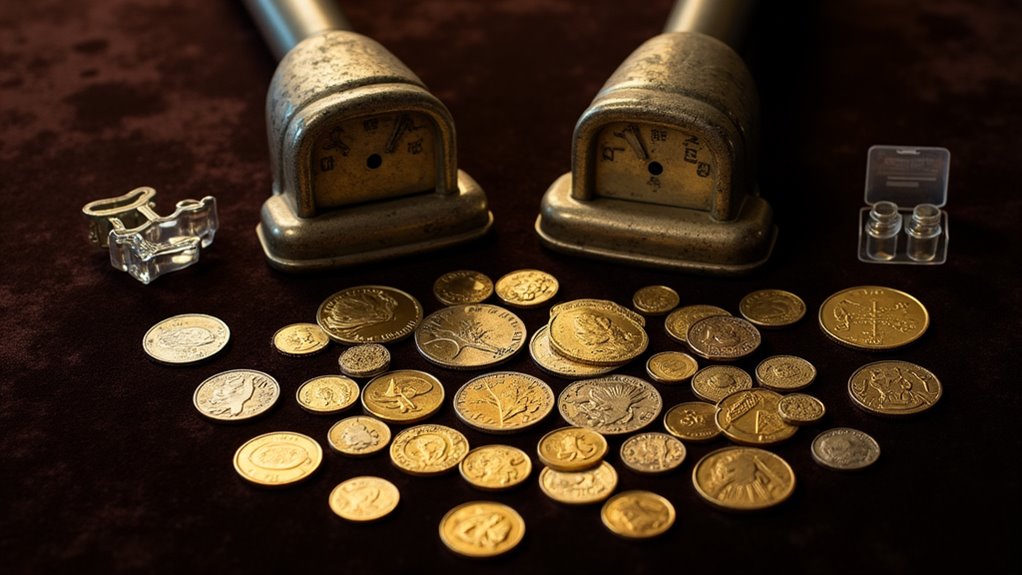
Gold’s grip on global trade spans millennia, from ancient Egyptian divine worship to modern market madness. Those shiny yellow rocks sparked epic trade networks in Mesopotamia, then King Croesus dropped the first coins around 600 BCE (game-changer alert!). Spain’s American gold bonanza threw Europe’s economy into overdrive, while England’s coinage innovations dominated trade routes. Post-1971? Gold went wild, breaking free from fixed prices – and that’s just scratching the surface of this glittering saga.

Gold’s glittering journey through human civilization reads like a tale of obsession, power, and cold hard economics. From ancient Mesopotamian trade routes to modern-day market frenzies, this precious metal has wielded an almost mystical influence over human affairs. Ancient civilizations like Egypt didn’t just value gold for its sparkle – they saw it as divine, using it in religious ceremonies while simultaneously building vast trading networks around it.
When King Croesus of Lydia introduced gold coins around 600 BCE, he practically revolutionized commerce (oops, spelled basically wrong there). The Romans took this innovation and ran with it, establishing extensive trading networks that would make today’s crypto bros jealous. Meanwhile, the Byzantines were like “hold my beer” and went absolutely bonkers with gold mining operations in the 7th century. Central banks’ monetary strategies began to evolve around this time, recognizing the importance of gold in maintaining economic stability, and these strategies would later include using gold as a tool for currency support. By the 21st century, countries like the United States and China’s gold reserves play a crucial role in global economic dynamics.
Fast forward to medieval Europe, and you’ve got Venice flexing with its gold ducats, while England’s getting fancy with its gold Florins in 1284. Sir Isaac Newton (yeah, that gravity guy) actually fixed gold’s price at £3.17 per troy ounce in 1717 – talk about a control freak! But hey, it worked, keeping prices stable for nearly two centuries. Who knew physics nerds could influence global economics?
Newton didn’t just master gravity – he also kept gold prices in check for 200 years as Britain’s money mastermind.

The Spanish hit the jackpot when they found massive gold deposits in the Americas. They were literally shipping boatloads of bling across the Atlantic, fundamentally altering the global economy. England, not to be outdone, started minting iconic coins like the Guinea and Sovereign, effectively saying “look who’s boss” to the rest of the world.
Things got really interesting during the 20th century. The Bretton Woods system tied the U.S. dollar to gold, creating a strange dance between paper money and precious metal that lasted until 1971. When that fell apart, gold prices went absolutely nuts – we’re talking $120+ per ounce in the 1970s. The highest recorded price (adjusted for inflation) hit during the 1980 economic meltdown, proving that nothing drives up gold prices like good old-fashioned panic.
Today’s gold market is like a roller coaster designed by an adrenaline junkie. Post-1973, prices have been free-floating, responding to everything from inflation fears to geopolitical drama. During crises, everyone suddenly remembers gold exists and runs to it like its ex who got really hot after high school.
Mining’s gotten tougher too – no more easy pickings like the ancient Egyptians had. Modern extraction requires serious tech and major investment, which keeps supply tight and prices… interesting. Additionally, various fundamental factors driving gold prices can lead to significant volatility in the market, making gold a complex asset to navigate.

Through it all, gold maintains its reputation as the ultimate “I told you so” asset during economic uncertainties. Whether its hyperinflation in post-WWI Germany or modern currency crises, gold keeps proving why humans have been obsessed with it for millennia. Some things never change, even if the price tags definitely do.
Frequently Asked Questions
How Did Ancient Civilizations Determine the Purity of Their Gold?
Ancient civilizations were surprisingly savvy when it came to gold testing! They relied on four main methods: fire assaying (the OG scientific approach), touchstone testing (scratch n’ compare), specific gravity checks (thank you, Archimedes!), and good ol’ visual assessments.
Fire assaying was the real MVP – mixing gold with lead at crazy-high temps to burn off impurities. Not exactly backyard science, but hey, it worked like a charm for thousands of years!
What Role Did Gold Play in the Development of Early Banking Systems?
Gold revolutionized early banking by serving as the bedrock of financial trust.
Goldsmiths’ receipts for stored precious metals evolved into the first banknotes, while their lending practices birthed fractional reserve banking.

The yellow metal’s intrinsic value made it perfect for backing currencies and stabilizing economies during crises.
Central banks, like the Bank of Venice, used gold reserves to build public confidence – a practice thats influence echoes through modern banking.
Why Did Some Cultures Value Silver More Than Gold Historically?
Several cultures historically favored silver over gold due to its practical advantages in commerce.
Silver’s wider availability and divisibility made it ideal for everyday transactions, while elaborate mining operations like those in South America boosted its accessibility.

Silver’s versatility in crafting tools and coins, combined with its antibacterial properties, enhanced its appeal.
Regional preferences, particularly in Islamic trade networks, cemented silver’s dominance as the go-to currency for merchants and traders.
How Did Gold Influence Marriage Customs Across Different Ancient Societies?
Gold profoundly shaped marriage customs across ancient civilizations, serving both practical and symbolic purposes.
Egyptian couples exchanged gold rings on the “vena amoris” finger, while Mesopotamians crafted elaborate gold headdresses for ceremonies.
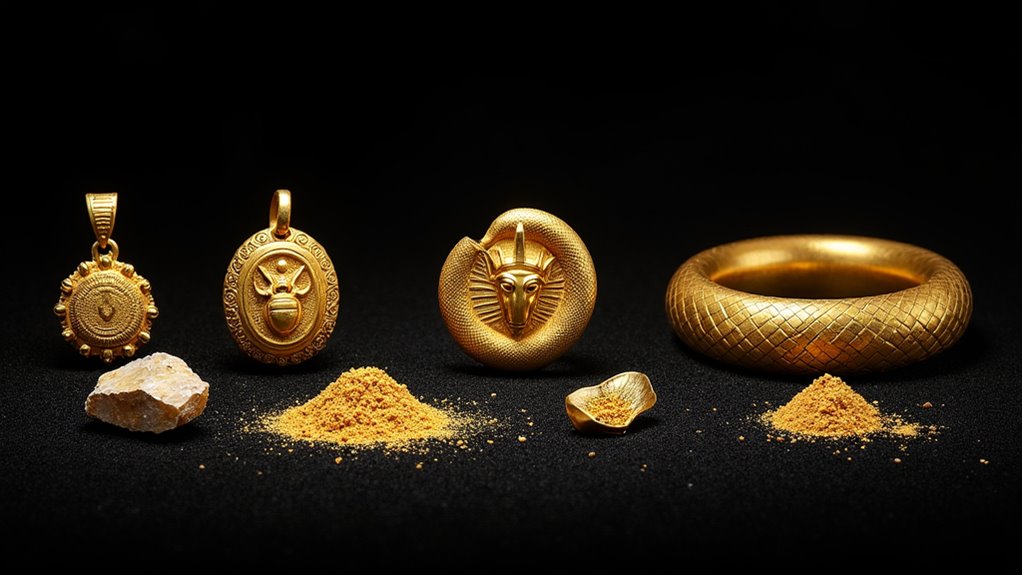
Romans legalized gold rings as marriage symbols, evolving from simple iron bands.
Greeks popularized Hercules knot designs, symbolizing unbreakable bonds.
The metal’s durability and value made it the perfect metaphor for eternal love n’ commitment.
What Methods Did Ancient Miners Use to Extract Gold From the Earth?
Ancient miners were seriously resourceful in their gold-hunting pursuits! They mastered placer mining, sifting river sediments with pans and sluice boxes to snag those precious yellow flakes.
When surface gold got scarce, they went underground, chiseling through rock with two-hand-mallets – tough work, but hey, gold fever’s a powerful motivator!

They also got crafty with mercury amalgamation and fire-based techniques like cupellation, which basically turned raw ore into shiny treasure.