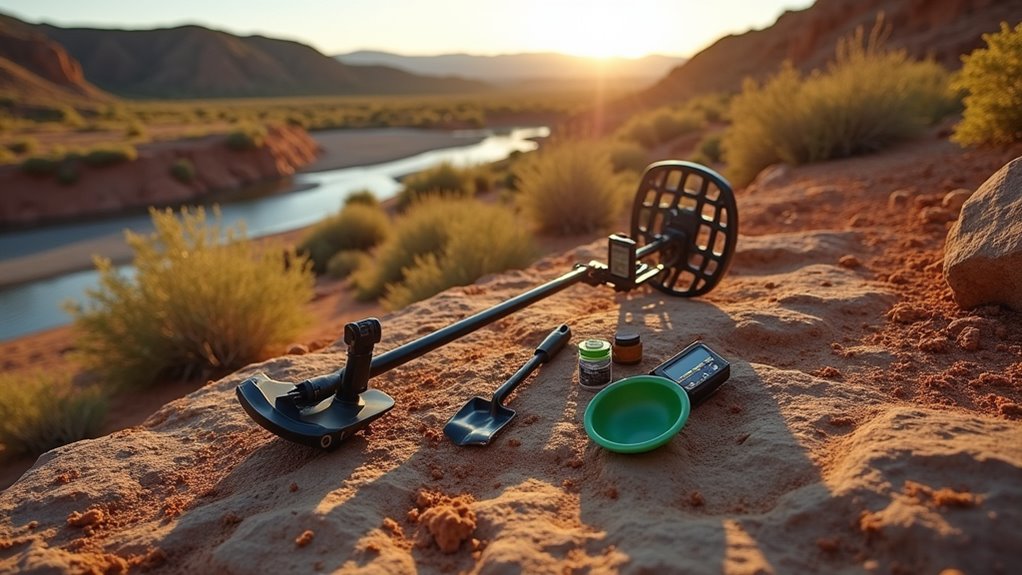
The El Dorado legend began with a Muisca ritual where chiefs covered in gold dust would plunge into Lake Guatavita. Spanish conquistadors, driven by gold fever, twisted this ceremony into myths of a legendary golden city hidden in South America’s wilderness. Multiple failed expeditions followed, leaving destruction and suffering in their wake. While no city of gold was ever found, El Dorado’s allure shaped history and continues to symbolyze humanity’s relentless pursuit of impossible dreams. The real story goes much deeper than mere legend.

Riches beyond imagination – that’s what drove countless explorers to their doom in the pursuit of El Dorado, the legendary city of gold. What began as a misinterpreted ritual of the Muisca people, where chiefs covered themselves in gold dust before plunging into Lake Guatavita, morphed into an obsession that would consume European explorers for centuries.
A simple ritual lost in translation sparked centuries of European obsession with a mythical golden city.
The tale spread like wildfire through the Spanish conquest, transforming from a simple ceremony into whispers of an entire kingdom dripping with precious metal. Early accounts by Gonzalo Fernández de Oviedo added fuel to the flames, as conquistadors fresh from pillaging Inca territories couldn’t resist the promise of even greater treasures lurking in South America’s uncharted depths.
By 1541, the Spanish were all-in, launching expedition after doomed expedition into the northern Amazon and Andean regions. Pedro de Ursúa‘s 1560 venture with 370 men went spectacularly wrong when Lope de Aguirre – history’s most unhinged mutineer – decided to hijack the whole operation.

Meanwhile, Sir Walter Raleigh got the British in on the action, convincing everyone that El Dorado was chillin’ by Lake Parime (spoiler alert: it wasn’t).
The quest for El Dorado became a convenient excuse for European powers to flex their colonial muscles. The Spanish Crown eventually had to step in and say “enough already!” with expedition restrictions – too many cowboys were running wild in the jungle, leaving a trail of exploitation and indigenous suffering in their wake.
Rumors of escaped Incas hauling massive gold hoards only made treasure hunters more rabid. Interestingly, gold has served as a core reserve asset for nations throughout history, helping them to stabilize economies during turbulent times, and it remains a key strategy for mitigating currency risk in today’s volatile markets. During financial crises, governments often turn to gold as a safe haven asset to protect their economies.
Modern culture can’t get enough of El Dorado’s seductive promise. The legend has inspired countless books, films, and metaphors for unattainable dreams. What’s fascinating is how a simple Muisca ritual got lost in translation and snowballed into this massive symbol of wealth and power that still captures imaginations today.

Despite all our fancy tech and historical research, El Dorado remains frustratingly elusive. No one’s ever found a city made of gold in the Amazon or Andes – shocking, right? But maybe that’s not the point. The real gold mine might be in understanding how this myth exposed humanity’s endless capacity for greed and self-delusion. Interestingly, the allure of gold has historically driven nations to accumulate core reserve assets as a means to stabilize economies and assert global dominance.
The mystery of El Dorado serves as a stark reminder of how legends can shape history, driving exploration while simultaneously fueling destruction. It’s a cautionary tale about the dangers of letting gold fever cloud your judgment – something today’s market watchers might wanna keep in mind.
In the end, El Dorado’s greatest legacy isn’t about lost treasure; it’s about the human tendency to chase impossible dreams, no matter the cost.
Frequently Asked Questions
What Role Did Spanish Conquistadors Play in Spreading the El Dorado Legend?
Spanish conquistadors were the ultimate hype-men for El Dorado!
These glory-seeking adventurers took the Muisca’s sacred gold ceremonies and transformed them into wild tales of cities paved with precious metal.

Through their expeditions and chronicles, they spread exaggerated stories across Europe, fueling colonial dreams of untold riches.
Their misinterpretation of indigenous customs and relentless pursuit of gold turned a local ritual into a continent-spanning legend that persists today.
How Did Indigenous Tribes React to European Searches for El Dorado?
Indigenous tribes responded to European searches for El Dorado with a mix of fierce resistance and clever deception.
While some groups fought to protect sacred sites like Lake Guatavita using guerilla tactics, others deliberately misled explorers with false tales and directions.

Many tribes were forced into reluctant cooperation under brutal Spanish pressure, though they maintained their cultural practices in secret.
Their spiritual connection to these sites remained unshakeable despite European intrusions.
Were There Any Female Explorers Who Searched for the Lost City?
One notable female explorer was Aloha Wanderwell, who soared into the El Dorado narrative in the 1930s with her seaplane expedition.
While male explorers dominated the historical searches, Wanderwell broke barriers as the “world’s most traveled woman,” investigating Percy Fawcett’s disappearance and the Lost City of Gold.

Before her, women’s roles were largely limited to funding expeditions or documenting second-hand accounts due to societal restrictions.
Talk about a glass ceiling crasher!
What Modern Technology Is Being Used to Search for El Dorado?
Today’s hunt for El Dorado packs some serious tech punch!
Researchers are deploying lidar scanners that strip away dense jungle canopy to reveal hidden ruins, while drones buzz overhead capturing thermal images of potential dig sites.

Ground-penetrating radar peeks beneath the soil, and supercomputers crunch massive datasets to predict likely locations.
GIS technology combines satellite imagery with historical records, creating a digital treasure map that’d make those old conquistadors jealous!
How Has Climate Change Affected Potential Archaeological Sites in the Amazon Region?
Climate change has hit Amazon archaeological sites hard. Intensified rainfall and flooding are exposing buried artifacts, making them vulnerable to looting and destruction.
Deforestation’s removing protective forest cover, while soil erosion‘s wreaking havoc on ancient remains. The region’s seeing more landslides and vegetation changes that complicate preservation efforts.
Rising humidity levels are even messing with LiDAR technology, making it tougher to map potential sites. It’s a real archeologicle nightmare out there!