Corporate responsibility in gold supply chain management is evolving at breakneck speed. Industry heavyweights are embracing blockchain tech and AI to track gold’s journey from mine to market – and it’s about time! Environmental stewardship isn’t just a buzzword anymore; it’s becoming mandatory. Companies are tackling everything from carbon footprints to Indigenous rights, while partnerships between major players like LBMA and RJC strengthen accountability. The gold industry’s transformation runs deeper than these surface-level changes.

Increasingly, the gold industry finds itself under the microscope as stakeholders demand greater accountability in supply chain management – and boy, are they delivering. The sector’s heavyweights have thrown down the gauntlet with ten ambitious sustainability objectives that’ll make your head spin, from responsible sourcing standards to human rights protections that actually have teeth. And they’re not just paying lip service – these commitments are getting baked right into their operational DNA. The UN Sustainable Development Goals are now integral to these industry-wide initiatives. The industry’s commitment to financial security through responsible practices strengthens global economic stability.
The industry’s gone full tech-nerd on us, implementing blockchain solutions that track every gleaming bar from mine to market. Talk about paranoid (in a good way)! They’ve even got AI systems identifying unique characteristics of gold bars – because apparently, each one’s got its own personality now. This obsessive attention to detail is creating a premium market for gold with an ironclad provenance story. Who knew being a control freak could be so profitable? Moreover, the push for environmentally responsible mining methods is gaining traction, ensuring that the extraction process minimizes harm to the planet.
Environmental and social responsibility isn’t just some feel-good checkbox anymore. These companies are sweating bullets over their carbon footprints and supporting responsible artisanal mining (yeah, the small guys finally get some love). They’re even considering impacts on Indigenous Peoples – its about time, if you ask us. And diversity? It’s not just a buzzword; it’s becoming as essential as the gold itself.
Gone are the days when eco-friendly mining was optional. Today’s gold industry is rewriting the rulebook on environmental stewardship and social impact.

The risk management game has gone next-level bonkers. Companies are implementing systems so thorough, they’d make a paranoid conspiracy theorist proud. Every transaction, every handoff, every whisper about gold gets scrutinized. They’ve got training programs that’d make your high school principal jealous, and don’t even get us started on their obsession with anti-money laundering regs.
Here’s where it gets really interesting (and slightly nerdy): ESG data collection has become the industry’s new gold rush. They’re measuring everything that moves – and plenty that doesn’t. Performance indicators? They’ve got em’ by the dozens, all neatly packaged in their internal control systems. It’s like they’re building a spaceship, except instead of reaching Mars, they’re aiming for perfect supply chain transparency.
The coolest part? These gold bugs aren’t working in isolation. They’re teaming up like superheroes in some fancy metal alliance, supporting projects in high-risk areas and creating upstream due diligence mechanisms that actually work. The LBMA and RJC are playing nice, aligning their programs like a well-oiled machine. And those partnerships? EPRM, RAGS, PPA – it’s alphabet soup, but its working!
The gold industry’s finally growing up, and it’s about time. They’re taking corporate responsibility seriously, even if it means spending more time in compliance meetings than actually handling gold. But hey, nobody said being responsible was gonna be easy – or cheap. At least they’re making it interesting!
Frequently Asked Questions
How Do Small-Scale Gold Miners Benefit From Responsible Sourcing Initiatives?
Small-scale gold miners reap serious perks from responsible sourcing – we’re talking game-changing benefits!
They snag guaranteed minimum prices (often 25% above market), plus that sweet $2k/kilo Fairtrade Premium for community projects.

No more mercury poisoning their waters, and workers finally get proper safety gear.
Best part? These miners connect directly with legit buyers, ditching sketchy middlemen.
They’re even forming co-ops and gettin’ proper training.
Talk about a golden opportunity!
What Role Do Third-Party Auditors Play in Gold Supply Chain Certification?

Third-party auditors serve as critical watchdogs in gold supply chain certification.
These independent inspectors dig deep into mining operations, scrutinizing everything from worker conditions to environmental impacts. They’re the ones who actually get their boots dirty, conducting surprise facility visits and grilling employees about compliance.
Their unbiased assessments help validate (or expose!) claims about responsible sourcing practices. Without em’, the whole certification system would basically be running on trust – and that ain’t gonna cut it.
Can Blockchain Technology Effectively Track Gold From Mine to Market?
Blockchain technology is transforming gold tracking with mind-blowing precision. The system creates an unbreakable digital fingerprint for each gold bar, following it from dirt to dealer.
While early trials show promising results, some hurdles remain – like getting old-school players onboard and dealing with tech growing pains.

But here’s the kicker: major industry players are already diving in, suggesting blockchain might just be gold’s new BFF in supply chain transparency.
How Do Gold Refineries Verify the Authenticity of Recycled Gold?
Gold refineries employ a multi-layered verification process for recycled gold.
Physical inspection starts with weight, size, and magnet tests, followed by hallmark verification.
Chemical analysis – including acid testing and XRF scanning – reveals precise metal composition.
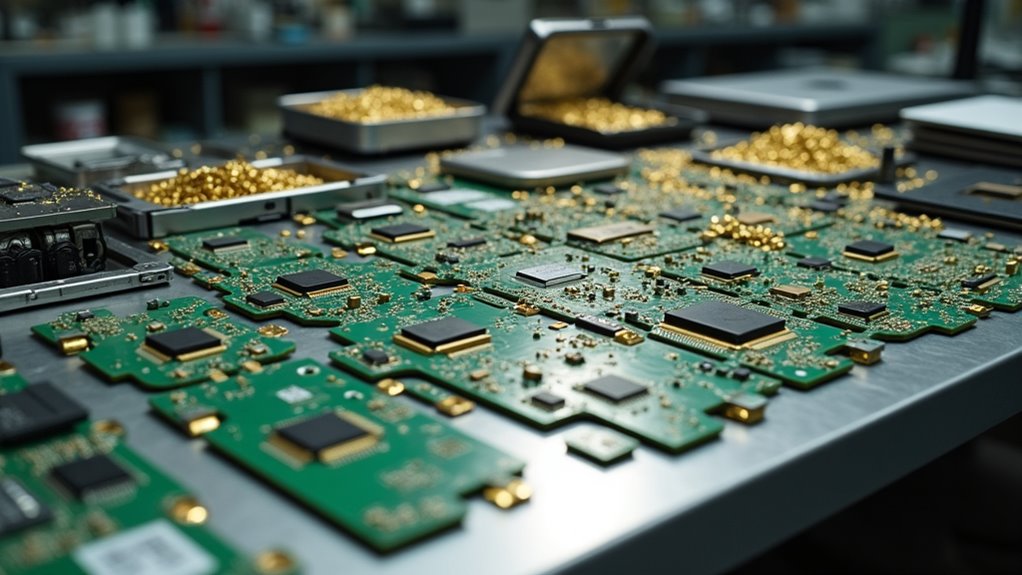
The real kicker? Advanced tech like electronic testers measure conductivity while specialized equipment checks density.
Documentation’s essential too; refiners scrutinize chain-of-custody records and supplier certs to authenticate recycled material’s origin.
What Insurance Policies Cover Responsible Gold Supply Chain Management Risks?
Several insurance policies tackle gold supply chain risks.
All Risks coverage handles theft, loss, and transit damage, while specialized Specie policies address mysterious disappearance and substitution.

Blockchain-enhanced insurance is shaking things up – slashing premiums while boosting transparency.
Cyber coverage? Absolutely essential these days, protecting against digital threats and system breaches.
Smart refineries layer these policies for bulletproof protection across their entire operation’s.