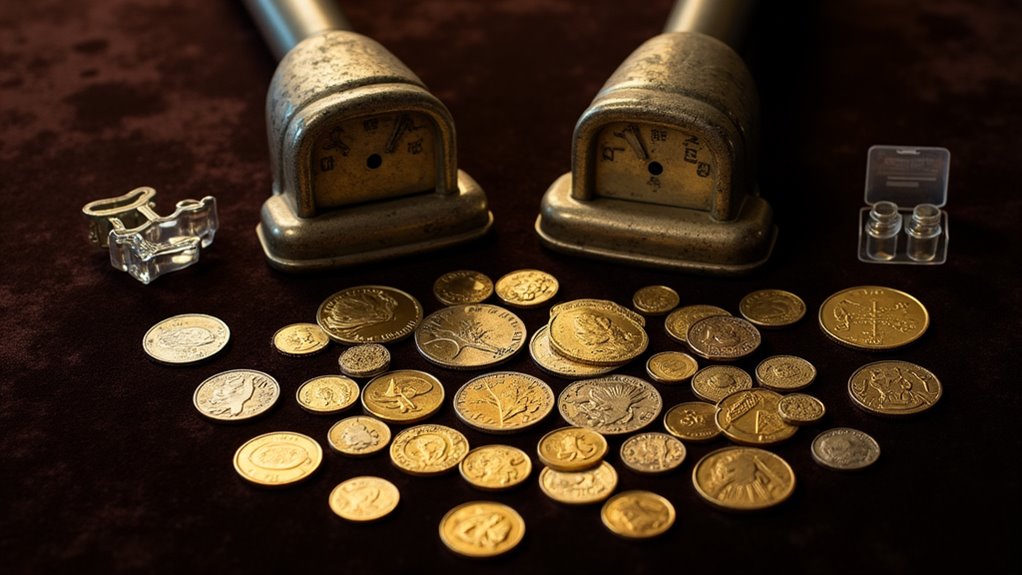

Ancient gold coins pack serious financial punch in today’s market. The 1933 Double Eagle smashed records at $18.9M, while pristine Lydian Lions regularly fetch six-figure sums. Roman Aureii frequently break the million-dollar barrier, particularly specimens with exceptional preservation and historical significance. Byzantine Solidi and Abbasid Dinars remain highly coveted for their cultural impact and rarity. These metallic time capsules tell fascinating tales of empires – and theres plenty more where that came from.

Glinting through the mists of time, ancient gold coins tell tales far grander than their tiny circumferences suggest. The legendary Lydian Lion, struck around 600 BCE, stands as humanity’s first gold coinage – though technically, it’s a gold-silver alloy called electrum. This revolutionary currency kicked off a monetary evolution that would reshape civilization’s very foundations.
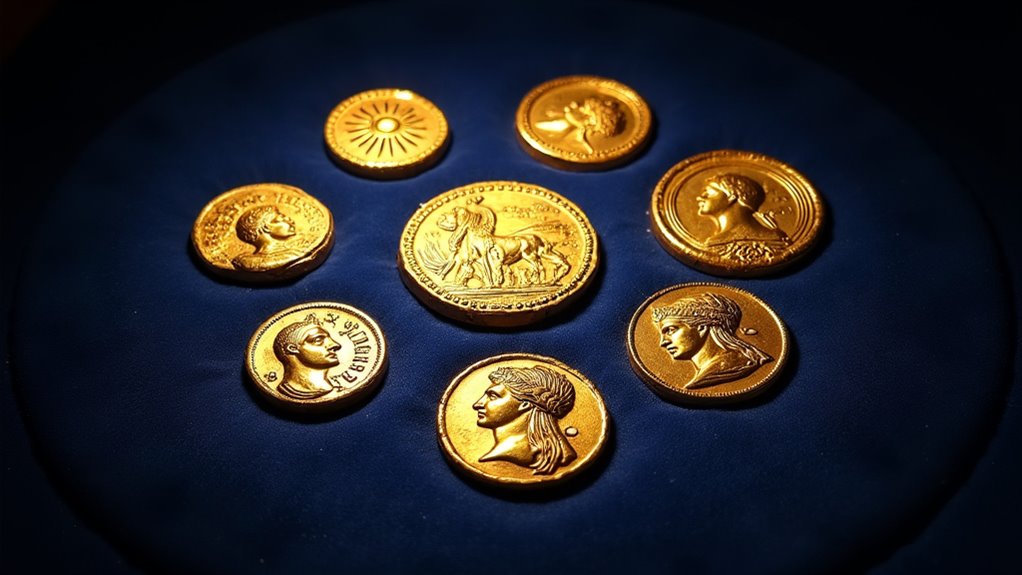
Talk about heavy hitters in the ancient numismatic world – the Philip II Stater from Macedonia isn’t just pretty face with Apollo’s visage. It’s a powerhouse that showcased Macedonia’s military might and basically screamed “we’ve got the gold, we make the rules.” The history of coinage tells us how this shift to standardized money influenced trade and economy, ultimately laying the groundwork for modern monetary systems. Economic events during this period, such as interest rate shifts, also played a pivotal role in shaping the value of these coins as they were integrated into local and international trade.
Philip II’s golden stater flexed Macedonia’s muscles across the ancient world, declaring supremacy through precious metal and divine imagery.
And let’s not forget the Roman Aureus, which practically owned the Mediterranean for centuries. These babies were so pure, you could literally bite into them (though we don’t recommend it).

The Byzantine Solidus might just be history’s most successful currency experiment. For over a millennium, this gold piece maintained its value while other currencies went belly-up faster than a fish in a desert.
Meanwhile, the Islamic world wasn’t exactly sitting on its hands – the Abbasid Gold Dinar was busy connecting trade routes from Spain to India, proving that sound money knows no religious bounds.
When it comes to modern values, these ancient pieces can fetch astronomical sums. A well-preserved Lydian Lion could easily command six figures at auction, while certain Roman Aureii have broken the million-dollar barrier.
But here’s the kicker – it’s not just about the gold content. The historical significance, artistic merit, and sheer rarity factor send prices into the stratosphere.

The preservation game is no joke either. These survivors have dodged countless wars, burials, and melting pots to reach us. Modern collectors treat them like delicate flowers, using specialized holders and climate-controlled vaults.
Getting one certified by PCGS or NGC is like obtaining a passport to the elite club of serious numismatics. Professional grading ensures that collectors understand the value and authenticity of their prized coins.
What’s truly mind-boggling is how these tiny discs shaped entire economies. The Greek city-states used them to fund everything from temples to warships. Roman emperors paid their legions with them, and Byzantine merchants could use their Solidi from Constantinople to Alexandria without breaking a sweat.
Even today, these coins continue their legacy – not as currency, but as supreme artifacts that command respect and ridiculous prices at auction houses worldwide.

The latest record-breaker? A 1933 Double Eagle that sold for $18.9 million in 2021. Sure, it’s not technically ancient, but it shows how the allure of gold coinage hasn’t diminished one bit.
In fact, you might say it’s gotten stronger – like fine wine or that cheese you forgot in the back of your fridge, except way more valuable and considerably less smelly.
Frequently Asked Questions
How Can I Authenticate an Ancient Gold Coin Before Purchasing?
Authenticating ancient gold coins requires multiple verification steps – no shortcuts here!
Start with physical inspection under magnification to check wear patterns and details. XRF testing reveals composition (those sneaky fakes won’t fool this), while density tests confirm it’s actually gold.

Professional grading services like NGC provide the final verdict. Smart buyers also research historical context and get certificates of authenticity.
Don’t skip the homework, people!
What Causes the Significant Price Variations Between Similar Ancient Gold Coins?
Price gaps between similar ancient gold coins often come down to the “perfect storm” of factors. Rarity plays a huge role – fewer surviving specimens equals ka-ching!
But condition is king, with mint-state pieces commanding exponentially higher prices than their worn cousins.

Historical significance (hello, Julius Caesar!) and provenance from famous collections drive values through the roof.
And let’s not forget those pesky market forces – collector demand can send prices soaring or crashing faster than you can say “numismatist.”
Which Modern Museums Have the Largest Collections of Ancient Gold Coins?
The British Museum leads the pack with its massive numismatic treasure trove, featuring everything from Lydian electrum to Byzantine beauties.
Hot on its heels, the U.S. Mint Collection in Denver boasts an impressive 1.6 million pieces.

Yale University Art Gallery’s got serious game too, with 120,000+ specimens.
And don’t sleep on Boston’s Museum of Fine Arts – their 7,500 ancient coins might seem modest, but they’re absolute stunners regarding quality.
How Were Ancient Gold Coins Originally Minted and Produced?
Ancient gold coins were produced through a meticulous process that’d make modern minters sweat!
First, raw gold was purified through smelting and mixed with alloys for durability.
The refined metal got hammered into uniform planchets (fancy word for blanks), which were then heated til’ malleable.
These hot discs were placed between two engraved dies and – BAM! – struck with hammers or mechanical presses to create those stunning designs we drool over today.
Are There Any Undiscovered Ancient Gold Coins Still Buried Around the World?
Experts believe significant numbers of ancient gold coins remain buried worldwide.
Archaeological evidence and historical records point to countless undiscovered hoards, particularly in regions like the Middle East and Europe. Recent discoveries, like the 2023 Persian gold cache in Turkey and the 2025 Luxembourg find, prove there’s plenty still hiding underground.
Despite challenges from urban development and legal restrictions, advancing technology keeps revealing new treasures – suggesting we’ve barely scratched the surface.