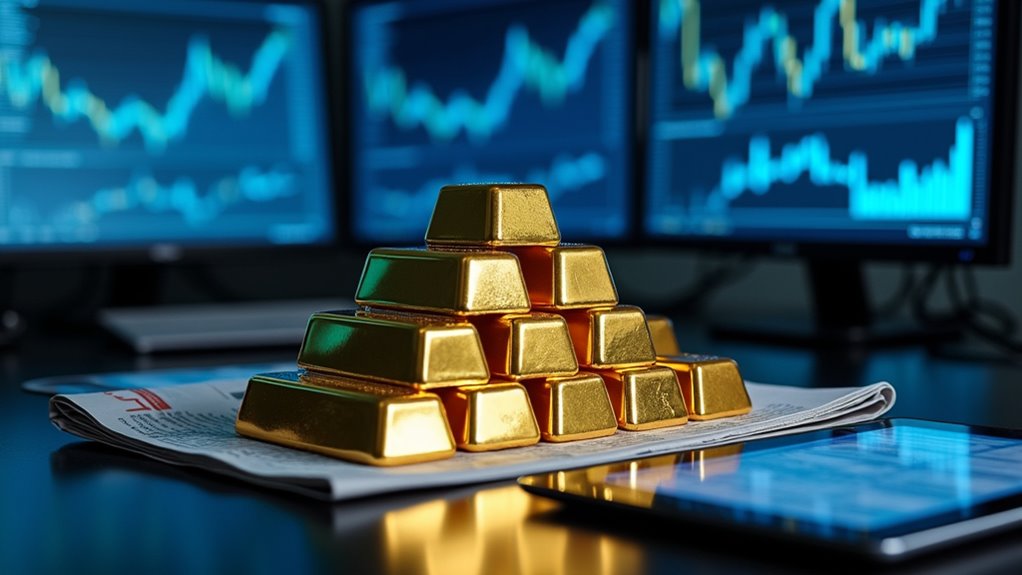
Investor sentiment’s got gold doing the market tango – and everyone’s watching. Social media chatter and ETF flows are driving price swings like never before, while retail investors pile into safe-haven assets faster than you can say “inflation hedge.” The recent surge to $3,100 shows just how powerful crowd psychology can be, especially when mixed with geopolitical jitters and a wobbly dollar. Central banks’ massive 1,000-tonne buying spree in 2023 ain’t just coincidence. There’s more beneath the surface of these golden waves.

The precious metal’s meteoric rise to $3,100 by March 2025 has got people acting like teenagers at a rock concert. But here’s the kicker – history’s got a nasty habit of serving up 10-15% corrections when everyone’s singing from the same songsheet. The Sprott Physical Gold Trust‘s premium/discount analysis is screaming “overbought” louder than a metal detector at a beach full of buried treasure. The emergence of social media sentiment has become a powerful predictor of gold market movements.
Central banks went absolutely bonkers in 2023, snatching up over 1,000 tonnes of gold like it was going out of style. Meanwhile, retail investors are piling into ETFs faster than you can say “diversification.” But here’s where it gets interesting – there’s this weird divergence between silver stocks and physical silver prices that’s making technical analysts scratch their heads until they’re practically bald. Tracking ETF holdings data has become crucial for understanding market sentiment and overall demand patterns. Historically, gold’s role as a hedge against currency risk has made it a preferred asset during times of economic uncertainty.
The macroeconomic picture ain’t exactly helping calm the gold fever. Geopolitical tensions are higher than a cat on a hot tin roof, and inflation fears are making everyone and their grandmother reach for their gold coins. The greenback’s showing weakness, and real interest rates are doing the limbo – how low can they go? This cocktail of chaos has sent safe-haven demand through the stratosphere.
With markets in turmoil and fears running wild, investors are scrambling for gold like squirrels hoarding acorns before winter.

Looking at the charts, those bearish reversal candles are forming patterns that would give technical traders nightmares. Gold’s flirting with a parabolic move formation that could either send prices to the moon or trigger a correction that’ll have investors reaching for the antacids. The quarterly closes? They’re more important than ever, with institutional investors watching them like hawks eyeing their next meal.
The long-term outlook suggests that we might be in for a multi-year bull market, with silver potentially stealing gold’s thunder in the later stages. But let’s not get ahead of ourselves – those 24% gains in 2024 and that shiny new record of $2,589.67 per ounce in September might need some time to digest.
Mining supply constraints are tightening like a vice, which could support higher prices in the long run – assuming sentiment doesn’t get too frothy and spoil the party first.
Remember folks, when everyone’s dancing to the same golden tune, sometimes that’s exactly when the music stops. But hey, what do we understand? We’re just here for the show.
Frequently Asked Questions
How Do Geopolitical Tensions Specifically Impact Gold Prices During Market Uncertainty?
Geopolitical tensions send gold prices soaring like a rocket – classic flight-to-safety play.
When conflicts heat up, investors scramble for that yellow safety blanket, driving prices stratospheric.

Russia-Ukraine? Boom. Middle East drama? Ka-ching! The metal jumped to $2,963.20/oz recently (insane!).
Smart money knows this dance: tensions rise, gold climbs.
Currency markets get jittery, central banks stockpile more bars.
It’s Economics 101 with a dash of panic-buying pizzaz.
What Role Do Central Bank Gold Reserves Play in Market Sentiment?

Central banks’ gold reserves pack a serious psychological punch in markets.
Their massive purchases – like 2022’s eye-popping 1,082-tonne haul – send ripples through investor confidence. When these financial heavyweights load up on gold, private investors often follow suit, viewing it as a vote of confidence in the yellow metal.
Their sales can trigger the opposite effect, spooking markets. These monster-sized moves by central banks basically act as a market mood ring.
How Does Seasonal Gold Demand Affect Long-Term Investment Strategies?
Seasonal gold demand profoundly shapes long-term investment tactics.
Smart money tracks those juicy July-to-February windows, when prices historically surge 6.96-11.27%.

But here’s the kicker – savvy investors don’t just chase seasonal peaks.
They’re layering strategies like dollar-cost averaging to ride out the predictable ups and downs.
Festival seasons in Q4 might spark buying frenzies, but it’s the steady accumulation through market cycles that defines winning portfolio plays.
Can Technical Analysis Accurately Predict Gold Price Movements in Volatile Markets?
Technical analysis offers valuable insights but can’t guarantee perfect predictions in volatile gold markets.
While indicators like RSI and MACD help spot trends, they’re not crystal balls.

Recent market data shows technical tools caught 65% of major price swings – not bad, but not perfect either.
Smart traders combine multiple indicators with fundamental analysis for better accuracy.
Still, gold’s notorious for throwing curveballs when geopolitical chaos hits the fan.
What Tax Implications Should Investors Consider When Trading Physical Gold?
Physical gold packs a hefty tax punch!
Investors face that nasty 28% maximum rate on long-term gains (held over 1 yr), while short-term profits get hammered at regular income rates. Ouch.

The IRS classifies gold as a collectible – because apparently, they’ve never met a tax they didn’t like.
Better keep meticulous records for Schedule D and Form 8949, or Uncle Sam might come knocking.
High-income folks? Brace for that extra 3.8% NIIT slap. Fun times!