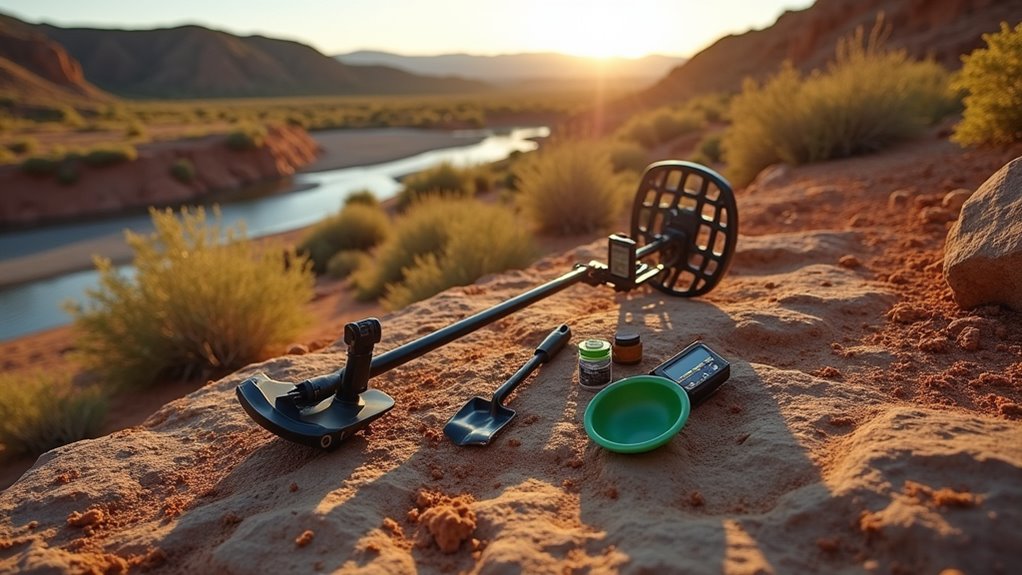
Modern gold exploration has ditched the old bloke with a pan for high-tech wizardry and hard science. Today’s prospectors combine geological mapping, geophysical surveys, and satelite imagery to pinpoint sweet spots.
They’re examining everything from quartz veins to plant life, while fancy tools like aeromagnetic surveys and 3D modelling reveal what’s hiding underground. Sure beats randomly digging holes!
The real treasure lies in understanding how these techniques work together to strike gold.

Prospecting for gold isn’t just about grabbing a pan and heading to the nearest stream anymore – modern exploration demands serious scientific grunt.

The days of lucky strikes are well and truly done, replaced by a arsenal of high-tech tools that would make old-timers’ heads spin. Let’s face it, finding the yellow stuff these days is more lab coat than luck. Modern prospectors process roughly one billion tons of metallic ore material annually in the United States alone. Successful prospectors frequently examine iron oxide staining as a key indicator of potential gold deposits. Furthermore, innovations in automation technology are streamlining the exploration process, enabling more efficient data collection.
Those fancy geological maps ain’t just pretty pictures. They’re telling stories about fault lines, folds, and those sweet mineralized zones where gold likes to hide. Smart prospectors are all over those quartz veins, knowing they’re often dead-set giveaways for gold deposits. And don’t get me started on digital terrain models – they’re revolutionising how we plan our explorations, mate.
The real game-changer is in the dirt itself. Geochemical prospecting is basically CSI for rocks, systematically measuring chemical elements in everything from creek water to soil samples. Those anomalous concentrations? They’re like nature’s breadcrumbs leading straight to the motherlode. Stream sediments and glacial debris are spilling secrets about what’s buried beneath, while geochemical halos are practically drawing X’s on the treasure map.
Geophysical surveys are where the rubber really hits the road. We’re talking gravimetric, magnetic, and electrical methods that can see what’s hiding underground. Seismic surveys are bouncing signals off rocks like a geological game of ping-pong, while satellite imagery gives us the big picture from way up high.

Even the gold grains themselves are grassing on their source. Scientists reckon they can tell how far gold’s travelled by looking at whether it’s pristine, modified, or reshaped – bit like forensics for minerals. And get this – some clever cookies are even using plants and bacteria as gold detectives, analysing leaves and roots for traces of buried treasure.
Early-stage exploration’s got smarter too. Aeromagnetic surveys are mapping potential deposits from the sky, while surface sampling and historical data analysis help nail down the sweet spots. But it’s the advanced methods that are really showing us the future – core drilling programs, 3D resource modelling, and even artificial intelligence crunching data faster than you can say “eureka.”
The truth is, modern gold exploration is a proper science these days, combining everything from satellite tech to bacterial analysis. It might not have the romantic appeal of the old prospecting days, but it’s a damn sight more effective. And while some oldtimers might scoff at all this fancy tech, the proof’s in the pudding – or in this case, in the gold reserves we’re finding.
Welcome to the new gold rush, where brains beat luck every time.
Frequently Asked Questions
What Are the Legal Requirements for Gold Exploration in Protected Wilderness Areas?
Gold exploration in wilderness areas is seriously restricted, mate.

The Wilderness Act of 1964 bans most commercial activities and motorised equipment. You’re basically limited to old-school methods like hand panning and sluicing – no heavy machinery allowed.
You’ll need special permits and environmental assessments before touching anything. Post-1983 claims don’t even get full surface rights. The govn’ment keeps those for itself.
Pretty tight restrictions, if you ask me.
How Much Does Professional Gold Exploration Equipment Typically Cost for Beginners?
Basic gold hunting gear won’t break the bank – think $40-60 for a starter kit with pan, sieve and shovel.
But mate, once ya get serious, costs add up quick. Entry-level metal detectors run $200-500, and a decent sluice setup hits around $600-1000 with all the bits n’ pieces.
Chuck in some extra tools like scales and storage vials, and you’re looking at roughly $1000-1500 to get properly kitted out as a beginner.
Can Satellite Imagery Be Used to Identify Potential Gold Deposits?
Satellite imagery is a game-changer for gold exploration.
Modern satellites pack some serious tech – hyperspectral imaging and advanced sensors that can spot mineral signatures linked to gold deposits. They’re picking up subtle differences in rock types and alterations that’d be invisible to the naked eye.

Sure beats walking around with a pan! While it’s not 100% accurate (nothing is), it’s revolutionising how companies target potential goldfields from space.
Technology’s come a long way.
What Qualifications Are Needed to Become a Professional Gold Exploration Geologist?
Becoming a pro gold exploration geologist ain’t a walk in the park.
You’ll need a Bachelor’s in geology or earth sciences – that’s the bare minimum. Most decent companies want a Master’s these days.
Gotta get those professional certifications too, like the Registered Geologist ticket. Tech skills are essential – GIS, 3D modelling, the whole package.
And here’s the kicker: field experience is non-negotiable. No shortcuts in this game.
How Long Does It Typically Take to Locate a Commercially Viable Deposit?
Finding a viable deposit is like hunting for a needle in a bloody haystack.
It typically takes 1-3 years of intense exploration – and that’s if you’re lucky. Most attempts end in failure, wasting millions of dollars.
Even when you strike gold, it’s a 15-year slog to get it out of the ground. Nickel’s even worse at 17.5 years.
The whole process is a gambler’s nightmare, with permitting delays and protests making it even messier.