Gold’s meteoric rise in Sweden hits 31,078 SEK per ounce, marking a jaw-dropping 33.9% surge from last year’s figures. The Swedish precious metals market’s showing serious muscle, driven by BRICS nations hoarding reserves and a wobbly krona. Daily price swings between 680-963 SEK per gram have traders clutching their charts, while the Riksbank’s quietly building its 106 billion SEK gold stash. There’s more to this glittering story than meets the eye.
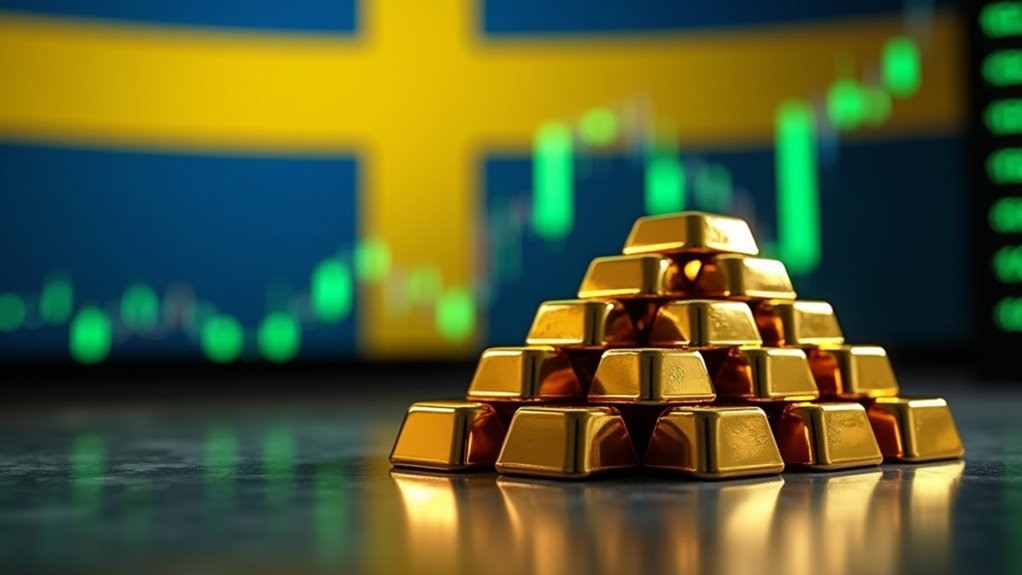
Glitter and turmoil mark Sweden’s gold market as prices surge to an eye-popping 31,078 SEK per ounce, up from 30,872 SEK just days ago. The precious metal’s meteoric rise reflects a staggering 33.9% increase over the past year, leaving investors and analysts scrambling to make sense of this golden fever. Remember when gold was lounging at a measly 22,886 SEK per ounce back in March 2024? Those days are long gone.
Sweden’s gold market ignites as prices rocket past 31,000 SEK per ounce, sending shockwaves through the investment world.
The Swedish gold landscape is getting spicier by the minute, with BRICS nations hoarding the yellow metal like there’s no tomorrow. Their massive central bank purchases have sent ripples through the market, while geopolitical tensions keep everyone on their toes. And let’s not forget about that struggling Swedish krona – it’s practically rolling out the red carpet for higher local gold prices. Currency values play a crucial role in shaping gold price fluctuations. Additionally, China’s recent gold accumulation strategy has influenced global demand, further complicating the dynamics of the market.
Speaking of drama, Sweden’s gold market took quite the nosedive with a 32.1% market size shrinkage in 2021. But don’t cry just yet – domestic production has been climbing steadily at 4.2% annually since 2012. Meanwhile, the Riksbank’s sitting pretty on a gold reserve worth a whopping 106 billion SEK, making up 8.29% of their total assets. Not too shabby for a rainy day fund.
The global picture? It’s a wild ride. Analysts are throwing around predictions like confetti, with some boldly claiming gold could hit $3,000 per ounce by the end of 2025. Even the mighty US dollar isn’t keeping gold prices in check anymore – talk about a plot twist! The precious metal’s been dancing between 680 and 963 SEK per gram throughout 2024, finally settling at a respectable 924 SEK/gram.
Here’s where it gets juicy: despite import numbers doing the cha-cha (up 2.1% annually between 2012-2021), Sweden’s gold market refuses to lose its shine. The Riksbank’s been playing it smart, boosting their gold reserves while everyone else watches the krona do its wobbly dance. And those central banks globally? They’re ditching dollars faster than last season’s fashion, all in favor of our glittering friend.
The writing’s on the wall – gold’s not just some pretty trinket anymore. It’s morphed into Sweden’s favorite hedge against inflation, especially with the krona acting about as stable as a three-legged chair. Moreover, sustainable practices in mining are becoming increasingly important for reducing ecological damage, ensuring that gold production aligns with environmental protection efforts. Whether you’re watching from the sidelines or jumping into the fray, one thing’s crystal clear: the Swedish gold market’s got more plot twists than a Nordic noir thriller, and this story’s far from over.
Frequently Asked Questions
Where Can I Safely Store Physical Gold in Sweden?
In Sweden, NSG offers top-tier secured storage with insured vaults – perfect for those serious gold stackers with 50k+ SEK worth of bars.
Yeah, home safes are an option, but they’re risky AF and insurance is a nightmare!
Most Swedish banks have ditched vault services (bummer), but there’s always those fancy offshore alternatives in Switzerland.
Pro tip: segregated storage beats shared vaults everytime – keep those bars exclusively yours!
Are Gold Transactions Taxed Differently From Other Investments in Sweden?
Gold transactions in Sweden follow the same capital gains tax framework as other investments, with no special treatment.
The flat 30% tax rate applies equally to profits from gold, stocks, or bonds. Investment gold meeting EU standards enjoys VAT exemption, but that’s standard across the EU.
The only notable difference is paperwork – gold gets reported under Section D of Form K4, while other investments go elsewhere.
Pretty straightforward stuff!
What Documentation Is Required to Sell Gold in Swedish Markets?
Selling gold in Swedish markets requires multiple layers of documentation.
Sellers must provide government-issued photo ID for transactions over SEK 5,000, along with proof of ownership certificates.
For gold worth €10,000+, customs declaration papers are mandatory.
LBMA conformity docs guarantee authenticity, while KYC checks demand passport verification.
Fascinatingly enough, even storage location paperwork might be needed – because apparently, Sweden likes its paper trail!
Which Swedish Banks Offer Gold Trading Services to Retail Investors?
Several major Swedish banks provide gold trading services to retail investors.
Handelsbanken leads the pack with its ETF offerings, while SEB caters to high-net-worth clients with physical gold purchases.
Nordea and Swedbank focus on gold-linked investment products and commodities trading.
Most banks partner with international custodians for secure storage solutions.
However, retail investors should note that services vary considerable between institutions, with some requiring minimum investment thresholds.
How Do Seasonal Trends Affect Gold Prices Specifically in Sweden?
Swedish gold prices dance to both local and global seasonal rhythms. Q4 sees prices climb thanks to Christmas shopping mania, while summer tourist influxes drive jewelry demand upward.
The krona’s seasonal wobbles against major currencies add extra spice to price swings. Though local traditions don’t rock the boat much, Sweden’s tight integration with European markets means global festivals and economic cycles ripple through its gold market like clockwork!