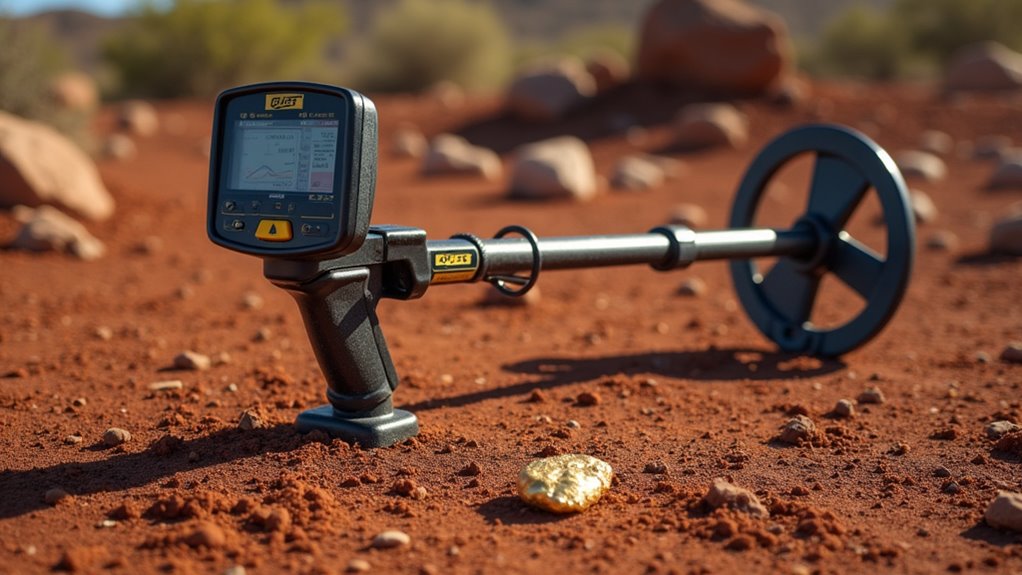

Long-range gold detectors are modern-day snake oil, plain and simple. Despite flashy claims of finding gold 2000 meters away or 40 meters underground, these devices lack scientific validation and fail consistently in controlled testing. They’re basically fancy dowsing rods with hefty price tags – targeting desperate treasure hunters’ dreams. Traditional electromagnetic detectors remain the only proven technology for metal detection, while these long-range gadgets belong in the same category as magic wands. The truth about gold detection goes way deeper than marketing hype.

While long range gold detectors promise to revolutionize treasure hunting with claims of detecting precious metals from thousands of meters away, the reality behind these devices isn’t quite as gleaming as their marketing suggests. These devices, which often come with hefty price tags and grandiose promises, have drawn intense skepticism from the scientific community and experts in metal detection technology.
Long-range gold detectors make bold promises, but their astronomical claims and high prices raise serious doubts among scientific experts.
The manufacturers of these controversial devices claim they can detect gold up to 2000 meters away and at depths of 40 meters underground using various technologies like VLF, PI detection, and resonance imaging. They’re marketed with impressive-sounding features like ground balancing, target discrimination, and the ability to distinguish between different metals. But here’s the kicker – there’s virtually no empirical evidence supporting these extraordinary claims. Modern detectors require basic components like circuits, capacitors, and printed electronic boards to function properly. Furthermore, the efficiency of traditional methods such as open pit mining has been well-documented, showcasing the importance of established techniques in resource extraction. Many leading nations in gold mining production utilize these traditional methods to maximize their output, which highlights the persistent challenges in gold recycling today. Additionally, the environmental impacts of air pollution caused by mining activities further stress the importance of responsible resource extraction. Historically, gold has served as a reliable hedge against inflation, reinforcing the value of proven methods over dubious technologies.
The fundamental problem lies in the physics (or lack thereof). Traditional metal detectors work on proven electromagnetic principles, but long range detectors seem to operate more like fancy dowsing rods. When subjected to controlled testing, these devices consistently fail to demonstrate their advertised capabilities. It’s basically the equivalent of trying to find a needle in a haystack while blindfolded and standing half a mile away.

The situation has become so concerning that several countries have implemented export bans on certain models, citing fraudulent marketing practices. Meanwhile, more reliable alternatives exist – ground-penetrating radar, magnetometers, and conventional metal detectors that, while offering more modest detection ranges, actually work based on established scientific principles. Real metal detectors rely on electromagnetic fields to identify metals underground.
What’s particularly troubling is these devices’ persistence in the market despite their dubious nature. They’ve even found their way into military and security applications, though their effectiveness remains unproven. The marketing often targets desperate treasure hunters and prospectors who’re willing to invest thousands of dollars in the hope of striking it rich.
For consumers considering these devices, the message is clear – buyer beware. The combination of extraordinary claims, lack of scientific validation, and high prices should raise red flags. While the allure of detecting gold from massive distances is undeniably appealing, the reality is that if such technology actually existed, it would revolutionize not just treasure hunting but mining, archaeology, and numerous other fields.
Instead of wasting resources on unproven technology, serious prospectors and treasure hunters would be better served by investing in established detection methods. Traditional electromagnetic induction detectors, while offering more limited range, provide reliable results based on actual physics.

Sometimes the old-school approach, combined with knowledge and patience, remains the most effective path to discovery. After all, if something sounds too good to be true in the world of metal detection, it probably is.
Frequently Asked Questions
How Much Training Is Required to Operate a Long-Range Gold Detector Effectively?
Effective operation of long-range gold detectors demands substantial training commitment.
Users typically need 40-60 hours of initial instruction, covering electromagnetic principles, signal interpretation, and field techniques.
Professional training costs $500-2,000, while self-study takes longer but saves money.

Mastery requires regular practice – most experts suggest 6-12 months of consistent usage before achieving reliable results.
Rushing the learning process usually leads to frustrating outcomes.
Can Weather Conditions Affect the Accuracy of Long-Range Gold Detectors?
Weather conditions greatly impact long-range gold detector performance.
Temperature swings mess with detector sensitivity, while humidity and rain alter electromagnetic signal propagation.

Storms create interference that throws off readings, and varying soil moisture levels can confuse conductivity measurements.
Even dewdrops on detector coils trigger false signals!
Professional operators compensate by regularly calibrating their equipment and using specialized coils designed for specific weather conditions.
What Is the Average Battery Life of a Long-Range Gold Detector?
Long-range gold detectors typically offer 10-20 hours of continuous operation on a single charge or set of batteries.
High-end models sporting lithium-ion packs can stretch to 30+ hours, while budget units using alkaline batteries might tap out sooner.

Here’s the kicker – actual battery life heavily depends on usage patterns, terrain difficulty, and those pesky power-hungry features like high sensitivity modes.
Pro tip: always pack spare batteries for those marathon treasure hunts!
Are Permits Required for Using Long-Range Gold Detectors in Different Countries?
Permit requirements for long-range detectors vary dramatically worldwide – it’s a regulatory jungle out there!
While Caribbean islands keep it casual, Europe’s got more rules than a chess tournament. France and Austria demand paperwork, while China and Jordan say “absolutely not!”

Even within countries like the U.S., regulations flip-flop between states.
Pro tip: long-range units often face stricter scrutiny than standard detectors, so double-check local laws before goin’ treasure hunting!
How Deep Can Long-Range Gold Detectors Penetrate Different Types of Soil?
Long-range gold detectors show varying penetration depths across soil types, with sandy soils allowing the deepest reach at 20-25 meters.
Clay tops out at 15 meters, while rocky terrain limits detection to just 5-10 meters.
Here’s the kicker – actual performance rarely matches manufacturer’s wild claims of 40+ meter depths.
Soil moisture, mineralization, and target size dramatically impact results.
Most experienced operators report reliable detection at roughly half the advertised depths.