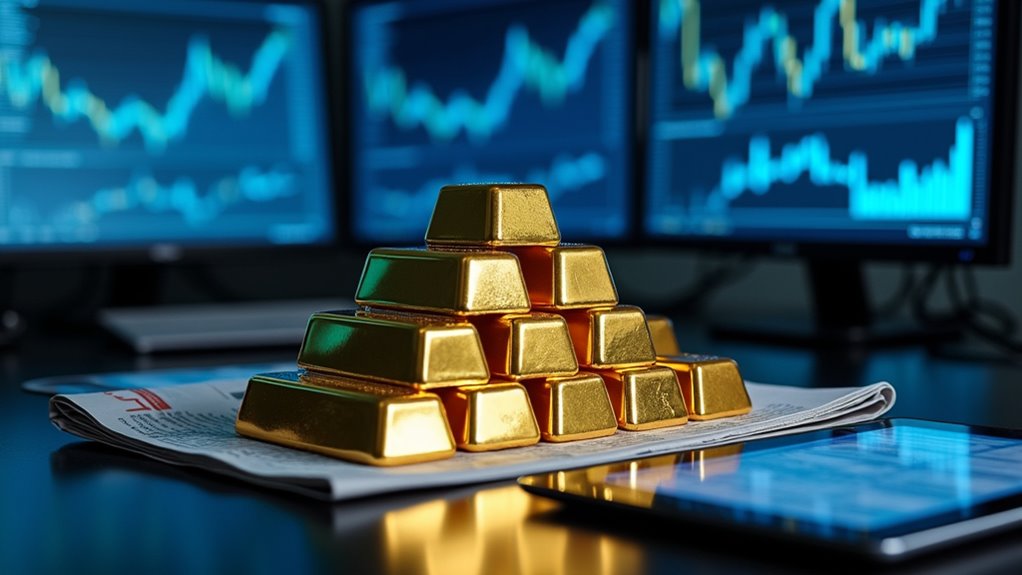
Futures trading has revolutionized gold’s price dynamics – and not always for the glittery better. The market’s now a wild playground where paper contracts dwarf physical demand, with traders controlling massive positions on razor-thin 2% margins. Those leverage-happy speculators? They’re creating price swings that’d make a rollercoaster jealous. Daily electronic fixing by LBMA provides benchmarks, but margin calls can trigger panic selloffs faster than you can say “precious metal.” There’s way more beneath this golden surface.

While gold may sparkle in jewelry cases, its price dance is increasingly led by the feverish rhythm of futures trading. The modern gold market, with its complex web of leveraged positions and speculative fervor, has transformed the way this precious metal’s value fluctuates. The LBMA gold price is electronically fixed daily, providing a crucial benchmark for market participants. Traders wielding margins as low as 2% can control massive positions, sending ripples – or sometimes tsunamis – through the market.
The futures market’s impact on gold prices is like watching a high-stakes poker game where everyone’s got an angle. When speculators pile in, their leveraged positions can amplify price swings faster than you can say “margin call.” And boy, do those margin calls hurt! When markets tank, forced selling can trigger a cascade of liquidations that sends prices into a tailspin. The psychological pressure of maintaining adequate margin top-up requirements forces many investors to exit positions prematurely.
Leverage cuts both ways in gold futures – when margin calls hit, it’s like dominoes falling through the trading floor.
But here’s the kicker – futures trading isn’t all chaos and drama. It actually helps establish more efficient price discovery, reflecting the collective wisdom (or maybe collective madness?) of market participants. Every trade, whether from a cautious hedger or a bold speculator, contributes to the market’s understanding of gold’s true value. Sometimes that understanding comes with a hefty dose of volatility, but hey, nobody said price discovery was gonna be smooth sailing. Moreover, the popularity of gold ETFs and mutual funds has allowed investors to gain exposure to gold without the complexities of physical ownership.

The interplay between physical and paper gold markets creates fascinating dynamics. When futures prices exceed spot prices (contango), or when spot prices surge above futures (backwardation), traders scramble to arbitrage the difference. These price relationships reveal vital information about market conditions and future expectations, even if they occasionally drive traders to tear their hair out.
Economic indicators keep the gold futures market on its toes. Interest rates, GDP figures, and employment data send traders into a frenzy of buying or selling. The US dollar‘s strength plays particularly hard-to-get with gold prices – when the greenback flexes, gold often sulks. And don’t even get us started on how geopolitical tensions can send futures traders into panic mode!
The real beauty of futures trading lies in its democratization of gold markets. Small traders can now dance with the big boys, though sometimes they step on each others’ toes. Central banks might be loading up their vaults with physical gold, but it’s the futures market that keeps the price discovery party going 24/7.
Whether it’s jewelry demand from India or ETF flows from Wall Street, every factor gets priced into futures contracts at lightning speed. In this wild west of precious metals trading, one thing’s certain: futures markets have forever changed how gold prices move.

They’ve added liquidity, complexity, and yes, volatility to the mix. But they’ve also made gold more accessible, more transparent, and infinitely more interesting to watch. Just don’t forget your seatbelt – this ride ain’t for the faint of heart!
Frequently Asked Questions
How Do Political Tensions Impact Speculative Trading in Gold Markets?
Political tensions send gold markets into overdrive!
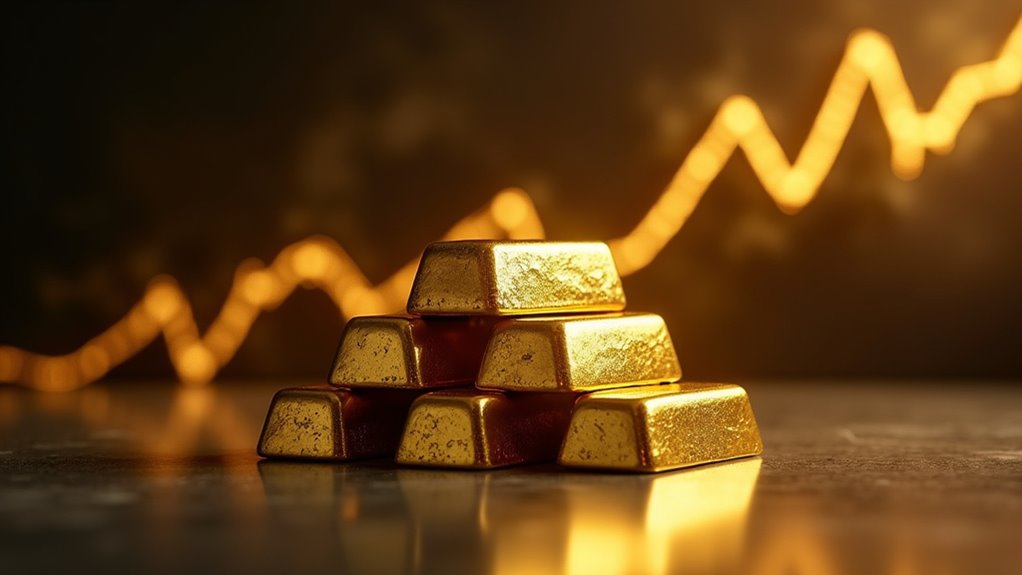
Speculators rush to futures contracts when global conflicts heat up, creating massive price swings.
The data’s clear – gold jumped 7.95% during March 2025’s trade disputes, while the Russia-Ukraine situation pushed Indian prices to ₹51,806 per 10g.
Algorithmic trading intensifies these moves, with traders piling into safe-haven positions.
Central bank decisions and ETF flows add fuel to the speculative fire during geopolitical flare-ups.
What Role Do Central Bank Gold Reserves Play in Price Speculation?
Central banks wield massive influence over gold price speculation through their hefty reserves.
When they go on buying sprees – like China’s recent 18-month shopping marathon – markets get jittery. These mega-players send ripples through trading floors, sparking frenzied speculation about their next moves.

Their reserve adjustments act like market crystal balls, especially for emerging economies looking to dodge dollar-dependence.
And when geopolitical tensions flare up? Those gold vaults start looking mighty appealing!
Can Retail Investors Participate Effectively in Gold Futures Trading?
Retail investors absolutely can plunge into gold futures now – the game’s changed big time!
Micro-contracts and 1-ounce futures have busted down those pesky capital barriers. The spreads are tighter than a vault door, and commission’s dropped to pocket change (we’re talking 45 cents per contract, folks!).

Sure, there’s still that volatility monster lurking, but with demo accounts and broker education tools, smart traders can learn the ropes without getting burned.
Just remember – leverage cuts both ways!
How Do Seasonal Demand Patterns Affect Gold Speculation Strategies?
Seasonal gold demand patterns create juicy opportunities for speculators.
The July-to-February window typically delivers a 6.96% gain, fueled by Indian weddings and Chinese New Year festivities. Smart money piles in before July 6th, riding the wave through peak buying seasons.

Festival periods in Asia spark predictable price jumps, while Western holiday demand adds extra oomph.
September’s volatility keeps things spicy – perfect for traders who love the seasonal rollercoaster!
What Technological Advances Have Changed Modern Gold Trading Practices?
Modern gold trading has undergone a radical transformation through technology.
AI-powered algorithms now dominate price predictions, while blockchain‘s creating unbreakable transaction records.
Digital platforms have democratized access, letting anyone buy fractions of an ounce from their phone.
Automated trading systems execute lightning-fast trades 24/7, while machine learning crunches massive datasets to spot patterns human traders might miss.
The game’s changed – old-school trading floors are becoming dinosaurs.