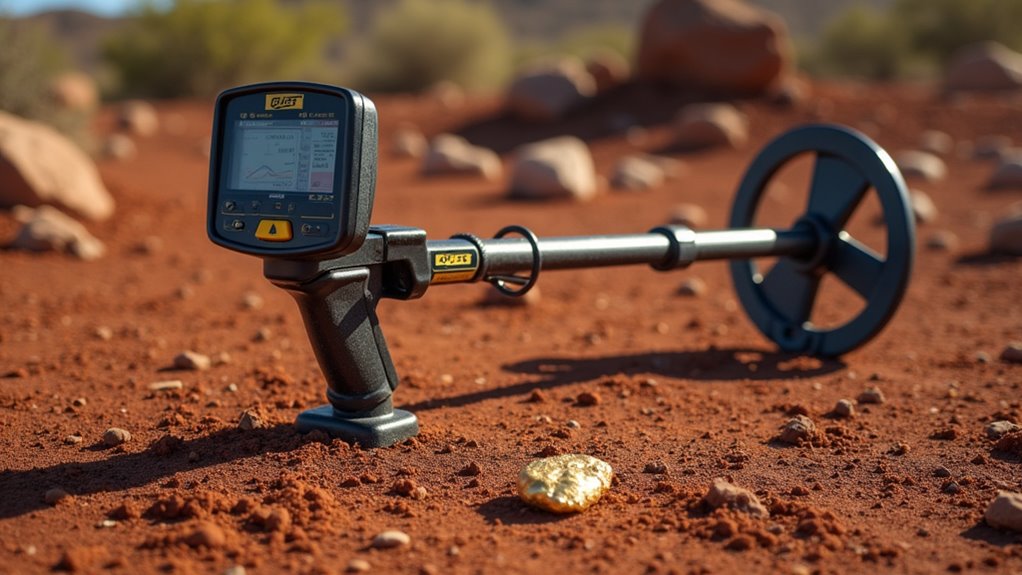
Gold detectors come in three main flavors: VLF, PI, and multi-frequency machines that hunt precious metals with electromagnetic wizardry. VLF detectors rock two coils – one broadcasts signals while the other catches metal responses, but they get finicky in mineral-rich soil. PI machines blast powerful pulses to snag deeper treasures, while multi-frequency systems adapt like chameleons to different conditions. Each type’s got its sweet spot, and there’s way more to uncover about these golden-seeking beasts.

While gold fever has driven prospectors to pan streams for centuries, modern treasure hunters are turning to increasingly sophisticated detection technology that makes those old-timey methods look like child’s play. The evolution of gold detection machines has revolutionized how we hunt for that precious yellow metal, with various types of detectors each bringing their own unique strengths to the table.
The most common workhorse in the field is the Very Low Frequency (VLF) detector, which uses two coils working in tandem – one transmitting signals into the ground and another receiving the bounced-back responses. These bad boys excel at telling different metals apart, making them perfect for general prospecting, though they tend to throw a fit in highly mineralized soils (dont we all?). High-end detectors like the TITAN GER 1000 can reach depths up to 45 meters when searching for gold deposits, although the effectiveness of some detectors is often questioned due to long range gold detectors that are marketed but not scientifically proven. Gold pans and sluices are often used in conjunction with metal detectors to help prospectors maximize their chances of finding gold. Additionally, many detectors are designed to ignore fake gold and other non-precious metals, ensuring that treasure hunters focus on genuine finds. Many prospectors prefer using the Desert Fox gold mining equipment for its efficiency in automated gold panning.
For those serious about getting deep into the earth’s secrets, Pulse Induction (PI) detectors pack a serious punch. These machines blast powerful bursts of current into the ground, penetrating deeper than their VLF cousins. They’re absolute champions at finding tiny gold nuggets and couldn’t care less about mineralized soil – though they’re not exactly picky about what type of metal they’re picking up.

Multi-frequency detectors are the swiss army knives of the detection world, operating at various frequencies simultaneously. These versatile machines adapt like chameleons to different soil conditions and gold sizes, featuring fancy ground balancing tech that keeps them stable in tricky terrain. Think of them as the overachievers of the detector family – they do everything well, but they’ll cost ya.
The real gold-hunting specialists are high-frequency detectors, operating above 40 kHz and specifically engineered for finding that precious yellow stuff. These sensitive beasts excel at spotting small gold pieces in heavily mineralized soils, often featuring specialized modes that make them absolute gold-finding machines. The XGB ground balance system in modern detectors like the Garrett Goldmaster 24K ensures consistently stable performance in challenging soil conditions. Modern versions come decked out with LCD displays, automatic ground tracking, and even Bluetooth connectivity for wireless headphones – pretty fancy for something you’re gonna drag through the dirt.
Choosing the right detector isn’t just about dropping cash on the fanciest model. Smart prospectors consider their hunting grounds’ soil conditions, the size of gold they’re after, and how deep they need to detect. Some machines are straightforward enough for beginners, while others require a PhD in patience to master.
The tech keeps evolving, with new features like 2D imaging and 3D ground scanning systems pushing the boundaries of what’s possible in gold detection. But at the end of the day, even the most sophisticated detector is only as good as the prospector wielding it – though having one sure beats panning streams with a tin pan and broken dreams.
Frequently Asked Questions
How Much Does a Professional Gold Detecting Machine Typically Cost?
Professional gold detecting machines pack serious sticker shock! Entry-level models start around $500, but serious prospectors typically shell out $1,500-$5,000 for mid-range units.

The real beasts? Those’ll set you back $5,000-$30,000! Popular models like the Minelab GPX 6000 ($6,999) and Garrett ATX ($2,625) show why prospecting ain’t cheap.
But hey, one motherlode could make it worth every penny… theoretically.
Can Gold Detectors Distinguish Between Real Gold and Fool’s Gold?
Most gold detectors struggle to reliably distinguish between real gold and pyrite (fool’s gold).
Basic models respond similarly to both minerals due to their conductive properties.

However, high-end detectors equipped with multi-frequency technology and advanced discrimination features can better differentiate between the two.
Even then, experienced prospectors don’t rely solely on detectors – they combine them with traditional verification methods like specific gravity tests and visual inspection for definitive identification.
What Is the Maximum Depth a Gold Detector Can Effectively Scan?
The maximum detection depth varies dramatically based on equipment and conditions.
Top-end 3D scanners like the OKM eXp 6000 boast depths up to 98.4 feet, but let’s get real – most hobbyist detectors max out at 10-16 inches for coin-sized objects.

Large nuggets? You’re looking at 4.9 feet in ideal conditions with specialized gear.
Soil mineralization, target size, and detector type all impact depth capabilities.
Those flashy manufacturer claims? Take ’em with a grain of pyrite!
Are Permits Required to Use Gold Detecting Machines in Public Areas?
Most public areas require permits for metal detecting, with regulations varying wildly by state and location.

While some beaches might let ya swing away permit-free, state parks usually demand official paperwork. It’s a beaurocratic maze out there!
Places like Maryland are pretty chill, but Minnesota’s a total buzzkill – completely banning detecting without authorization.
Smart move? Get those permits sorted before diggin’, or risk fines and equipment seizure.
How Long Does It Take to Become Proficient With Gold Detecting Equipment?
Mastering gold detecting isn’t an overnight affair. Most prospectors need at least 100 hours of field time to get the basics down, while true proficiency demands 2+ years of consistent practice.

The real pros? They’ve got 10-30 years under their belts! Trashy ground makes learning even tougher, requiring hundreds of extra hours.
Factors like detector complexity, practice frequency, and terrain definitely impact the learning curve – yeah, we spelled that wrong on purpose!