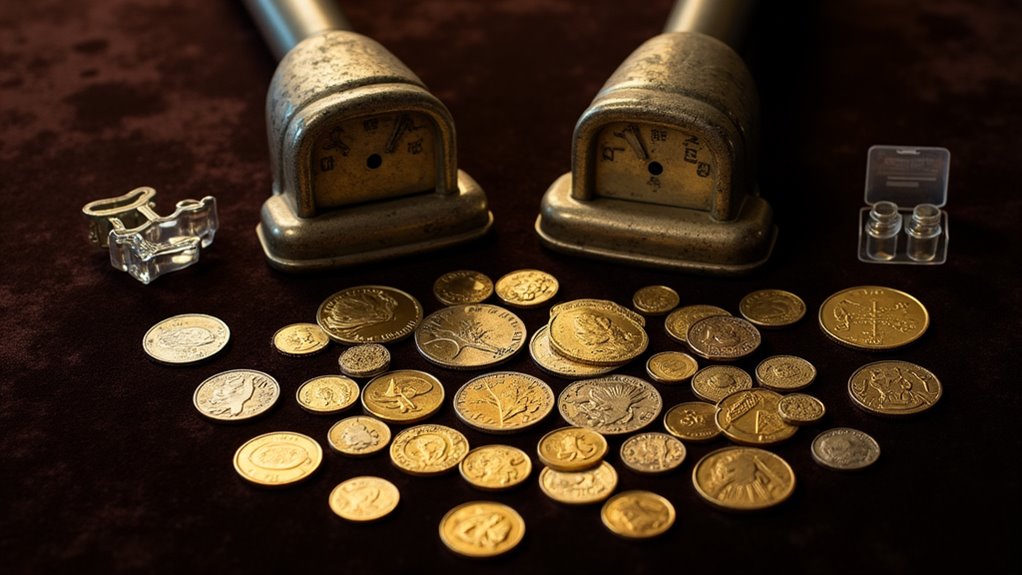
The Krugerrand burst onto the global stage in 1967, becoming the world’s first modern bullion coin and absolutely dominating the market with 90% share by 1980. South Africa’s golden child broke the mold by ditching face values and letting pure gold content determine worth. Its distinctive copper-gold alloy and springbok design sparked a revolution, inspiring copycats like the Canadian Maple Leaf. Even through apartheid sanctions, this red-tinged rebel kept trading – and theres more to this glittering tale.

While countless gold coins have graced the world’s markets, none have quite captured the global imagination like South Africa’s legendary Krugerrand. First minted in 1967 by the South African Reserve Bank, this game-changing coin burst onto the scene when private gold ownership was still a pipe dream in many countries. Talk about perfect timing!
The Krugerrand’s meteoric rise is nothing short of remarkable – by 1980, it dominated a whopping 90% of the global gold coin market. What’s the secret sauce? A killer combo of 22-karat gold (91.67%) and copper (8.33%) that makes these babies tougher than your typical pure gold piece. And lets be honest, that signature reddish tinge? Pure marketing gold.
That reddish glow isn’t just for show – the Krugerrand’s copper-gold combo created an unstoppable force in the global gold market.
When the going got tough during the apartheid era, the Krugerrand got… creative. Despite Western nations slapping import bans left and right, this resilient coin somehow kept finding its way into investment portfolios worldwide. The sanctions eventually lifted in ’91, but the Krugerrand’s reputation for being one sneaky survivor was already cemented in gold trading lore. This resilience mirrors the practices of leading gold mining companies that adapt to market challenges and shows how central bank actions, such as gold sales, can influence investor sentiment. Additionally, the coin’s adaptability during turbulent times reflects how central banks strategically manage their gold reserves to bolster financial stability.

Here’s where it gets juicy – the Krugerrand’s success literally spawned a whole new generation of copycats. The Canadian Maple Leaf, American Gold Eagle, and Australian Nugget all owe a tip of the hat to this pioneering piece. But unlike its shinier 99.99% pure gold competitors, the Krugerrand stuck to its guns with its time-tested alloy formula. Sometimes being first means never having to say you’re sorry.
Speaking of firsts, the introduction of fractional sizes in 1980 (1/2, 1/4, and 1/10 ounce) was pure genius. Suddenly, everyday investors could get in on the action without breaking the bank. With over 50 million ounces sold since inception, its safe to say that strategy paid off big time.
The coin’s design is deliciously straightforward – Paul Kruger‘s stern mug on one side, a prancing springbok on the other. No fancy face value here; the Krugerrand’s worth is tied directly to its gold content and market price. During economic meltdowns, these coins become more popular than free money – they’re basically the gold equivalent of comfort food for nervous investors.
Today’s Krugerrand continues to flex its muscles in the global bullion scene. Sure, it’s got more competition than ever, but there’s something about being the OG that keeps investors coming back for more. Whether your stashing them away for a rainy day or using them as a hedge against inflation, these South African stunners prove that some legends never die – they just keep getting more valuable. Additionally, the Krugerrand’s legacy is further solidified by its role in shaping global gold reserves and influencing how nations accumulate precious metals.
Frequently Asked Questions
Can Krugerrands Be Used as Legal Tender in South Africa?
While Krugerrands technically have legal tender status in South Africa, you won’t see folks buying groceries with these golden beauties!
The coins carry no fixed face value – their worth fluctuates with gold prices, making them pretty impractical for everyday transactions.

Sure, some private dealers might accept them, but let’s be real – these babies are meant for investment portfolios, not your wallet.
The legal tender thing? More of a technicality than anything else.
How Do I Authenticate a Krugerrand Gold Coin?
Authenticating a Krugerrand requires multiple verification methods.
Physical inspection comes first – check that reddish-yellow color and those precise springbok engravings!

Smart collectors use tools like loupes for detail examination and XRF machines to verify that sweet 91.67% gold content.
The magnet test‘s a quick trick – real ones don’t stick!
For absolute certainty, certified dealers or professional numismatists can provide authentication services and documentation.
Avoid sketchy sellers; they’re just askin’ for trouble.
What Is the Best Way to Store Krugerrand Coins?

Professional storage facilities and bank vaults reign supreme for Krugerrand storage, offering exceptional security with 24/7 monitoring.
But hey, a quality home safe works too if you’re the hands-on type! The key? Climate control and proper packaging – those babies need consistent temps and low humidity.
Pop ’em in protective capsules or tubes, and keep ’em away from sunlight. Whatever you choose, make sure it’s insured – these aren’t your average pocket change!
Are There Any Restrictions on Buying Krugerrands in Certain Countries?
Currently, there are no restrictions on buying Krugerrands in any country.
While these South African gold coins were banned in the US and other Western nations during the 1980s apartheid era, those restrictions were lifted in 1991.

Today, they’re freely traded globally and remain legal tender in South Africa.
The coins’ dramatic history of sanctions is now just that – history.
Anyone can buy em’, though local regulations on gold trading still apply.
Why Do Krugerrands Have a Copper-Colored Tinge Compared to Other Gold Coins?
Krugerrands display their distinctive copper-colored tinge due to their unique 22-karat composition, containing 91.67% gold and 8.33% copper.
This “crown gold” alloy gives the coins their signature reddish hue, setting them apart from purer gold coins.

While some collectors might wrinkle their noses at the color, there’s genius in the design – the copper adds essential durability that pure gold coins just can’t match.
It’s basically like giving gold a suit of armor!