In February 1869, miners John Deason and Richard Oates stumbled upon what would become the world’s largest gold nugget – the Welcome Stranger. Initially mistaken for a boring rock in Moliagul, Victoria, this 241-pound beast had to be smashed into three pieces just to move it! The chunk fetched a whopping 10,000 pounds (that’s millions in today’s cash) at the London Chartered Bank. Sadly, it was melted down, but its legacy lives on. The full story gets even juicier.

Buried just inches beneath Victoria’s sun-baked soil lay the mother of all gold discoveries – quite literally. In February 1869, two Cornish miners, John Deason and Richard Oates, stumbled upon what would become the largest alluvial gold nugget ever found. The massive chunk of precious metal, later dubbed the Welcome Stranger, was practically winking at them from beneath a tree’s roots in Bulldog Gully, Moliagul.
Talk about a rock that wasn’t just a rock! Initially mistaken for an ordinary stone, the miners’ skepticism turned to shock when they spotted that telltale golden gleam beneath the ironstone-stained quartz. At 241 pounds (109 kg), this beast was so massive it had to be broken into three pieces just to get it to town. I mean, when your gold nugget’s too big for the scale, you know you’ve hit the motherlode.
The discovery wasn’t just about finding the gold – it was about keeping it. These clever miners knew better than to broadcast their find to the world. They covered it up faster than a cat buries its business, moving it under the cover of darkness with a crew of trusted friends playing bodyguard. Smart move, considering the wild nature of gold rush territories, where challenges in gold mining in Africa could easily parallel their own.

When they finally got it to the London Chartered Bank of Australia in Dunolly, jaws hit the floor. The final refined weight clocked in at 3,123 troy ounces (thats 97.14 kg for you metric fans). The bank shelled out 10,000 pounds – equivalent to about $3-4 million in today’s cash. Not bad for a day’s work, eh? Today, the impact of the leading nations in gold production can be traced back to discoveries like this, which helped establish Australia as a significant player in the global gold market, influencing the global gold reserves of the nation.
The nugget’s journey didn’t end there. After being melted down into ingots (a tragik fate for such a magnificent specimen), it was shipped off to Melbourne and eventually made its way to the Bank of England. By February 21, 1869, Australia’s greatest gold nugget had left its homeland forever, transformed into boring old gold bars.
Today, Moliagul stands as a monument to this extraordinary find. The Victorian gold rush region, already famous for its rich deposits, became legendary after the Welcome Stranger’s discovery. Modern visitors can walk the heritage trail, imagining what it must have felt like to stumble upon such a massive fortune just centimeters below their feet. The impact of the Welcome Stranger nugget on the gold mining industry is still felt today, influencing both mining practices and tourism.
The Welcome Stranger’s legacy lives on as more than just a record-holder. It’s become a symbol of the incredible wealth hidden beneath Australia’s harsh landscape, a reminder of the gold rush era that shaped the nation’s identity. While modern miners might dream of finding its equal, this mammoth nugget remains unmatched – a testament to those wild days when fortunes could literally be stumbled upon in the Victorian bush.
Frequently Asked Questions
What Happened to the Welcome Stranger Nugget After It Was Sold?
After its sale in Dunolly, the Welcome Stranger nugget met a fate that’d make collectors weep!

The massive 66kg chunk was brutally broken down on a blacksmith’s anvil (ouch!) before being melted into boring ol’ bullion.
Talk about a transformation – yielded roughly 2,304 ounces of pure gold.
Now all that’s left is a lonely sketch of this legendary nugget.
Kinda tragic how they turned history into just another gold bar, right?
Did the Discoverers Face Any Legal Challenges Over Their Find?
Remarkably, Deason and Oates managed to dodge any serious legal hassles over their massive gold find.

Their swift, secretive handling of the Welcome Stranger proved genius – they rushed it straight to Dunolly for weighing and sale before anyone could stake competing claims.
While other prospectors of the era often got tangled in lengthy court battles, these savvy miners’ quick actions meant the nugget was melted down and sold before potential challengers could even catch wind of it.
Were There Other Large Gold Nuggets Found in the Same Area?
The Victorian goldfields were basically a treasure trove of massive nuggets. The Welcome Nugget, weighing in at a whopping 68.2kg, was found in nearby Ballarat – talk about striking it rich!
Moliagul itself kept delivering the goods, with Deason and Oates snagging a decent 1.1kg chunk in ’66 before their legendary Welcome Stranger find.

Bulldog Gully was particularly hot, regularly coughing up smaller but still impressive nuggets throughout the rush.
How Much Would the Welcome Stranger Nugget Be Worth Today?
Based on current gold prices, the Welcome Stranger nugget would be worth approximately $5.46 million just for its melt value – but that’s only part of the story!
Given its legendary status as the largest alluvial gold nugget ever found, collectors would likely bid the price into stratospheric territory.
With its impressive 98.6% purity and historical significance, experts suggest the true value could easily exceed $10 million in today’s market.
What Tools Were Used to Extract the Welcome Stranger From the Ground?
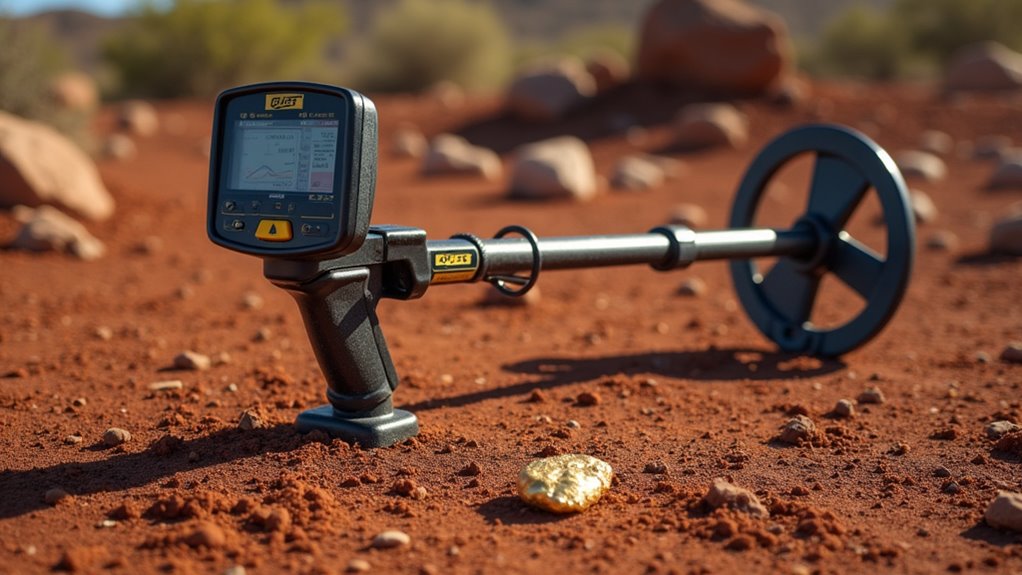
The Welcome Stranger’s extraction was surprisingly basic – just a pick and knife did the trick!

The massive nugget was sitting barely two inches below the surface, making those fancy gold-hunting tools unnecessary.
Miners John Deason and Richard Oates literally stumbled on it while working with standard prospecting equipment.
Talk about luck! They used basic hand tools to carefully dig it out and a sledgehammer to break it down for transport.