Central banks are flexing their gold-buying muscles like never before, snatching up over 1,000 tons annually for three straight years. These financial powerhouses ain’t messing around – they’re deliberately driving up prices through massive over-the-counter purchases while giving traditional currencies the side-eye. Their buying sprees send shockwaves through markets, creating a self-fulfilling prophecy as other investors scramble to follow suit. There’s more to this golden chess game than meets the eye.
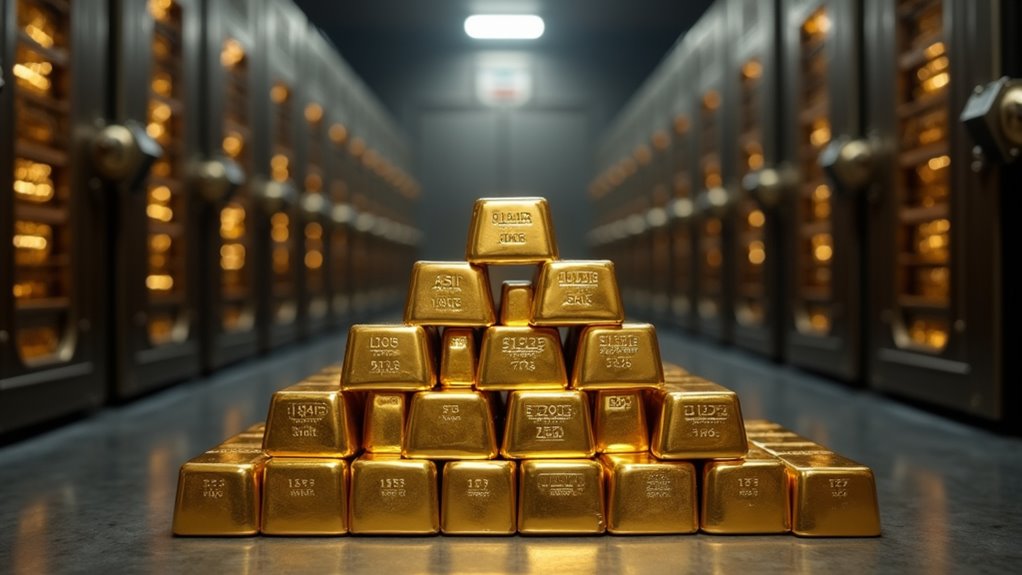
While economists love to debate the minutiae of monetary policy, central banks have been quietly orchestrating one of the biggest gold-buying sprees in modern history. With global reserves topping 35,000 metric tons – roughly 20% of all gold ever mined – these institutions aren’t just dipping their toes in the precious metals pool; they’re doing a full cannonball.
Let’s be real: central banks aren’t stockpiling gold because it looks pretty in their vaults. They’re hedging their bets against a world where traditional reserve currencies might not cut it anymore. The numbers don’t lie – 2024 saw another massive 1,045 tons added to reserves, marking the third straight year of 1000+ ton purchases. That’s not just collecting shiny objects; that’s a deliberate middle finger to the status quo. Their strategic focus on safe-haven asset status during economic uncertainties drives their persistent accumulation of gold reserves. Central banks have maintained net buyer status consistently since 2009, showing their long-term commitment to gold acquisition. Historically, gold has served as a hedge against inflation during times of economic turmoil, making it an attractive option for these institutions.
These titans of finance aren’t exactly subtle about their methods. Whether they’re working through the over-the-counter market or dealing with the Bank of International Settlements, they’re gobbling up Good Delivery bars like they’re going out of style. And guess what? When central banks make moves this big, the market notices. Every major purchase sends ripples through the price charts and sets trader’s phones buzzing.

The geopolitical subtext here is thicker than a vault door. With global tensions rising faster than your grocery bill, gold’s appeal as the ultimate “trust no one” asset is stronger than ever. Emerging market central banks, led by savvy players like the National Bank of Poland (with its chunky 90-ton purchase), are leading this charge. They’ve clearly gotten the memo: diversification isn’t just a fancy word for investment nerds anymore.
The impact on gold prices has been predictably explosive. When institutions with this much firepower enter the market, they don’t just influence prices – they shove them around like a bouncer at a nightclub. Every major purchase creates upward pressure, and the psychological effect on other investors is like watching sheep follow the shepherd.
Looking ahead to 2025, don’t expect this gold rush to slow down anytime soon. The shift from traditional “inside money” to the ultimate “outside money” (gold) is gaining momentum faster than a runaway train. Central banks are expected to keep their buying spree going, potentially racking up another 1,000+ tons this year. It’s like watching a slow-motion revolution in global finance, except instead of pitchforks, they’re wielding gold bars.
The message is clear: in a world where currency values bounce around like a ping-pong ball, central banks are voting with their vaults. They’re not just buying gold; they’re building fortresses of financial independence. And whether you love it or hate it, this trend is reshaping the global monetary landscape one gold bar at a time.
Frequently Asked Questions
What Percentage of Global Gold Reserves Do Private Investors Hold?
Private investors hold roughly 40% of global above-ground gold – that’s a massive chunk.

Let’s be real: these folks are sitting on more gold than governments worldwide.
Add in the jewelry stash (mostly private too), and you’re looking at around 90% of global gold in private hands.
Pretty wild stuff.
ETFs make up a decent slice of that pie, but it’s those Indian and Chinese households that’re really hoarding the shiny stuff.
How Do Geopolitical Tensions Affect Central Banks’ Gold Purchasing Decisions?
When global tensions flare up, central banks rush to stockpile gold like it’s going out of style.
They’re not stupid – gold is sanctions-proof and crisis-resistant.
Just look at how Asian banks loaded up after US-China trade wars kicked off, or how Russia went gold-crazy when Ukraine tensions mounted.
It’s a classic “better safe than sorry” move.
Plus, it’s their way of giving the middle finger to dollar dependence.

Smart strategy? You bet.
Can Individual Investors Buy Gold at Central Bank Prices?
No way – individual investors can’t access those sweet central bank gold prices.
That’s an exclusive club for the big players only. Regular folks are stuck paying retail premiums of 5-10% over spot, plus dealer markups.
Central banks get bulk discounts through private deals with bullion banks, often below spot price.

Welcome to the two-tiered system, where the average Joe gets squeezed while the elite institutions get preferential treatment.
Tough luck!
Which Countries Have Historically Sold the Most Gold Reserves?
Switzerland takes the crown as the biggest gold dumper, unloading a massive 1,300 tons between 2000-2008.
The Netherlands wasn’t far behind, ditching 1,100 tons in the 90s and early 2000s.

The UK’s infamous “Brown’s Bottom” saw them sell 395 tons at rock-bottom prices – talk about terrible timing!
France also jumped on the sell-off bandwagon, dropping 589 tons from 2004-2009.
Pretty epic gold purge from these European heavyweights.
How Do Central Banks Store and Transport Their Physical Gold?
Central banks don’t mess around with their gold storage. They use ultra-secure underground vaults with military-grade security – we’re talking reinforced steel, biometric scanners, and 24/7 armed guards.
When they need to move the stuff, it’s armored vehicles and specialized cargo planes all the way. The big players like Fort Knox and NY Fed’s vault are basically fortresses.
Every ounce is tracked, monitored, and audited religiously. No room for whoopsies here.