Long-term gold investors play defense, parking 5-10% in physical metals as a safety net against economic mayhem. Meanwhile, trigger-happy traders chase quick gains through ETFs and futures – good luck with that rollercoaster. Physical gold beats paper trading for stability but demands premium prices and storage headaches. Mining stocks offer juicy leverage but pack serious risk. Smart money knows gold ain’t about getting rich quick; it’s insurance for when things go south. The real strategy lies deeper beneath the surface.

While countless financial talking heads spew endless predictions about the “perfect” way to invest in gold, the reality is far messier than their polished soundbites suggest. The truth is, there’s a stark divide between long-term gold strategy and the short-term gambling that masquerades as “strategic trading.” Long-term investors treat gold as a portfolio diversifier, typically allocating 5-10% to physical metals while watching paint dry.
Meanwhile, short-term speculators bounce between ETFs and futures like caffeinated squirrels, convinced theyre gonna outsmart the market.
Let’s get real – long-term gold strategy isn’t sexy. It’s about as exciting as watching grass grow, but that’s kinda the point. It serves as a hedge against inflation and economic uncertainty, helping portfolios weather storms like 2022 when gold actually gained 3% while stocks and bonds got absolutely demolished. The low correlation with traditional assets means it can actually improve risk-adjusted returns over time, even if it doesn’t make you rich overnight. Tax benefits from gold IRAs make this approach even more attractive for retirement planning. Additionally, gold’s historical role as a safe haven asset provides further reassurance during turbulent economic times.
Long-term gold investing may be boring, but it provides crucial portfolio protection when markets crater and inflation soars.

Short-term gold trading is a whole different animal. These folks live and die by every geopolitical hiccup and market twitch, glued to their screens like it’s the latest Netflix series. They prefer gold ETFs and futures for quick entry and exit, though they conveniently ignore how those expense ratios slowly eat away at their gains like termites in a wooden house. The dollar-cost averaging approach offers a more balanced strategy for reducing market timing risks.
Sure, some make money – but plenty get burned trying to time an asset that’s more influenced by psychology than actual supply and demand.
Physical gold investment sits somewhere in the middle of this mess. Yeah, you’ve got actual gold in your hands (or hopefully in a secure vault), but you’re paying premiums over spot price and dealing with storage costs that can chip away at returns. It’s less liquid than ETFs, but that might actually be a good thing – keeps you from making stupid emotional decisions during market panics.
The real kicker? While gold mining stocks seem like a clever way to get leveraged exposure to gold prices, they’re basically strapping a rocket to an already volatile asset. These companies face operational risks that can send their stocks plummeting even when gold prices rise. Though unlike physical gold, at least they might throw you a dividend bone occasionally.

Here’s the uncomfortable truth nobody wants to admit: gold’s long-term returns historically lag behind equities, and it doesn’t generate cash flow like stocks or bonds. But that’s not really the point. Its real value comes from being that weird, contrarian asset that tends to shine exactly when everything else looks like garbage.
Central banks get this – they’re loading up on gold through 2025. Maybe they know something those day-trading “experts” don’t.
Frequently Asked Questions
What Role Do Geopolitical Tensions Play in Gold Price Fluctuations?
Geopolitical tensions are gold’s best friend – period.
When wars rage and tensions flare, investors sprint to this shiny safe haven faster than politicians flip-flop on promises.
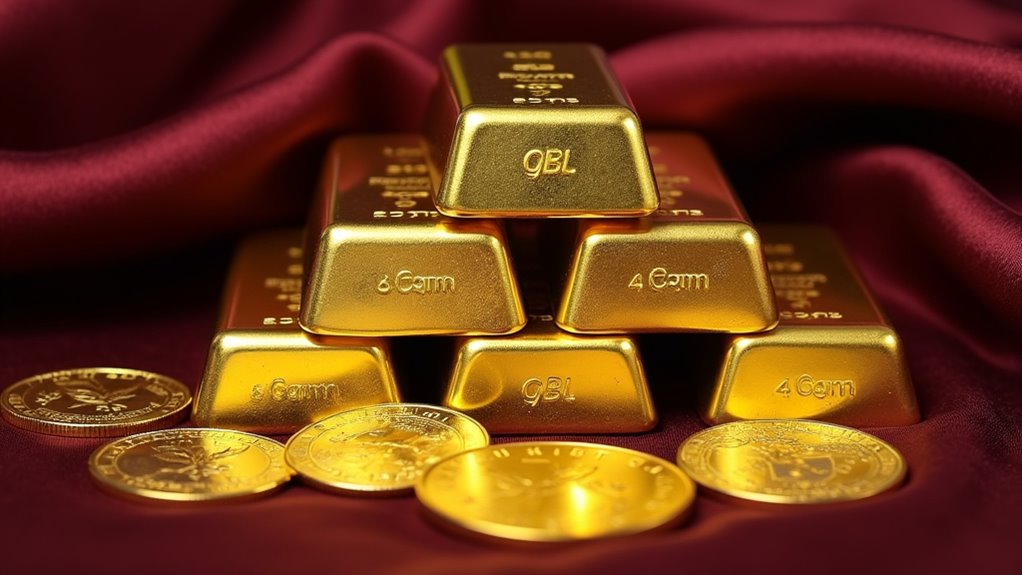
Just look at how Russia-Ukraine and Gaza conflicts sent prices soaring.
Economic uncertainty? Bang – gold jumps.
Currency chaos? Boom – another spike.
Central banks know it too, hoarding thousands of tons since 2010.

It’s simple: more global drama equals higher gold prices.
How Do Central Bank Gold Purchases Affect Individual Investment Decisions?
Central banks’ massive gold hoarding isn’t just some boring financial footnote – it’s lighting a fire under individual investors.
When the big players gobble up 290 tonnes in Q1 2024, retail investors take notice. It’s like watching sharks in a feeding frenzy – nobody wants to be left behind.
The numbers dont lie: record highs of $2,450 are making regular folks think twice about their portfolio mix.

Safe haven? You bet your bottom dollar.
Can Gold ETFS Provide the Same Benefits as Physical Gold Ownership?
Gold ETFs and physical gold aren’t exactly twins.
Sure, ETFs offer convenience and lower costs, but they miss that vital “hold-it-in-your-hands” factor that physical gold delivers.
When systems fail, you can’t exactly swap digital shares for goods.

ETFs expose investors to counterparty risks and management fees that physical gold owners dodge completely.
Bottom line: ETFs track gold prices well but can’t match the primal security of having real metal in your possession.
What Percentage of a Portfolio Should Be Allocated to Gold Investments?
Most experts suggest keeping gold allocation between 5-15% of a portfolio – anything more is probably overkill.
Look, traditional wisdom says 10% in physical gold and maybe 5% in mining stocks or ETFs.
Yeah, some gold bugs scream for 50% or more, but that’s extreme.
The sweet spot? Around 10% total gold exposure has historically improved returns while cutting overall portfolio risk.
Just don’t go nuts thinking gold’s your ticket to instant riches.
How Do Seasonal Gold Demand Patterns Impact Pricing Throughout the Year?
Gold prices dance to a predictable seasonal rhythm – it’s almost like clockwork.
Prices typically surge during India’s wedding season and Chinese New Year, while summer months are dead zones.
The pattern’s so obvious it hurts: prices climb from July through February, with gains averaging 6.96% to 11.27%.
Smart money knows this game – they stack up during summer slumps and ride the wave through peak seasons.
Its really that simple.