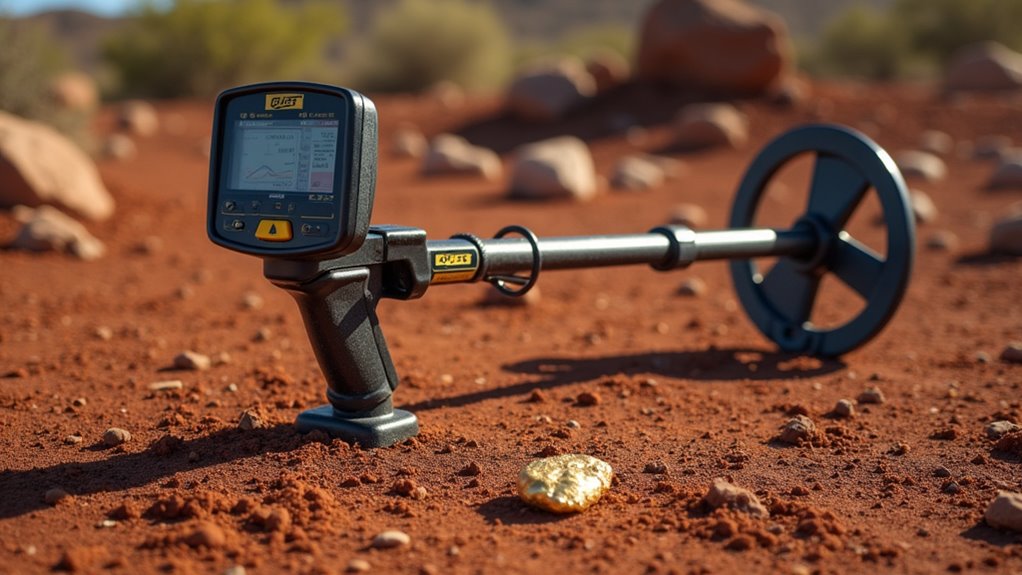
Today’s gold prospecting machines pack serious punch, with high-frequency detection at 18+ kHz being the sweet spot for finding those elusive nuggets. The Nokta Makro Gold Kruzer crushes it at 61 kHz, while premium options like the GPZ 7000 dominate the pro scene. Entry-level hunters can score decent gear starting around $500, but serious prospectors might shell out $3000+. DD coils handle mineralized soil like champs, while smaller coils nail those tight spots. The deeper you go, the more secrets these machines reveal.

Let’s get real about what makes these machines tick. High operating frequencies are absolutely vital – we’re talking 18 kHz or higher if you want any shot at spotting those elusive tiny nuggets. The Nokta Makro Gold Kruzer crushes it with a 61 kHz frequency that’ll make even the smallest bits of yellow metal sing. Double D coils offer superior performance in heavily mineralized soils. Additionally, many of the top gold detectors for beginners are designed to be lightweight and easy to handle, making them perfect for long days in the field. Moreover, essential tools such as gold pans and sluices enhance the overall prospecting experience. A successful search often involves understanding the unique terrain type you will be working in.
And don’t forget about ground balancing – without it, you’re basically swinging a very expensive stick through mineralized soil. Having specialized features like gold probability register helps users determine whether they’ve found an authentic target. You can also refer to updated maps for prospecting hotspots to maximize your chances of success.
The price tags on these bad boys range from “okay, I can manage that” to “maybe I’ll sell my car.” Entry-level prospectors can get their feet wet with something in the $500-$750 range, while the serious players drop $3000+ on beasts like the GPZ 7000. Smart newbies often opt for rentals at $50-$100 per day – because nobody wants to be stuck with an expensive paperweight if they realize gold hunting isn’t their thing.

Coil size matters, and anyone who tells you different is probably trying to sell you something. Small coils (5-8 inches) are perfect for getting into those tight spots where nuggets love to hide, while the big boys (12+ inches) are great for covering more ground.
DD coils cut through mineralized soil like a hot knife through butter, but concentric coils still have their place in less challenging terrain.
Technology choices can make or break your prospecting success. VLF detectors are fantastic for shallow hunting and spotting smaller nuggets, while PI systems laugh in the face of mineralized ground and go deeper than your ex’s trust issues. Newer models often incorporate multi-frequency technology, which can help detect different types of metals more effectively.
The serious prospector knows success isn’t just about the detector – it’s about the complete package. Pinpointers, gold pans, and proper digging tools are essential companions.

And for crying out loud, invest in some decent headphones – trying to hear those faint signals over ambient noise is like trying to hear a whisper at a rock concert.
The learning curve can be steep, but joining local prospecting clubs and attending training sessions can save months of frustrating trial and error.
Practice makes perfect, and testing your detector with known targets helps develop the skills needed to differentiate between that rusty nail and your next golden payday.
Frequently Asked Questions
Do I Need a Special Permit to Use a Metal Detector?
Yes, you’ll likely need permits – and they’re as varied as gold prices!

Most public spots demand ’em, though requirements differ wildly by location. State parks? Definitely. National forests? Sometimes. Private land? Get that sweet written permission, treasure hunter!
Local rules are a maze of bureaucratic fun – some spots demand annual permits, others want day passes.
Hot tip: Check with local authorities before you dig, or risk getting slapped with fines. Ouch!
How Deep Can Most Hobby-Grade Gold Detectors Scan Underground?
Most hobby-grade gold detectors penetrate 10-28 cm (4-11 inches) underground – not exactly reaching the Earth’s core!

Mid-range models can hit 30-45 cm in perfect conditions, while premium machines like the Minelab GPX5000 might squeeze out 1.5 meters.
Depth’s a fickle beast, though – soil mineralization, target size, and detector tech all play their part.
Here’s the kicker: most gold nuggets hang out in the top 20 cm anyway. Go figure!
Can Gold Detectors Differentiate Between Gold and Other Metals?
Modern gold detectors can differentiate between metals, but they’re not infallible. Using electromagnetic tech and VDI readings, these machines analyze conductivity patterns unique to different metals.

While gold’s distinct low conductivity helps identification, factors like mineralized soil, depth, and nearby metals can muddy the signals. Some metals (especially lead n’ brass) produce frustratingly similar readings to gold.
Multi-frequency technology helps, but there’s still no 100% guarantee.
Are Waterproof Gold Detectors Worth the Extra Cost?
Waterproof gold detectors pack serious value for their premium price – if you’re hitting wet terrain regularly.
The 20-30% markup buys peace of mind and access to previously off-limits hunting grounds. For weekend warriors in dry regions? Maybe skip it.

But for those chasing paydirt near streams or in rainy climates, that extra investment’s pure gold. Plus, these bad boys tend to last longer, which means more time finding treasure, less time finding replacement parts.
What Maintenance Is Required for a Gold Detecting Machine?
Gold detectors demand regular TLC to stay sharp in the field.
Basic maintenance includes wiping down that housing with a soft cloth and keeping the search coil squeaky clean with mild soap.
Battery management’s essential – check levels often and yank ’em during storage.
Smart owners inspect coils for damage, keep cables mint, and store their gear in dry spots.
Pro tip: compressed air blasts make quick work of stubborn dirt buildup.