China’s iron grip on global gold production is no joke, churning out a whopping 330-380 tonnes annually.
Australia and Russia are neck-and-neck for second place, each producing around 300 tonnes yearly.
The United States and Canada hover around 200 tonnes, while Mexico and South Africa round out the pack with 120 and 110 tonnes respectively.
These seven powerhouses dominate 80% of world production – leaving other nations fighting for golden scraps. Dig deeper to unearth the real dynamics shaping this glittering power struggle.
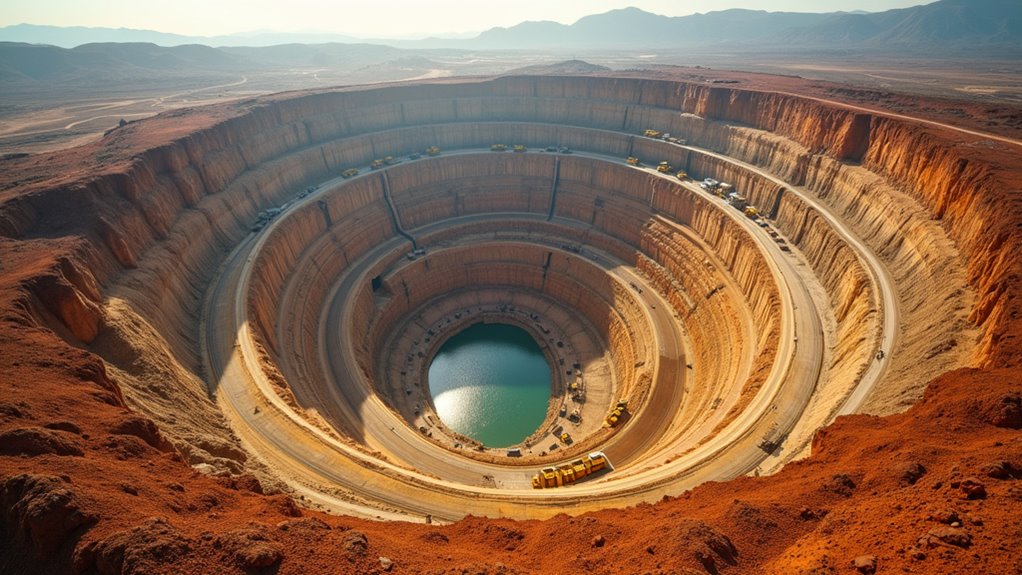

Seven powerhouse nations dominate the global gold mining landscape, churning out a whopping 80% of the world’s precious yellow metal. At the top of this glittering heap sits China, flexing its mining muscles with an impressive 330-380 tonnes annually – that’s a solid 10-11% of global production. Their state-owned companies have got their fingers in 127 gold mines nationwide, with Shandong Province being the crown jewel of their operation.
China leads the global gold rush, commanding 10-11% of world production through 127 state-owned mines across the nation.
Nipping at China’s heels, Australia‘s pulling its weight with 290-320 tonnes per year. The Land Down Under’s got Western Australia to thank for 71% of its golden output, and with 7,400 tonnes in reserves, they’re not running dry anytime soon.
The Boddington mine‘s their heavy hitter, churning out a whopping 813,000 ounces yearly – that’s a lot of gold! The recent surge in gold prices above $1,900 has made Australian mining operations increasingly profitable.
Russia’s muscled its way into third place, matching Australia’s output with 295-320 tonnes annually. The beast of the East’s got their massive Olimpiada mine pumping out nearly 2 million ounces, while their vast Siberian, Far Eastern, and Ural regions are literally swimming in gold deposits. Talk about a golden empire! The country’s Polyus Gold leads production efforts with state-of-the-art technology.

The United States and Canada are locked in a proper tussle for fourth and fifth place, each pushing out between 170-220 tonnes annually.
Uncle Sam’s got Nevada doing most of the heavy lifting with 72% of production, while the Canucks are relying on Ontario and Quebec to keep their golden dreams alive. Both nations might be trailing the top three, but they’ve still got serious skin in the game.
Mexico’s holding down sixth place with a respectable 120-130 tonnes yearly. Their Peñasquito mine‘s leading the charge, proving that sometimes the underdog’s got more bite than bark.
Meanwhile, South Africa – once the undisputed king of gold – has fallen to seventh or eighth place, scraping together 100-110 tonnes annually. Bit embarrassing for a country sitting on the legendary Witwatersrand Basin, innit?

The global gold game’s changing faster than a chameleon in a paint factory. China’s iron grip on the top spot seems unshakeable, while Australia and Russia are locked in a proper dogfight for second place.
The Americans and Canadians are stuck in their own private wrestling match, while Mexico‘s quietly getting on with business. And poor old South Africa? Well, they’re learning the hard way that past glory doesn’t guarantee future success.
With labour issues and mine closures plaguing their industry, they’re struggling to keep up with the young guns. But in this cutthroat world of global gold production, yesterday’s leader can become tomorrow’s has-been faster than you can say “precious metal.”
Frequently Asked Questions
How Does Gold Mining Impact Local Communities and Indigenous Populations?
Gold mining brutally disrupts indigenous communities – there’s no sugarcoating it.
Companies force locals off ancestral lands, poison their water with mercury, and destroy sacred sites.
Sure, mining creates jobs, but the benefits rarely reach those most impacted.
Traditional ways of life get decimated while outsiders profit.
Communities end up divided, with increased social problems like alcoholism and prostitution.
The environmental damage? It’s permanent, mate.

Indigenous rights get trampled while fat cats get richer.
What Are the Environmental Consequences of Modern Gold Mining Techniques?
Modern gold mining’s environmental toll is brutal, mate. One gold ring needs 20 tonnes of excavated earth – imagine that!
The industry dumps 180 million tonnes of toxic waste yearly, poisoning waterways with mercury and cyanide.
Mining’s left 500,000 abandoned sites across the western U.S. alone, costing billions to clean up.
Worst bit? 40% of western U.S. watershed headwaters are contaminated.
The damage persists for generations, wreaking havoc on ecosystems and biodiversity.
How Long Does It Typically Take to Develop a New Gold Mine?
Gold mines take a whopping 20.8 years on average to go from discovery to production – longer than you’d think, eh?
The process is a real slog, with nearly 12 years spent just on discovery, exploration and endless studies.
Even after all the feasability work’s done, there’s still another 1.5 years of mucking about before construction starts.
Sure, some mines get cranking in 6 years, but others drag on for 32.
Welcome to the slow-burn world of gold mining.
What Percentage of Mined Gold Is Used for Jewelry Versus Industrial Purposes?
Let’s cut straight to it – jewelry is the undisputed heavyweight champ of gold usage, hogging about 50% of all mined gold.
Meanwhile, industrial applications are the quiet underdog, nibbling away at just 7-8% annually.
It’s mind-boggling that we’re using half our precious gold for bling when tech innovations are scraping by with scraps.
The rest? It’s split between investment vultures and central banks stockpiling their vaults.
How Do Political Conflicts and Sanctions Affect the Global Gold Mining Industry?
Political instability hits gold mining hard – just look at Africa’s mess of coups and conflicts.
When governments get grabby with mining contracts or slap sanctions around, it’s chaos for the industry.
Russia’s Ukraine drama sent shockwaves through gold markets, while places like Burkina Faso are kicking out foreign miners.
It’s not just about digging anymore – it’s a proper political circus affecting everything from production costs to trade routes.
Brutal.