Global central bank gold reserves hit a staggering 36,699 metric tons by end-2023, with the U.S. hoarding the lion’s share at 8,133.46 tons. Banks snatched up 1,037 tons in 2023, while 2024’s first quarter saw another 290 tons vanish into vaults. Turkey’s gone all-in with 100% gold reserves, and China’s quietly stockpiling. With spot prices exploding past $2,940/oz in February 2025, the yellow metal’s rampage shows no signs of cooling – unless it does. There’s more to this glittering saga.

While central banks worldwide have been hoarding gold like squirrels before winter, their collective appetite hit a jaw-dropping 36,699 metric tons by end-2023 – that’s a whopping 17% of all the yellow metal ever yanked from Earth’s crust! The United States remains the undisputed heavyweight champion, clutching onto 8,133.46 metric tons, while Germany trails behind with 3,351.53 metric tons. Together, the top 10 gold-holding nations are sitting pretty on 67.9% of all central bank reserves. Turkey has emerged as a notable leader with 100% gold reserves, showcasing the highest percentage among all central banks. Central banks’ gold strategies are increasingly crucial as they adapt to changing economic landscapes, especially as they utilize gold for currency support in times of economic uncertainty. Additionally, the global ranking of gold reserves highlights how these strategies vary across nations. The historical significance of gold as a reserve asset reinforces its strategic importance in the face of fluctuating currencies and geopolitical tensions, particularly as geopolitical factors increasingly influence national monetary policies.
Central banks are stockpiling gold at a dizzying pace, with the top 10 nations hoarding over two-thirds of global reserves.
The past couple years have been absolute bangers for gold acquisitions. Central banks snatched up 1,037 tonnes in 2023, just shy of 2022’s record-breaking 1,082 tonnes. And they’re not letting up – nearly 290 tonnes vanished into their vaults during Q1 2024, followed by another 18 tonnes in January 2025. Uzbekistan led buyers with an impressive 8 tonnes acquired that month. Talk about a buying spree!
Poland’s been particularly ravenous, gobbling up 89.54 tonnes (a 25% boost to their stash), while Turkey and India weren’t far behind, adding 74.79 and 72.6 tonnes respectively. China keeps doing its thing, methodically accumulating 44.17 tonnes as part of their apparent “gold is good” strategy. Meanwhile, some countries are playing the other side – the Philippines dumped 29.4 tonnes, and Kazakhstan lightened their load by 10.18 tonnes.

The reasons behind this golden obsession? It’s not just about looking fancy. Central banks are increasingly viewing gold as their financial bomb shelter – it’s crisis-proof, can’t default like those pesky sovereign bonds, and serves as a middle finger to dollar dominance. Speaking of which, 62% of central bankers reckon the greenback’s slice of the reserve pie is gonna shrink.
Looking ahead, the outlook’s shinier than a freshly-minted krugerrand. A whopping 81% of central banks predict global gold holdings will keep climbing over the next year, while 29% are planning to beef up their own reserves.
The spot price has been on an absolute tear, blasting past $2,940 per troy ounce in February 2025 after a mind-blowing 50% surge in 2024.
And despite retail ETF holdings shrinking back to pre-pandemic levels, analysts are throwing around some seriously optimistic numbers – we’re talking $2,900-$3,000 by mid-2025, potentially hitting $3,100-$3,200 by years end.

Though let’s be real, predicting gold prices is about as reliable as forecasting next month’s weather using grandma’s knee pain. What’s crystal clear is that central banks aren’t just dipping their toes in the gold pool anymore – they’re doing canonical backflips into the deep end, and showing no signs of climbing out anytime soon.
Frequently Asked Questions
Why Do Some Central Banks Choose Not to Publicly Report Their Gold Holdings?
Central banks often keep their gold holdings under wraps for strategic reasons.
It’s not just about being secretive – it’s smart business! They’re protecting against market speculation, avoiding unwanted attention from adversaries, and maintaining flexibility in international dealings.
Plus, there’s the whole security thing – nobody wants their gold vault locations becoming public knowledge.

Some banks even play it extra cautious, keeping those numbers totally dark!
How Do Geopolitical Tensions Affect Central Banks’ Decisions to Buy Gold?
Geopolitical tensions send central banks scrambling for gold’s safe embrace.
When international conflicts heat up, these institutions instinctively bulk up their precious metal holdings to shield against potential sanctions, currency warfare, and economic uncertainties.
Just look at Russia’s 2022 sanctions – that triggered a gold-buying spree faster than you can say “de-dollarization.”

It’s like financial chess, where gold becomes the ultimate defensive piece against global power plays.
What Security Measures Protect Central Bank Gold Reserves From Theft?
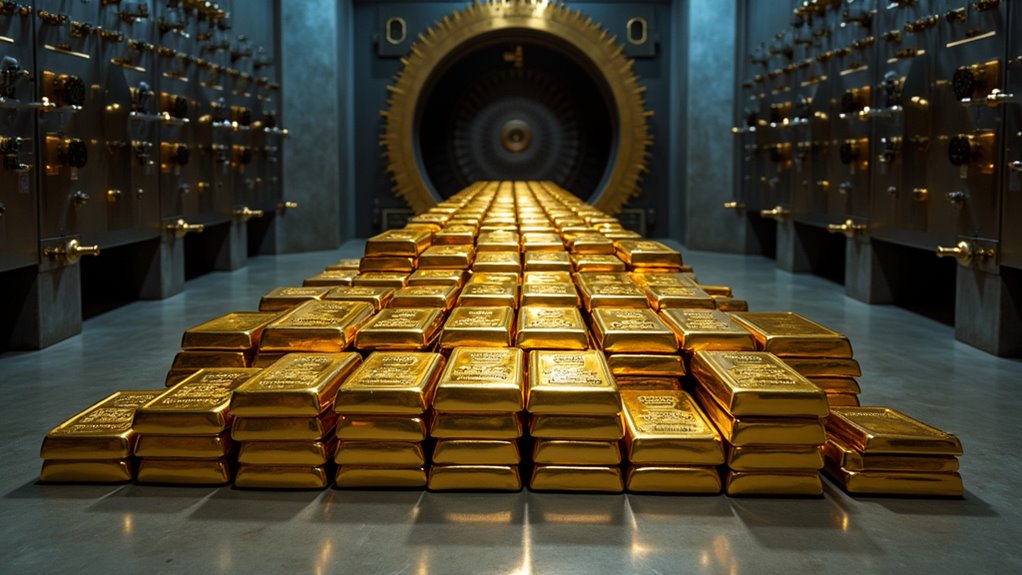
Central banks protect their gold reserves with fortress-like security that’d make Fort Knox jealous!
Multi-layered defense systems combine biometric scanners, reinforced vaults, and time-locked barriers. These bad boys sit deep underground – NY Fed’s vault chillin’ 80 feet below street level – guarded by sharp-shooters and monitored 24/7.
No single person knows all vault combos (smart move!), and those steel-plated walls can handle explosions.

Talk about paranoid – but hey, with billions in gold, who wouldn’t be?
How Do Central Banks Verify the Authenticity of Their Gold Reserves?
Central banks employ multi-layered verification processes to authenticate their gold holdings.
Physical inspections involve weighing bars, checking serial numbers, and examining refiner markings. Third-party auditors regularly conduct independent examinations, while assay testing determines gold purity through fire assay and spectrographic analysis.
Custodial verification guarantees proper segregation in allocated accounts, with tamper-evident seals and dual control procedures protecting vault access.
These overlapping measures maintain confidence in reserve authenticity.
Can Central Banks Lease Their Gold Reserves to Generate Additional Income?
Central banks can and do lease their gold reserves, turning those shiny bricks into money-making machines.
Through gold leasing, they’re basically playing landlord to commercial banks and bullion dealers who pay sweet interest rates – currently hovering around a juicy 10% (up from measly 1-2% previously).
It’s not all glitter though; there’s always that pesky counterparty risk if borrowers can’t return the goods.
Still, it’s a slick way to make idle gold work harder!