The global gold hierarchy remains deliciously predictable – the U.S. sits pretty with a whopping 8,133 metric tons, while Germany trails with 3,355. Italy and France are neck-and-neck around 2,400 tons, and Russia rounds out the top five with 2,298. But here’s where it gets spicy: China claims 2,000 tons officially, but whispers suggest they’re secretly hoarding up to 14k tons! The real gold game runs deeper than these shiny numbers suggest.

Five major economic powerhouses hoard more than half the world’s official gold reserves, with the United States sitting pretty on a whopping 8,133 metric tons – enough to make any gold bug’s heart skip a beat. Germany follows with 3,355 metric tons, while Italy and France duke it out for third place, each holding around 2,400 metric tons. Russia rounds out the top five with 2,298 metric tons, though they’ve been aggressively stockpiling more. These reserves serve as economic insurance for these nations during times of market volatility and often respond to Federal Reserve gold purchases that can influence global market dynamics. Additionally, the IMF plays a crucial role in international gold management, ensuring that gold reserves are utilized effectively. Central banks globally are aware that gold’s strategic importance is growing, making it a key component of their financial strategies.
The gold landscape’s getting spicier as emerging powers flex their monetary muscles. China‘s been on an absolute tear, amassing nearly 2,000 metric tons through sneaky-smart accumulation strategies over the past decade. Switzerland, ever neutral but never naive, maintains a respectable 1,040 metric tons, while Japan and India hover around the 800-ton mark. The Netherlands, despite its tiny size, somehow squeezes into the top ten with 612 metric tons. According to intelligence sources, China’s actual holdings may reach 14,000 metric tons, far exceeding official reports. Central banks have increasingly recognized the importance of gold reserves as a strategic asset in their financial portfolios, which plays a critical role in monetary policy and national security.
China’s gold-buying frenzy shows how emerging economies are reshaping the precious metals game, leaving traditional powers scrambling to keep pace.
Central banks worldwide haven’t just been window shopping – they’ve been net buyers since 2010, and boy, have some been shopping hard. Russia’s been the biggest gold glutton for seven straight years (talk about commitment issues!), while Poland’s been making waves with substantial purchases in 2023. Even Singapore’s gotten in on the action, bulking up its reserves like it’s prepping for a financial apocalypse.

The whole gold reserve thing isn’t just about showing off shiny metals in fancy vaults. It’s a serious hedge against economic chaos, helps stabilize currencies when markets go bonkers, and gives countries some serious financial street cred. Fort Knox might be the most famous gold storage facility, but the Bank of England‘s vaults are like a gold hotel, hosting precious metal deposits from multiple countries who trust those stoic Brits with their treasure.
Europe’s still got serious skin in the game, with several countries in the top rankings. Asia’s the up-and-coming player, with China and India leading the charge. Meanwhile, South America’s barely made a dent in the global rankings, and the Middle East maintains a quiet but substantial presence.
Looking back, gold’s role has evolved faster than a chameleon in a candy store. Since the U.S. ditched the gold standard in ’71, the yellow metal’s gone from currency backbone to financial safety net. The 1999 Central Bank Gold Agreement put some breaks on wild selling sprees, but the 2008 financial crisis made everyone remember why they loved gold in the first place.
Now, heading into 2025, central banks are treating gold like its going out of style – except it definitely isn’t. The precious metal’s still proving its worth as an essential part of national reserves, even if nobody can quite agree on how much is enough.
Frequently Asked Questions
Why Do Some Countries Choose Not to Store Gold Reserves?
Countries skip gold reserves for shrewd reasons!
Some opt for foreign exchange instead – way more flexible than that shiny stuff.

Storage costs? Don’t even get us started.
Plus, many nations prefer investing in tech, infrastructure, and human capital that actually generates returns (unlike that pretty paperweight in the vault).
Risk management’s another biggie – gold’s price swings can be brutal.
And let’s be real: in today’s digital economy, diversification beyond precious metals just makes more cents.

See what we did there? 😉
How Often Do Countries Buy or Sell Their Gold Reserves?
Central banks typically adjust their gold reserves quarterly, though actual trading patterns vary wildly!
Larger economies tend to move like sloths, making infrequent changes, while emerging markets are way more trigger-happy with their gold trades.
China’s been on a monthly buying spree lately (15 months straight!), while others might sit tight for years.

Economic chaos, geopolitical drama, and fiscal reporting cycles often spark these golden shuffles.
What Security Measures Protect National Gold Reserves?
National gold reserves are protected by layers of intense security that’d make Fort Knox jealous!
We’re talking massive vault doors weighing literal tons, biometric scanners that’d reject James Bond himself, and armed guards who don’t mess around.
Most fascinanting? The combo of old-school muscle (reinforced concrete bunkers) with Star Trek-level tech (infrared sensors, AI surveillance).
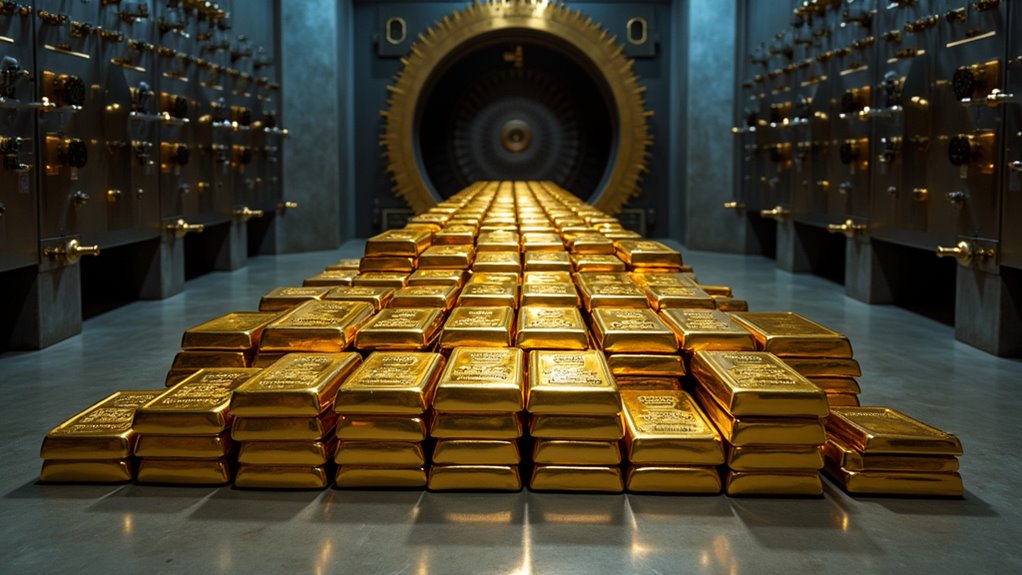
No single person has complete access – gotta love that paranoia!
Can a Country’s Gold Reserves Be Seized by Other Nations?
Gold reserves can technically be seized through international legal mechanisms, but it’s a messy business.
Major precedents include Iraq (1992) and Venezuela (2019), where foreign nations blocked access to gold. The process requires solid legal grounds – usually tied to sanctions or reparations.
It’s not a simple smash-and-grab; countries need legal justification like UN resolutions or proof of international law violations. Even then, seizures face fierce legal challenges that drag on for years.
How Do Central Banks Verify the Authenticity of Their Gold Holdings?

Central banks employ multiple verification methods to authenticate their gold holdings.
Fire assays remain the gold standard (pun intended!), while XRF spectroscopy offers quick, non-destructive analysis.
Regular audits include specific gravity tests and ultrasound scans to detect fake bars.
LBMA standards guarantee consistency across international holdings, while chain-of-custody procedures like tamper-evident seals and RFID tracking maintain security.
Third-party verification firms conduct periodic reviews to confirm authenticity.