Gold’s crushing it in the commodity game – no contest. While agricultural commodities dance to weather’s tune and oil prices went bonkers during COVID (um, negative prices anyone?), gold kept its cool with a solid 12% annual return over two decades. Unlike its dysfunctional precious metal cousins, gold maintains lower volatility and higher liquidity than most markets. Throw in its safe-haven status during economic meltdowns, and you’ll understand why central banks can’t get enough.
Gold’s swagger in the commodity markets isn’t just for show. The yellow metal has outmuscled major commodity sub-indices over the past decades, flexing a remarkable 12% annual return from 1999 to 2019. While other commodities stumble through market volatility like drunk uncles at a wedding, gold maintains its composure with considerably lower price swings and a market so liquid it makes several major financial markets look like kiddie pools. From 2000 to 2020, gold achieved a 530.97% increase in value, crushing the performance of other assets.
When you pit gold against crude oil, the differences are starker than a full moon on a clear night. While black gold rides the economic growth rollercoaster like an adrenaline junkie, yellow metal keeps its cool during downturns, averaging a sweet 10.4% annual return since 1971. During the COVID-19 chaos, oil prices went completely bonkers (remember that brief moment when they actually went negative?), while gold just kept doing its thing, proving yet again why it’s the ultimate safe haven badboy. The market saw this dynamic clearly as demand for oil plummeted while gold prices surged during the 2020 lockdowns. Historically, gold’s performance during economic uncertainty has underscored its role as a reliable hedge against inflation. Furthermore, gold mining has increasingly adopted sustainable practices to mitigate its environmental impact and ensure the longevity of gold resources, which include modern techniques that enhance operational efficiency. Gold investment benefits from its intrinsic value, often leading to increased interest during periods of economic instability.
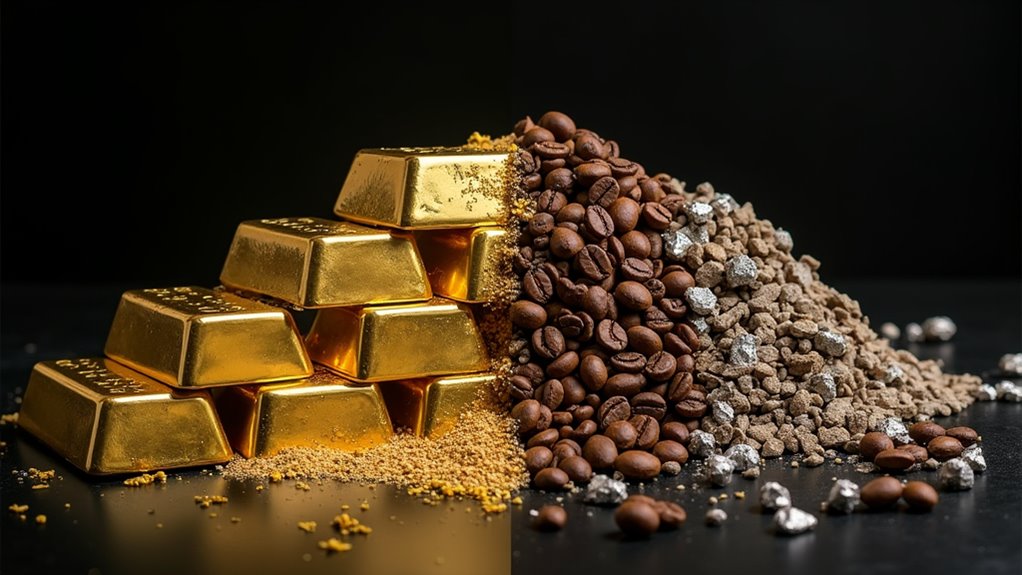
Agricultural commodities? They’re like that friend who’s way too affected by the weather. Sure, cocoa had its moment in 2024, doubling in price and making gold look almost boring, but that’s the exception rather than the rule. Coffee prices have been bouncing around like a caffeinated kangaroo due to harvest issues, while gold maintains its steady strut. Both benefit from economic upswings in emerging markets, but gold doesn’t care if it rains too much or too little.

The relationship between gold and other precious metals is kinda like a dysfunctional family – they’re definitely related, but each one’s got their own drama. Silver‘s been showing off with a 31.24% gain year-to-date as of November 2024, but gold’s still the popular kid at school when it comes to global recognition. Unlike its industrial-heavy cousins silver and platinum, gold doesn’t need to worry too much about factory demand to maintain its street cred.
What really sets gold apart is its unique ability to flip the bird at conventional market wisdom. While most commodities cozy up to the US dollar, gold gives it the cold shoulder, actually performing better when the greenback takes a dive. Central banks can’t get enough of it during uncertain times, and it’s got this weird superpower of performing well even when inflation’s playing dead.
For investment portfolios, gold’s like that reliable friend who shows up when everyone else is too busy. Adding just 5-10% of the stuff has historically juiced up risk-adjusted returns over the past decade. With daily trading volume hitting Rs 10.3 trillion in 2019, and a supply that’s steadier than a surgeon’s hand, gold’s proven itself to be more than just a pretty face in the commodity crowd. It’s the rebel that plays by its own rules, influenced more by vibes and geopolitical drama than boring old economic growth.
Frequently Asked Questions
Why Do Some Investors Prefer Silver Over Gold During Economic Uncertainty?
During economic turmoil, silver’s dual identity as both precious metal and industrial commodity makes it particularly appealing.

Investors eye its historically higher volatility – yeah, it’s risky, but that means potential for bigger returns. At roughly 1/80th gold’s price, silver’s lower entry point lets investors grab more metal for their money.
Plus, silver’s proven track record of outperforming gold during past crisis (like that wild 400% surge post-2008) keeps drawing the bold ones in.
How Does Platinum’s Industrial Usage Affect Its Price Compared to Gold?
Platinum’s heavy industrial dependency makes it dance to a different beat than gold.
While gold shrugs off economic hiccups, platinum’s price gets whiplashed by factory slowdowns and car sales.

Just look at 2022’s 11% industrial demand nosedive – ouch!
Once the precious metals’ price king, platinum’s now trailing gold by nearly half.
Those automotive catalytic converters (38% of demand) keep platinum chained to manufacturing’s boom-bust cycles like a needy ex.
What Role Does Seasonal Demand Play in Gold Versus Agricultural Commodities?
Seasonal demand creates distinctly different price patterns for gold versus ags.

Gold’s peaks align with cultural events – Indian weddings in November, Chinese New Year, and Western holiday jewelry buying.
Meanwhile, agricultural commodities dance to nature’s rhythm, with prices swinging wildly based on harvest cycles and weather patterns.
Gold’s 1% annual supply growth stays steady, while crop yields fluctuate dramatically season to season.
Cultural factors drive gold; Mother Nature rules the farm.
How Do Storage Costs Differ Between Gold and Other Precious Metals?
Gold’s storage costs pack a smaller punch than its precious metal cousins, typically running just 0.12% annually compared to silver’s heftier 0.30%.

The yellow metal’s high value-to-weight ratio is the hero here – you can stash $100k worth for a mere $120 yearly.
Meanwhile, the same value in silver demands $300, and platinum? It’ll set you back $600 annually.
Storage providers gotta deal with more bulk for silver and platinum, hence the premium.
Can Gold Futures Contracts Be More Volatile Than Other Commodity Futures?
Gold futures actually show lower volatility than many other commodity futures – surprise!

While crude oil can swing wildly on geopolitical drama and agricultural futures dance to weather’s unpredictable tune, gold tends to keep its cool.
With a 15.44% annualized volatility over 30 years, it’s practically zen compared to its rowdier commodity cousins.
Though, let’s be real – when interest rates do their thing or global chaos hits, even gold can get a bit jumpy.