The global gold scene’s dominated by three absolute units – Newmont cranking out 5.5 million ounces, Barrick Gold pumping 4.05 million, and Agnico Eagle crushing it with 3.44 million in 2023. China’s still the mysterious kingpin of production, though they’re tight-lipped about exact numbers. While Freeport-McMoRan and Glencore flex their $58B and $55B market caps, Newmont’s recent $17B Newcrest grab shows these giants aren’t done growing. The industry’s next moves might surprise even seasoned metal-watchers.
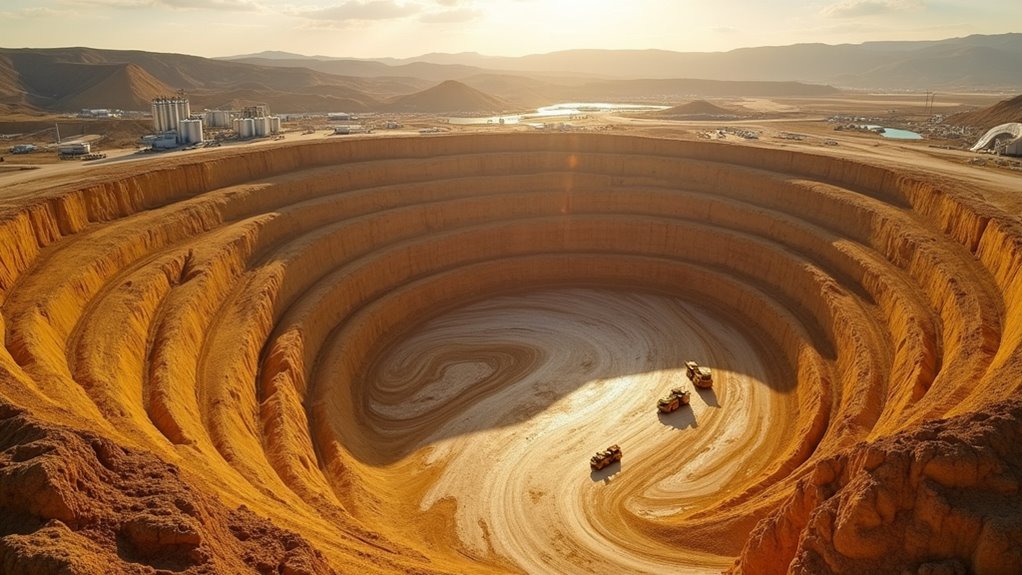
Gold’s heavy hitters are reshaping the industry landscape in 2024, and boy, do the numbers tell a spicy story. Newmont‘s crushing it with a whopping 5.5 million ounces produced in 2023, while Barrick Gold trails behind at 4.05 million ounces. Agnico Eagle‘s not exactly slacking either, pumping out 3.44 million ounces and showing a tasty 10% growth spurt that’s got everyone talking.
The geographic spread is where things get juicy. Australia’s flexing with two of the world’s top 10 mines, while China’s doing its thing as the global production leader (though let’s be real – they’re keeping their cards close to their chest). South Africa’s still in the game, but those sky-high production costs are giving executives migraines these days. Zijin Mining shows impressive 20% year-on-year growth in gold production, leading China’s listed mining companies. With gold prices reaching new heights, the gold-to-platinum ratio sits at a remarkable 3.14 to 1. This is further emphasized by the sustainability practices that companies are adopting to meet evolving regulations. Additionally, the top gold mining countries are continuously innovating to maintain their competitive edge, embracing greener operations to align with global sustainability trends. The political challenges faced by mining companies in various African nations can also impact investment strategies.
Market caps are dancing around like nobody’s business. Freeport-McMoRan‘s sitting pretty at $58 billion, with Glencore nipping at its heels at $55 billion. Newmont’s recent $17 billion Newcrest acquisition? That’s the kind of power move that makes lesser players nervously adjust their ties. Meanwhile, Barrick’s playing it cool, focusing on organic growth instead of throwing cash at acquisitions like it’s going out of style.
Big players are flexing their financial muscles, with Freeport-McMoRan and Glencore leading the pack in market capitalization dominance.

These giants aren’t just one-trick ponies, either. Newmont’s got its fingers in four continental pies, while Barrick’s spread across 13 countries like butter on toast. AngloGold Ashanti’s running nine operations in seven countries, proving that diversification isn’t just a fancy buzzword – it’s survival strategy 101.
But let’s not sugar-coat it – the industry’s got more challenges than a chocolate factory has calories. Environmental pressures are breathing down everyone’s neck, gold prices are doing their usual rollercoaster impression, and finding new deposits is about as easy as teaching a cat to swim. Plus, geopolitical risks are making executives reach for their antacids more often than their coffee.
The future’s looking… interesting (that’s corporate-speak for “wild ride ahead”). Companies are throwing money at exploration like confetti – just look at Navoi dropping $100 million for 2024 exploration budgets. Everyone’s suddenly super into this whole decarbonization thing, and technology’s finally making mining less of a headache.
The smart money’s betting on politically stable jurisdictions, because who needs extra drama when you’re already dealing with fluctuating commodity prices?

The consolidation game’s heating up faster than a prospector’s pan in the Yukon, and efficiency’s becoming everyone’s favorite word. Whether these giants can keep their crowns depends on how well they dance with new tech, handle green pressures, and navigate the increasingly complex global stage.
But one thing’s certain – in this glittering circus, the show must go on.
Frequently Asked Questions
How Long Does It Take to Establish a New Gold Mining Operation?
From first glance to golden pour, new gold mines don’t happen overnight!
The typical journey takes a whoping 15.7 years – but buckle up, because some operations drag on for 32 years.

Recent trends show even longer delays, averaging 17.9 years for mines launched since 2020.
Here’s the kicker: only 1 in 3,000 discoveries actually make it to production.
Exploration, feasability studies, permiting, and construction all demand their pound of flesh.
What Environmental Regulations Affect Gold Mining Companies Across Different Continents?
Environmental regulations hit gold miners with different intensity across continents.
North America’s strict Clean Water Act and CERCLA make compliance expensive, while South America’s focus on rainforest protection adds complexity.

Europe’s tight EU directives on mining waste and water protection set high standards.
Africa’s regulations vary wildly – South Africa maintains rigorous oversight, while other nations struggle with enforcement.
It’s a regulatory maze that’s keeping mining execs up at night!
How Do Geopolitical Tensions Impact Major Gold Mining Companies’ Operations?
Geopolitical tensions hit gold mining companies like a sledgehammer, disrupting operations on multiple fronts.
Supply chains crumble when conflicts erupt, while sanctions can freeze access to vital reserves. Companies scramble to relocate from unstable regions, facing skyrocketing insurance costs and worker retention nightmares.

Smart operators diversify across countries and pump cash into remote tech solutions.
Meanwhile, market volatility sends stock prices on a wild ride, though gold’s safe-haven status often cushions the blow.
What Technologies Are Emerging to Make Gold Mining More Sustainable?
Gold mining’s going green with some seriously cool tech. The CLEVR process is kicking cyanide to the curb, while bioleaching lets tiny microbes do the heavy lifting.
Smart mines are embracing AI and IoT for precise extraction, while driverless trucks keep workers outta harm’s way.

Solar and wind power’s making waves too – B2Gold’s Namibia operation’s running on 40% sunshine!
Even plants are getting in on the action with phytomining. Who knew sustainability could be so metal?
How Do Gold Mining Companies Handle Local Community Relations and Social Responsibilities?
Gold mining companies are stepping up their community game – big time.
They’re pumping billions into local economies through wages ($8.7bn in 2020!) and taxes, while keeping it local with 95% native workforce.
These mining giants aren’t just digging holes; they’re building schools, clinics, and infrastructure.
They’ve got formal grievance systems in place and special programs for Indigenous peoples.
Plus, they’re teaching financial literacy and entrepreneurship – pretty slick way to build sustainable relationships, tbh.