The gold mining industry’s future gleams with eco-innovation. Major players like B2Gold and Gold Fields are already powering operations with up to 40% renewable energy, while AI and driverless vehicles boost efficiency. Smart water recycling and waste transformation into construction materials showcase mining’s green evolution. Old mines transform into agricultural projects and renewable energy sites. Mining’s sustainable revolution isn’t just a dream – it’s happening now, and there’s way more to this story than meets the eye.
While the gold mining industry has long been criticized for its environmental toll, a radical transformation is sweeping through the sector as companies scramble to prove they’re not just digging up shiny metals – they’re actually giving a damn about Mother Earth.
The future of sustainable gold mining is taking shape through groundbreaking initiatives that would’ve seemed like sci-fi fantasies just a decade ago.
Leading the charge is the integration of renewable energy, and boy, is it making waves! B2Gold’s Otjikoto Mine is crushing it with solar power handling up to 40% of their energy needs, while Gold Fields’ Agnew Mine is rocking a hybrid system that combines wind, solar, and batteries. Mining companies are actively supporting local businesses by partnering with regional renewable energy providers. Dedicated sustainability managers are leading these innovative energy initiatives across mining operations, which are increasingly relying on renewable energy sources to meet their energy demands. Recent studies have shown that sustainable practices can significantly enhance the efficiency of energy use in mining operations. Additionally, renewable energy adoption is helping to decrease reliance on fossil fuels, further contributing to a greener industry. This push for renewable energy not only diminishes the carbon footprint but also aligns with the principles of a circular economy, promoting the recycling of resources.

It’s not just about looking green – these moves are slashing carbon footprints faster than you can say “climate change.”
The industry’s getting smart about water too, because let’s face it, you can’t mine gold without getting wet. Companies are implementing sophisticated recycling systems and filtration tech that’s so advanced it makes your Brita filter look like stone-age technology. Some operations are even creating artificial wetlands that purify contaminated water – nature’s kidneys, if you will.
But here’s where it gets really interesting: mining waste isn’t waste anymore. Companies are pulling off some seriously clever moves, turning what used to be “garbage” into construction materials.
Tailings management has gone high-tech with dry stacking techniques, and steelmaking slag is finding new life in road construction. Talk about turning trash into treasure!

The digital revolution isn’t just for Silicon Valley anymore. Mining operations are embracing AI and IoT like teenagers with new smartphones.
Driverless vehicles are cruising around mine sites, while smart programs crunch data faster than a rookie trader during a gold rush. These tech solutions aren’t just cool – they’re making operations more efficient and safer for workers.
Supply chain transparency is getting a blockchain makeover, making it easier to track gold from mine to market.
It’s not perfect (what is?), but it’s a huge step forward in ensuring responsible sourcing practices.

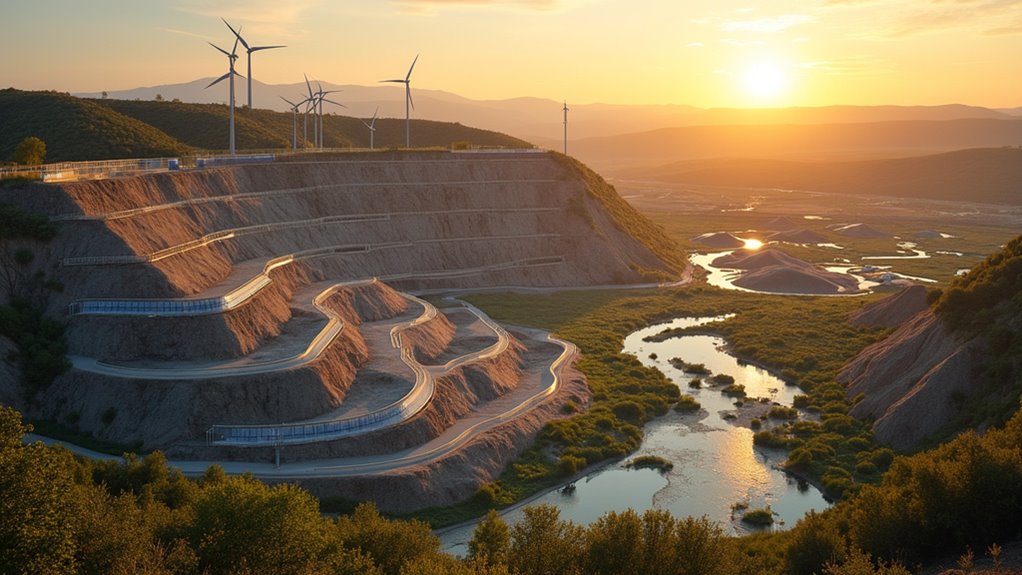
And speaking of responsibility, land rehabilitation is finally getting the attention it deserves. Old mines are being transformed into agricultural projects or renewable energy sites, proving that there is life after mining.
The future of sustainable gold mining isn’t just about reducing environmental impact – it’s about reimagining the entire industry.
With companies investing in these initiatives like there’s no tomorrow, we’re seeing a shift that’s as good as gold.
Sure, there’s still work to be done, but the industry’s finally showing it can shine without leaving a trail of environmental destruction in its wake.

And that’s something worth its weight in, well, you know what.
Frequently Asked Questions
How Does Climate Change Impact Modern Gold Mining Operations?
Climate change hits gold mining with a triple-whammy of water woes, extreme weather chaos, and infrastructure nightmares.
Mines in water-stressed regions face shutdowns – just ask Brazil’s RDM mine! Intense storms threaten tailings dams, while scorching temps jack up cooling costs underground.
Supply chains buckle under disrupted transport routes, and energy rationing’s becoming a real headache.

Plus, local communities ain’t happy sharing dwindling water resources with thirsty mining operations.
What Role Does Artificial Intelligence Play in Sustainable Gold Mining Practices?
AI’s revolutionizing gold mining faster than you can say “sustainable profits.”
These smart systems are crushing it – analyzing geological data to pinpoint deposits before anyone breaks ground, slashing exploration costs by up to 50%.
AI-powered autonomous trucks and drills are working 24/7, while predictive maintenance keeps equipment humming.

Environmental monitoring? Yeah, AI’s got that covered too, tracking everything from water quality to carbon emissions in real-time.
Mining’s getting smarter, cleaner, and definitly more efficient.
Can Gold Mining Ever Become Completely Environmentally Neutral?
Complete environmental neutrality in gold mining remains a pipe dream – like trying to make chocolate cake without calories.
While emerging tech and stricter practices are shrinking the footprint (hello, waterless mining!), the harsh reality is that extracting anything from Earth leaves a mark.
The industry’s pushing hard with zero-waste initiatives and renewable energy, but let’s face it – the best we can aim for is “significantly less destructive” rather than truly neutral.
How Do Local Communities Benefit From Sustainable Gold Mining Initiatives?
Sustainable gold mining packs a serious punch for local communities.
Beyond the obvious job creation, these initiatives pump cash into infrastructure, healthcare, and education.
Mining companies are throwing serious money at vocational training programs and scholarships, while environmental projects create alternative income streams.
It’s not just about digging up gold anymore – communities snag benefits from water management projects, reforestation efforts, and improved sanitation.
The ripple effect is real, folks!
What New Technologies Are Being Developed to Minimize Mercury Usage?
Several breakthrough technologies are pushing mercury out of gold mining operations. The CLEVR Process is leading the charge, using non-toxic chemicals that crush mercury’s traditional role.
Bio-mining’s crafty microorganisms are nature’s own gold-grabbers, while in-situ leaching literally dissolves the need for mercury altogether.
Smart AI systems and IoT sensors are fine-tuning these processes, making them more efficient. These innovations aren’t just cleaner – they’re actually outperforming mercury-based methods.