From humble prospectors panning at California’s Sutter’s Mill to today’s mega-mines, gold’s got quite the story. Modern beasts like Nevada Gold Mines spew out 3.3 million ounces yearly, while Indonesia’s Grasberg mine churns through a mind-boggling 178,100 tons of ore daily.
Historic sites dot the landscape like ghost towns, memorialising the 1848 Gold Rush that sparked America’s westward explosion.
There’s more beneath the surface of these legendary mines than just precious metal.
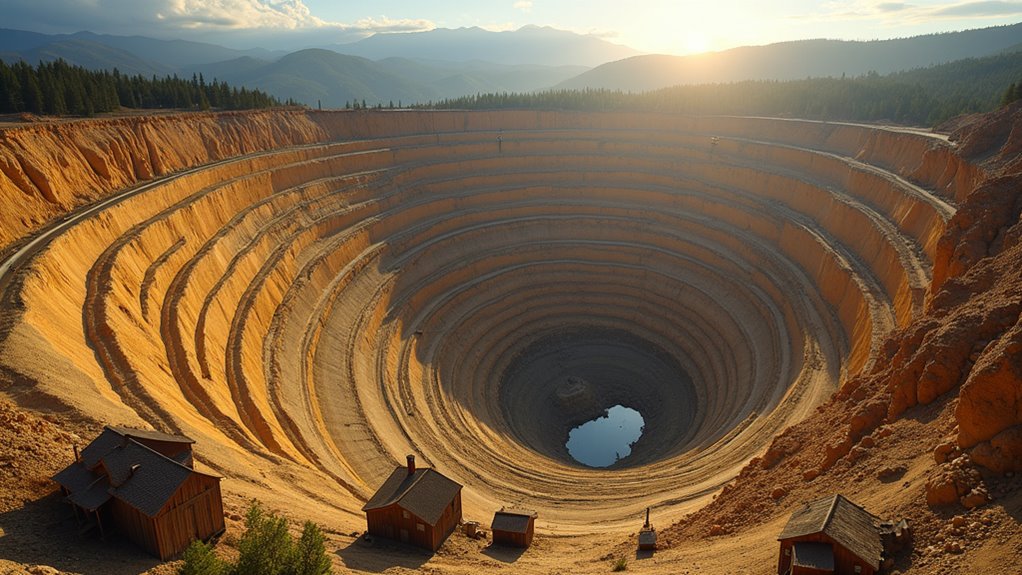
While most people think gold mining peaked during the California Gold Rush, today’s mega-mines would make those old-timers’ jaws drop faster than a mine shaft elevator.

The modern gold mining industry operates on a scale that would’ve been unfathomable to those 1848 prospectors panning for nuggets at Sutter’s Mill. Just look at Nevada Gold Mines, the world’s largest gold mining complex, which cranked out a whopping 3.3 million ounces in 2021 – that’s enough to make any ghost town resident spin in their grave.
But Nevada isn’t the only heavy hitter in the global gold game. Indonesia’s Grasberg mine sits perched like a golden eagle’s nest 4,100 metres above sea level near Puncak Jaya. It’s not just massive – it’s also pulled off the impressive feat of evolving into the world’s largest underground block-caving operation. The mine’s daily operations process an astounding 178,100 tons of ore to maintain its impressive production levels. Since its opening in 1972, the mine has produced an incredible 30 million ounces of gold. Talk about going deep or going home. In fact, Indonesia ranks among the top gold mining countries in the world, showcasing its crucial role in the global market.
Speaking of going deep, South Africa’s South Deep mine takes that literally. As the seventh deepest mine on Earth, reaching nearly 3,000 metres below the surface, it’s sitting on the largest gold reserves globally. That’s 32.8 million ounces of the shiny stuff just waiting to be extracted from the legendary Witwatersrand Basin. Crikey, that’s a lot of gold.
Over in Uzbekistan, the Muruntau mine is proving that sometimes bigger really is better. This monster open-pit operation accounts for more than 80% of the country’s gold production, churning out nearly 3 million ounces in 2021.

Meanwhile, Russia’s Olimpiada mine has been quietly doing its thing since 1996, processing a casual 13 million tonnes of ore annually like it’s no big deal.
The Dominican Republic might seem like an unlikely player in this high-stakes game, but the Pueblo Viejo mine is laughing all the way to the bank. This joint venture between mining giants Barrick and Newmont isn’t just making shareholders happy – it’s become an essential part of the Dominican economy.
Those California Gold Rush sites might not be producing much these days, but they’ve left an indelible mark on history. The rush transformed America’s west coast, spawned countless ghost towns, and created a legacy that’s preserved in places like the California State Mining and Mineral Museum.
But let’s be real – those historic sites are mere scratches compared to the moon-sized craters being dug by today’s mining operations.

Modern gold mining is a different beast entirely – it’s industrial-scale extraction that makes those old prospectors’ efforts look like kids playing in a sandbox. Yet there’s something oddly poetic about how we’re still chasing the same yellow metal that drove those fortune seekers to cross oceans and continents more than 170 years ago.
Frequently Asked Questions
How Much Gold Is Still Undiscovered in the Earth’s Crust?
only 0.0007% is concentrated enough to actually mine.
Most of it’s scattered in trace amounts that’d be bonkers to extract.
Sure, there’s probly heaps more undiscovered deposits, but good luck getting to them.
They’re either too deep or in seriously dodgy locations.
What Safety Equipment Do Modern Gold Miners Use Underground?
Modern gold miners don’t mess around with safety – they’re kitted out like space warriors.
The basics: helmets with built-in lights, steel-capped boots, and reflective gear that makes em’ look like disco balls.
But here’s the serious stuff: self-contained breathing gear, gas detectors, and high-tech communication systems.
Plus, there’s those fancy rescue chambers stocked with oxygen and supplies – cause when you’re digging for gold, you better be ready for anything.
Can Tourists Pan for Gold at These Historic Mining Sites?
Yep, most of these tourist traps let visitors try their luck at striking it rich.
Places like Marshall Gold Discovery Park and Columbia Historic Park in California are total crowd-pleasers – they’ll rent ya the gear and everything.
The international spots are more hit-or-miss though. Some mines like Central Deborah in Straya focus more on underground tours than getting ya hands dirty.

Pro tip: don’t expect to get wealthy, its mostly just for fun.
Which Historical Gold Rush Created the Most Millionaires?
The California Gold Rush hands-down created the most millionaires – like, it’s not even close. By 1852, San Francisco alone had 23+ millionaires strutting around in fancy suits.
Blokes like Samuel Brannan and Levi Strauss weren’t even diggin’ for gold – they got rich selling stuff to the miners!
While other rushes made some wealthy folks, none came close to matching California’s epic wealth-generating machine.
Talk about striking it rich.
What Modern Technologies Are Used to Detect Gold Deposits Today?
Modern gold hunters don’t mess around with pans anymore – they’re packing serious tech.
Remote sensing satellites scan for mineral signatures from space, while AI crunches massive geological datasets.
Drones zip through remote areas collecting samples, and fancy ground-penetrating radar sees what’s hiding below.
Even nanotech’s getting in on the action, targeting those elusive gold particles.
On-site analysis rigs can spot gold in core samples within 20 mins.
Technology’s changing the game.