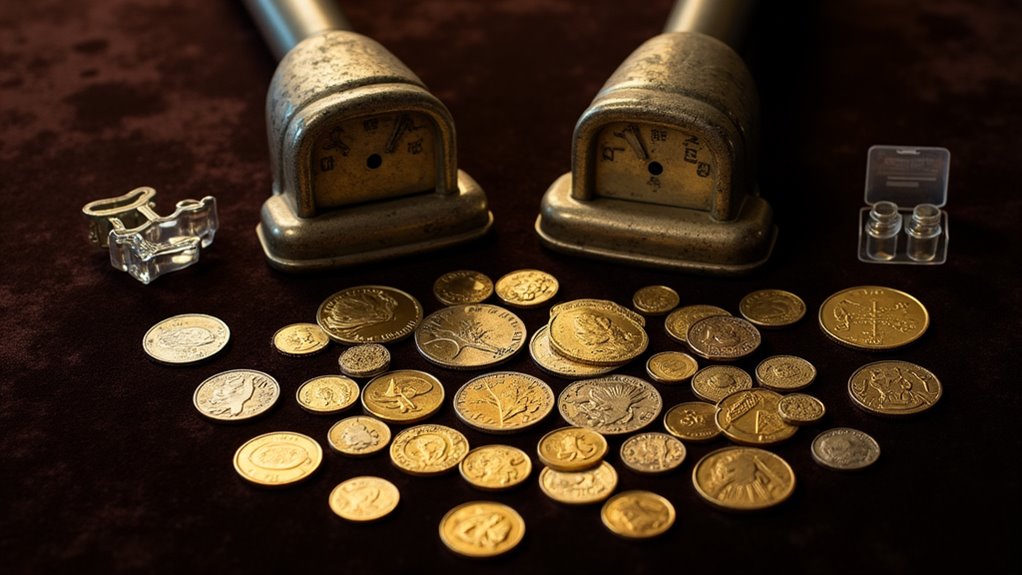
Gold’s price history reads like a wild rollercoaster ride. After ditching the gold standard in ’71 at a measly $35 per ounce, it shot up to $850 by 1980 – roughly $2,250 in today’s cash. But that’s nothing compared to March 2025’s mind-blowing surge past $3,000, crushing all previous records.
Central banks went on a buying spree, snatching up 1,136 metric tons in 2022 alone. The real story behind this historic peak goes deeper than just numbers.
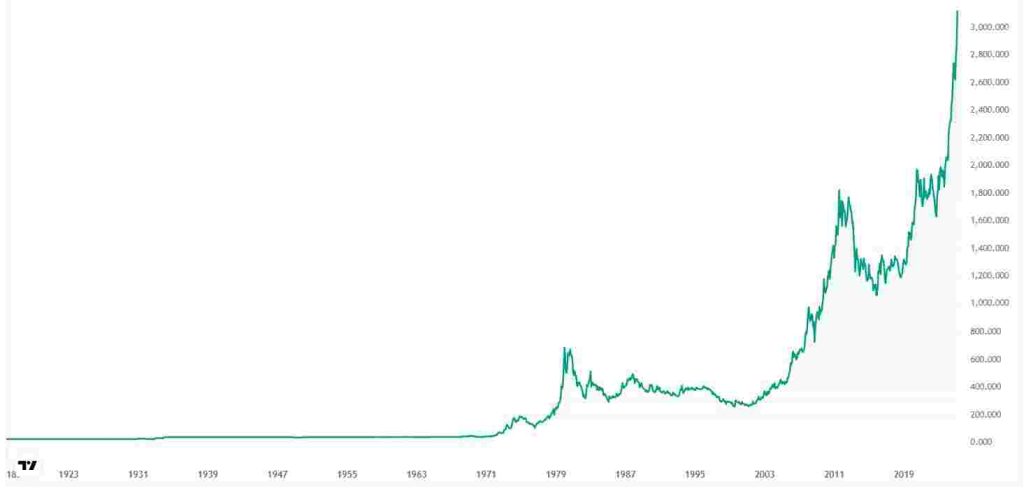
Money talks, but gold screams. And in March 2025, it screamed louder than ever before, shattering records when it soared past $3,000 per ounce. This wasn’t just another day at the office for the yellow metal – it was a mic drop moment that left traditional investors clutching their pearls and crypto bros sweating through their hoodies.
Gold didn’t just make history – it rewrote the rulebook, leaving Wall Street’s old guard shaking and crypto kings questioning their choices.
Let’s rewind the tape a bit. Back in 1971, when Nixon kicked the gold standard to the curb, an ounce of gold was worth a measly $35. Yeah, you read that right. You could’ve bought an ounce of gold for what now barely covers dinner for two at Applebee’s.

The 70s saw gold go absolutely bonkers, rocketing to $850 by 1980 – equivalent to about $2,250 in today’s money if you’re counting. Between 1980 and 2000, gold took a two-decade nap, slumping to $280. But then something interesting happened. The precious metal woke up and chose violence, steadily climbing until it hit $1,922 in 2011.
The follow-up act?
A decade of teasing between $1,000 and $2,000, like a financial strip tease that never quite delivered the goods. Every time the world got scared, gold got busy. During the 2008 financial crisis, it jumped from $730 to $1,300 faster than you could say “subprime mortgage crisis.” The latest surge to Trump’s proposed tariffs sent investors scrambling for safe-haven assets in early 2025. Central banks worldwide fueled this historic rise by purchasing an unprecedented 1,136 metric tons of gold in 2022, a move that highlights gold’s role as a hedge against inflation.
The COVID-19 pandemic? Gold broke $2,000 while everyone was busy hoarding toilet paper. And don’t even get me started on what happened during those oil shocks in the 70s.

Here’s the thing nobody wants to admit: gold isn’t just some shiny trinket for boomers to stash under their mattresses. It’s the ultimate middle finger to economic uncertainty. When stocks are having a meltdown, gold is usually doing victory laps. When inflation starts eating your dollars for breakfast, gold sits there looking smug. It’s like that friend who always seems to thrive during chaos.
Technology has changed the game too. These days, you can buy gold faster than you can order a pizza, thanks to online trading platforms. Algorithms are trading the stuff at light speed, and blockchain tech is trying to turn it into ones and zeros.
But at its core, gold’s still the same old rebel – defying governments, laughing at inflation, and making skeptics eat their words. Looking ahead, some analysts are throwing around numbers like $5,000 per ounce. The real crazy ones? Their talking $10,000 or even $40,000.
Sure, these predictions might sound like they came after a few too many drinks at the financial forecast party, but with the way things are going, whose brave enough to say they’re wrong?
Frequently Asked Questions
Why Do Central Banks Continue to Stockpile Gold Despite Price Fluctuations?
Central banks keep hoarding gold for one simple reason: stability in an unstable world.
It’s their ultimate insurance policy against economic chaos, currency meltdowns, and geopolitical drama. When everything else goes sideways, gold stands firm.

Those 35,000 metric tons ain’t just for show – it’s protection against U.S. sanctions, market crashes, and whatever mess tomorrow brings.
Plus, gold’s negative correlation with bonds/stocks makes it the perfect portfolio stabilizer.
How Do Geopolitical Tensions Directly Impact Daily Gold Trading Prices?
Geopolitical tensions send gold prices on a wild rollercoaster ride daily.
When conflicts erupt, like the Israel-Gaza situation that pushed gold to $3,057.21, traders frantically bid up prices.

It’s simple – chaos equals cash grabs.
Regional instability, especially in oil-rich areas, triggers instant price spikes of 1-3% in a single day.
Smart money knows the drill: tensions rise, currencies wobble, and gold shoots up like a rocket.
What Role Does Cryptocurrency Adoption Play in Modern Gold Prices?
Crypto’s rise has definitely shaken up gold’s status as the go-to safe haven.
While Bitcoin’s wild price swings have scared some traditional investors straight back to gold (hello, 11% jump in 2025!), younger traders are all about that digital life.
Both assets are actually playing nice together.
Tokenized gold hit $1.8B as investors wanted both worlds.
Think of crypto as gold’s edgy cousin who crashes family reunions but somehow makes things interesting.
How Do Seasonal Jewelry Demands Affect Gold Prices in Different Regions?
Seasonal jewelry demands hit gold prices differently across regions.
India’s Diwali and wedding seasons jack up prices in Q4, while Chinese New Year sparks buying frenzies in Dec-Jan.
Western markets? They’re all about Christmas bling and Valentine’s rings.
Meanwhile, Middle East’s getting squeezed – high prices crushed 2024 demand everywhere except Turkey.
Funny how cultural events create these predictable price swings, yet traders still act surprised every year.
Can Gold Mining Production Rates Significantly Influence Short-Term Market Prices?
Mining production barely moves the needle on short-term gold prices.
Here’s the cold truth: supply changes are painfully slow, with output growing a measly 9% over the past decade.
Day-to-day price swings? That’s all about demand, baby. When central banks go shopping or ETFs start hoarding, prices jump instantly.
Sure, mining costs set a price floor ($1,212/oz in early 2024), but it’s those quick-fire demand shifts that really call the shots.