China’s gold stash hit a jaw-dropping 2,290 tonnes in February 2025 – that’s a monster leap from their measly 395 tonnes back in 2000! They’re now the world’s sixth-largest gold hoarder, with precious metal making up 5.9% of their total forex reserves. Monthly additions of 5 tonnes keep stacking up, while domestic mines pump out 332 tonnes annually. But here’s the kicker: experts whisper the real numbers could be triple what’s reported. The golden dragon’s appetite only grows fiercer.

China’s voracious appetite for gold shows no signs of slowing down, as the nation’s official reserves hit a staggering 2,290 tonnes in February 2025 – and lets be real, that’s probably just the tip of the gold-plated iceberg.
The numbers are eye-popping: a massive leap from 395 tonnes in 2000 to today’s hefty stockpile, representing 5.9% of China’s total forex reserves. That’s enough to make China the world’s sixth-largest gold hoarder, though some whisper the real number could be way higher (wink, wink). The Shanghai Gold Exchange serves as the mandatory trading platform for all gold imports into the country. The past few months have seen consistent 5-tonne additions – like clockwork, if clockwork was made of solid gold. The country’s domestic mines contributed 332 tonnes of gold to their growing reserves in 2022.
Looking back, a 2015 was game-changer when reserves mysteriously jumped from 1,054 tonnes to 1,658 tonnes in June. Talk about a golden surprise! The steady climb continued through 2019, hitting 2,010 tonnes, and hasn’t stopped since. In 2024 alone, they’ve already packed on 44 tonnes – that’s what we call a serious bulk-up phase.
China’s gold hoarding hit hyperdrive in 2015, skyrocketing from 1,054 to 1,658 tonnes – and they’re still piling on the precious metal today.

But here’s where it gets juicy: since 2023, China’s been actually telling us about their purchases (shocker!). Monthly announcements have become a thing, though let’s not kid ourselves – there’s still more mystery around China’s actual gold holdings than there are zeros in their forex reserves. Some “experts” (air quotes intended) reckon the real number could be double or triple the official figure. The ongoing accumulation of gold demonstrates how enhancing portfolio diversification is becoming a priority for central banks.
The strategy behind this golden shopping spree? It’s all about playing the long game. China’s clearly trying to distance itself from the dollar‘s gravitational pull while giving the renminbi some serious street cred. And with gold hitting $208.643 billion in value by February 2025, who can blame them? The yellow metal’s been crushing it, outperforming major local assets and scoring a solid 10% gain in Q1 2024. This is a strategic move as central banks globally recognize gold’s core reserve asset status, which adds credibility to their financial systems. Additionally, gold has historically served as a currency support tool in times of economic uncertainty, further reinforcing its status as a hedge against inflation. The ongoing accumulation of gold by central banks worldwide reflects its enduring importance in supporting national currencies and stabilizing economies.
Looking ahead, China’s showing no signs of putting the brakes on their bullion binge. Monthly purchases are expected to continue like a well-oiled machine, though predicting exactly how much they’ll buy is about as easy as counting grains of sand in the Gobi Desert.
What we do know is that gold’s becoming increasingly central to China’s financial diplomacy playbook – and that’s probably keeping a few Treasury officials up at night.

The real kicker? While other central banks hem and haw about diversification, China’s been quietly amassing a fortune in physical gold that would make King Midas blush. Whether this is preparation for some future gold standard or just smart portfolio management, one thing’s crystal clear: China’s gold game is strong, and they’re playing for keeps.
Frequently Asked Questions
How Does China’s Gold Trading Affect Global Commodity Markets?
China’s gold trading sends shockwaves through global commodity markets!
Their massive appetite (about 1/3 of world demand) makes prices go bonkers whenever they sneeze.
Those crazy-high Shanghai premiums – hitting $121.2/oz last September – ripple across continents.

When Beijing restricts imports, supply chains get wonky real fast.
Plus, their stockpiling strategy‘s got everyone nervous about critical metals too.
Talk about a golden butterfly effect!
What Security Measures Protect China’s Physical Gold Storage Facilities?
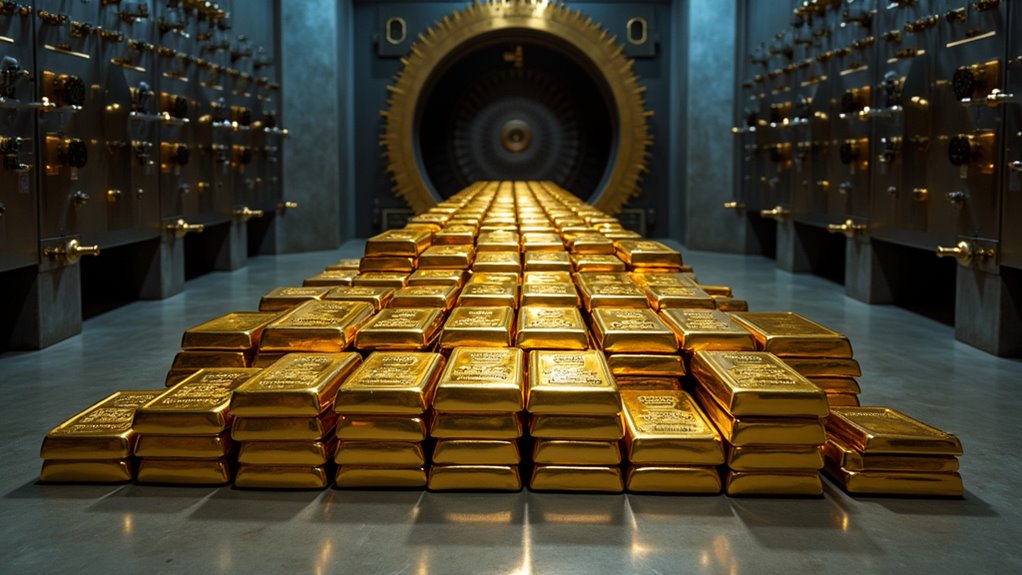
China maintains fortress-like security at its gold storage facilities, though specific details remain classified.
Multi-layered physical barriers, armed personnel, and cutting-edge surveillance systems form the backbone of protection.

The People’s Bank of China reportedly utilizes biometric access controls, reinforced vaults, and encrypted communications networks.
Storage locations are strategically dispersed and often integrated with military installations – classic “don’t keep all your eggs in one vault” strategy!
Who Are the Key Decision-Makers in China’s Gold Reserve Management?
China’s gold reserve decisions flow through a tight web of power players.
PBoC Governor Yi Gang pulls the main strings, while SAFE Director Pan Gongsheng handles the nuts-and-bolts of reserve management.

But let’s be real – President Xi’s economic vision calls the big shots!
The Politburo Standing Committee and Vice Premier Liu He weigh in too, creating a complex decision matrix that’s about as transparent as a brick wall. 🏦💰
How Does China Verify the Authenticity of Its Gold Holdings?
China employs a multi-layered verification system for its gold holdings.
Physical tests include X-ray fluorescence, drill sampling, and ultrasound scanning to detect fake bars or tungsten cores.
The country’s also gone high-tech, implementing blockchain tracking and RFID tagging for inventory management.
Third-party audits by international firms and China’s National Audit Office provide additional oversight, though some results remain behind closed doors (classic China move!).
What Role Do Private Chinese Banks Play in National Gold Reserves?
Private Chinese banks maintain a curious arms-length relationship with national gold reserves.
While they don’t directly feed into official reserves, these institutions serve as critical market makers on the Shanghai Gold Exchange, facilitating physical gold trades and storage.
They’re basically PBoC’s unofficial wingmen – reporting holdings, executing market ops when asked, but keeping their own gold business separate from state reserves.
Talk about playing hard to get!