Germany’s massive gold stash clocks in at 3,351.53 tonnes, making it the second-largest gold hoard globally after the USA. Currently valued at a whopping 307.853 billion USD, these reserves are strategically scattered across four locations – New York’s Federal Reserve, Frankfurt, London’s Bank of England, and Paris’s Banque de France. The 2013 repatriation plan brought more gold back to German soil, though some questons about transparency still linger beneath the surface.

Germany’s Gold Reserves
The glitter of Germany’s gold stash is enough to make any bullion buff weak in the knees. The European powerhouse currently holds a whopping 3,351.53 tonnes of gold, making it the second-largest hoarder of the yellow metal globally, trailing only behind Uncle Sam’s coffers. As of February 2025, this pile of precious metal is worth an eye-watering 307.853 billion USD – up from January’s 302.407 billion, proving that sometimes just sitting on your gold can make you richer. The nation’s impressive reserves contribute to its total reserves holdings of 322.7 billion USD reported in 2023.
Germany didn’t just stumble into this golden fortune overnight. The bulk of these reserves were accumulated during the gold standard era between 1952 and 1968, when the country’s stash peaked at a staggering 129.69 million ounces. After some fluctuations, the reserves settled around 109 million ounces by 2014, where they’ve pretty much stayed put, except for the occasional nibble taken out for minting commemorative coins. This represents a significant decrease from the all-time high of 3,468.60 tonnes recorded in Q2 2000. Furthermore, these reserves have significant implications for global gold reserves, influencing market stability and geopolitical dynamics. Central banks globally view gold as a core reserve asset that can provide a hedge against economic uncertainty, making effective gold reserve management essential for financial security. This is because gold serves as a monetary stability anchor, helping economies navigate through turbulent times.
Germany’s massive gold reserves weren’t an accident – they grew steadily during the gold standard years before settling at today’s impressive levels.

But here’s where it gets juicy – Germany’s gold isn’t all tucked away in a single vault. It’s scattered across four locations like a treasure hunter’s wildest dream. The largest chunk, 1,447 tonnes, crashes at the Federal Reserve Bank in New York, while 1,192 tonnes chills in Frankfurt. The rest is split between London’s Bank of England (438 tonnes) and Paris’s Banque de France (307 tonnes). This geographic spread wasn’t random – it emerged from historical circumstances and market-related practicalities. Additionally, holding gold as a core reserve asset is critical for central banks to maintain financial stability.
In 2013, the Bundesbank dropped a bombshell announcement that sent gold bugs into a frenzy – they wanted their precious metal back home. The plan was to transfer 50 tons annually from New York for three years, checking every bar’s weight and quality along the way. Spoiler alert: they finished ahead of schedule in 2016, though some skeptics still raise eyebrows about the whole operation.
Speaking of raised eyebrows, the transparency situation is… interesting. Federal auditors haven’t been shy about criticizing the lack of physical inspections. The Bundesbank’s been playing it cool, relying on written confirmations from storage sites, while German parliament members who’ve tried to peek at the gold have been shown the door. It’s enough to make conspiracy theorists’ heads explode!
Despite these quirks, Germany’s gold reserves serve as a serious economic heavyweight. They’re not just pretty numbers on a spreadsheet – they act as a buffer against financial disasters, boost Germany’s clout in the EU, and help keep the Euro steady.

While there haven’t been any major changes to the reserves since 2014, the debate about ideal storage strategy continues to simmer. One thing’s for sure – this massive golden safety net isn’t going anywhere anytime soon, even if some folks would prefer to see more of it glittering on home soil.
Frequently Asked Questions
How Does Germany Transport Its Gold Reserves Between Storage Locations?
Germany moves its gold using a multi-layered security approach that’s practically Fort Knox on wheels!
High-security containers, armed escorts, and split shipments keep those precious bars safe. They favor air transport (hello, Lufthansa cargo!) over land routes, though armored vehicles still get some action.
The whole operation’s wrapped in secrecy, with transfers happening in stages.

Every bar gets the white-glove treatment – weighed, checked for purity, and verified by Bundesbank’s eagle-eyed experts.
What Security Measures Protect Germany’s Gold Stored in Foreign Countries?
Germany’s gold stored abroad enjoys fortress-level protection through multi-layered security systems.
Partner central banks deploy seismic sensors, advanced surveillance, and biometric access controls. Regular audits verify authenticity using ultrasound tech, while blockchain tracks every bar’s movement.
The storage facilities feature underground vaults with restricted access zones. International agreements guarantee shared responsibility, with partner banks conducting joint security exercises and maintaining strict protocols.
Can German Citizens Buy Portions of the National Gold Reserves?

No, German citizens cannot directly purchase portions of Germany’s national gold reserves.
Despite Germany’s massive 3,355-ton gold stockpile, there’s no mechanism for public access to these official reserves.
Interesting twist though – Germans aren’t exactly gold-starved!
They’ve got a whopping 8,918 tons in private holdings, worth about 330 billion euros.

That’s roughly 129 grams per person, way more than their 40-gram “share” of national reserves.
How Often Does Germany Audit Its Gold Reserves?
The Bundesbank conducts rigorous annual audits of Germany’s gold reserves – no slacking when it comes to those precious bars!
Physical inspections happen yearly, as mandated by German federal court. These checks aren’t just local – they cover gold stashed worldwide, including the chunks at NY’s Federal Reserve.
Every bar gets the full treatment: weight, fineness, the works. Plus, independent experts pop in periodically for extra verification. Talk about keeping tabs!
Why Doesn’t Germany Store All Its Gold Reserves Within Its Borders?
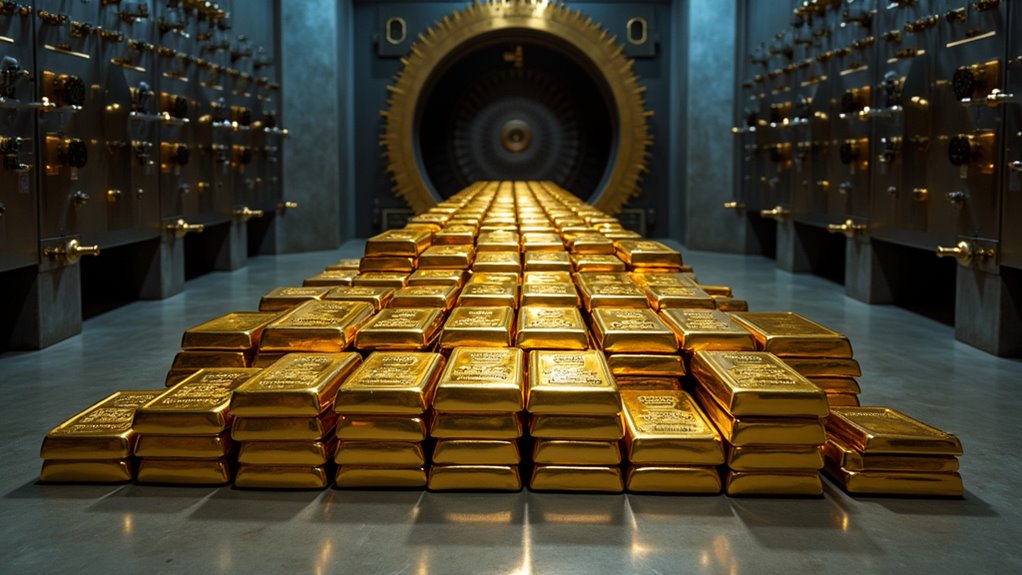
Germany maintains a strategic split of its gold reserves between domestic and international locations for practical and economic reasons.
Keeping gold at major trading hubs like New York and London reduces transaction costs and enables quick currency exchanges during crises.
The 50-37-13 split between Frankfurt, New York, and London reflects a careful balance between domestic security and international accessibility.
This arrangement preserves Germany’s ability to respond swiftly to global financial challenges.