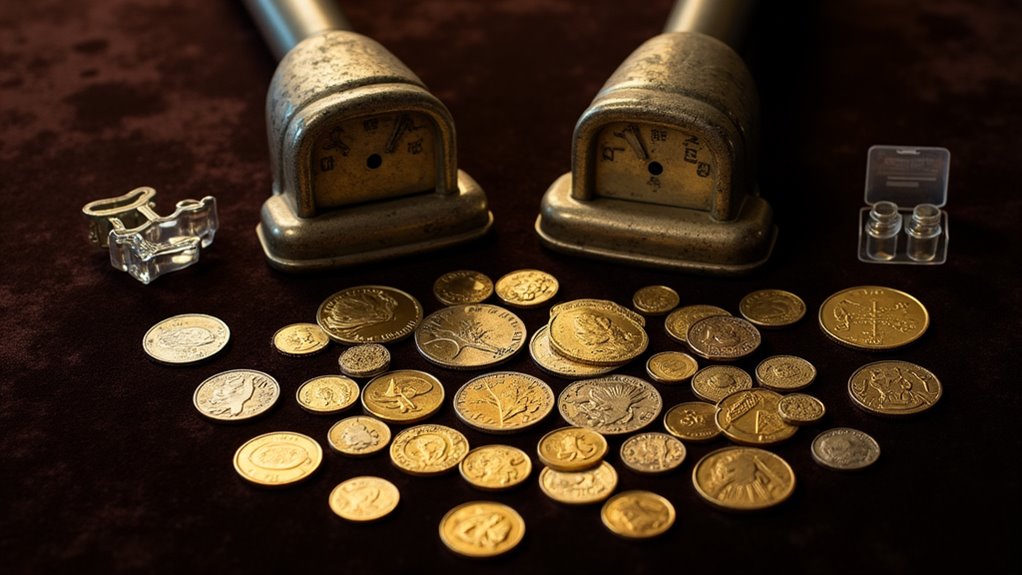
The UK gold market‘s blazing hot – smashing records at $2,792.70 per ounce in October 2024. Central banks can’t get enough, snatching up 108 tonnes in December alone, while Goldman Sachs teases a 9% price surge ahead. London’s still king of the gold game, trading a whopping 18 million ounces daily through those legendary vaults. Between Fed jitters and Brexit drama, gold’s safe-haven status keeps getting shinier. The real treasure lies in understanding what’s driving this golden frenzy.

While global markets twist themselves into knots, the UK gold scene is having its own little moment of mayhem – and it’s about bloody time we dissect it. The numbers don’t lie: a tasty 5% uptick in demand year-over-year, with jewelry hogging 60% of the action like it’s the last piece of cake at a birthday party.
And oh boy, those central banks? They’ve been shopping like teenagers with their parents’ credit cards, snatching up 108 tonnes in December 2024 alone. Goldman Sachs projects that sustained central bank demand could drive a remarkable 9% increase in prices. Recent market data shows record-breaking highs of $2,792.70 per ounce have already been achieved in October 2024, reflecting the gold price history in Canadian dollars trends that impact global markets. Central banks are strategically influencing gold prices through their monetary policies and reserve decisions, adding further complexity to the market dynamics.
Let’s get real about what’s driving this glittery circus. The Fed’s doing its usual dance across the pond, making everyone here nervous enough to bite their nails (or buy gold). Brexit’s still throwing economic curveballs, and the pound’s playing seesaw with the dollar like it’s nobody’s business.

Meanwhile, geopolitical tensions are making gold look sexier than a James Bond in a tuxedo. Innovations in sustainable gold mining practices are increasingly being recognized as crucial for the industry’s future, with leading companies adopting environmental standards to enhance their operations.
Here’s the kicker – the UK’s basically got zilch regarding domestic gold production. We’re like a tea shop without tea leaves, importing everything we need while Scotland and Wales desperately try to convince everyone they’re sitting on the next Eldorado.
Good luck with those environmental regs, mates. At least we’re getting creative with urban mining and recycling (because apparently, grandma’s old rings are now considered a strategic resource).
The investment scene’s evolving faster than a TikTok trend. ETFs are the new cool kids on the block, but physical gold‘s still got its die-hard fans clutching their bars like security blankets.

And would you look at that – gold-backed crypto’s trying to marry old money with new tech, while the government’s jumped on the bandwagon with sovereign gold bonds. Talk about keeping up with the times!
London’s still the big kahuna in the global gold game, with the LBMA calling the shots and setting standards that make Fort Knox look casual.
We’re talking 18 million ounces sloshing around daily in 2024, with enough gold in London vaults (7,500 tonnes) to make a dragon jealous. The twice-daily price fixing is basically the world’s most expensive game of “pick a number.”
The future’s looking interesting, to say the least. Ethical gold‘s becoming a thing (because apparently, people care where their bling comes from now), and blockchain‘s muscling its way into trading faster than you can say “distributed ledger.”

AI’s joining the party too, trying to predict gold prices like some kind of digital fortune teller. Whether any of this actually helps investors make better decisions is anyone’s guess – but hey, at least it keeps things entertaining.
Frequently Asked Questions
How Does Brexit Impact Gold Trading Regulations in the UK?
Brexit’s shakeup of UK gold trading is no joke!
The shift created a dual-regulation headache, with companies now juggling both UK REACH and EU REACH requirements.
Standard-rated gold got slapped with a Special Accounting Scheme, while investment gold over £5k needs extra paperwork – because bureaucracy loves paperwork!

Trade’s taken a hit too, with exports to EU down 14% and imports plunging 24%.
Talk about regulatory gymnastics – and we’re just getting started.
What Are the Tax Implications of Selling Gold Bullion in Britain?
The UK hits gold bullion profits with Capital Gains Tax at rates between 18-28%, depending on your tax bracket.
But here’s the kicker – Royal Mint coins like Britannias and Sovereigns? Totally CGT-exempt!

A sweet £3,000 tax-free allowance applies for 2024/25 on other bullion sales.
While investment-grade gold dodges VAT entirely (unlike it’s cousins silver and platinum at 20%), profits from non-UK coins and bars still face the CGT hammer.
Keep those receipts!
Which UK Cities Have the Highest Concentration of Gold Dealers?
London dominates the UK gold dealing scene, with the iconic Hatton Garden and West End hosting a dense network of prestigious dealers.

Birmingham claims second place, its historic Jewellery Quarter still pulsing with bullion activity.
Manchester’s emerging as a serious contender, while Edinburgh holds it down as Scotland’s gold hub.
The capital’s got the LBMA swagger, but Brum’s old-school charm gives it a run for it’s money – literally!
How Do UK Gold Prices Compare to International Markets?
UK gold prices typically run higher than international markets due to GBP/USD conversion rates.
While COMEX futures set the global benchmark in USD, British buyers face premium pricing thanks to currency dynamics.
The London market’s influence remains massive, yet Asian powerhouses like India and China increasingly drive worldwide demand.
Euro-denominated gold often trades cheaper than UK prices, making continental Europe’s market slightly more accessible for investors.
What Documentation Is Required to Open a Gold Trading Account in Britain?
Opening a gold trading account in Britain requires thorough identity verification.
Traders must submit their name, birth date, address, and phone details. Two forms of documentation are mandatory: one from List 1 (passport/driving license) and another from List 2 (utility/council tax bill).
All documents must be originals – no photocopys! For transactions over £5k, additional paperwork kicks in.
Customer records must be maintained and regularly updated per regulations.