Gold transcends mere monetary value in religious texts, serving as a powerful spiritual symbol across faiths. Ancient Egyptians saw it as divine favor, while Judaism incorporated it into sacred vessels and menorahs. Christianity links gold to Christ’s kingship, Hindu traditions connect it to cosmic abundance, and Islamic texts describe Paradise’s golden vessels. From the Ark of the Covenant to Buddhist statues, gold bridges earthly wealth and divine domains – and that’s just scratching the surface of its sacred significance.

Throughout the ancient pages of humanity’s most sacred texts, gold gleams as more than just a precious metal – it radiates as a powerful symbol of divinity, purity, and spiritual enlightenment. From Biblical narratives to Hindu scriptures, this lustrous element transcends its material worth, becoming a bridge between earthly existence and divine domains.
In Biblical texts, gold’s significance literally shines through the construction of sacred objects. The Ark of the Covenant, overlaid with pure gold, stood as a proof of divine presence, while the infamous golden calf story serves as a stark reminder about the perils of misplaced worship. King Solomon‘s legendary wealth, though impressive, carries subtle warnings about material excess – even when its God-given. The ethical sourcing of gold, particularly in sacred contexts, underlines the importance of conflict-free sourcing in maintaining spiritual integrity. In ancient Egypt, gold was often associated with the divine, reflecting the belief that it was a material favored by the gods and used in rituals and royal burials, further emphasizing its sacred significance.
Jewish tradition elevates gold beyond mere decorative purposes. The precious metal’s presence in the Tabernacle and Temple wasn’t just for show – it represented humanity’s highest aspirations toward divine connection. Golden menorahs illuminate both physical spaces and spiritual wisdom, while sacred vessels crafted from this noble metal continue to play vital roles in religious ceremonies.

Hindu teachings embrace gold as a powerful conduit between mortals and deities. It’s no coincidence that Hindu gods and goddesses sparkle with golden ornaments – it’s not just bling, but a reflection of divine beauty and cosmic abundance. The association with Lakshmi, goddess of prosperity, cements gold’s role as both material and spiritual wealth (though sometimes it’s hard to tell which is which!)
Christianity picked up the golden thread, weaving it into profound symbolism. The Magi weren’t just flexing when they brought gold to baby Jesus – they were acknowledging divine kingship. Early Christian churches went all-in, incorporating gold into everything from icons to altars.
And let’s not forget those streets of gold in Revelation – talk about divine urban planning!
Islamic teachings take a fascinatingly nuanced approach to gold. While the Quran describes Paradise with golden vessels and ornaments, earthly guidelines restrict men from wearing gold jewelry – a reminder that true wealth isn’t about what you wear. The gold-adorned Kaaba covering shows how the metal can serve spiritual purposes without becoming an object of worship itself.

Buddhism brings yet another perspective, using gold to represent enlightenment and mental clarity. Those gleaming Buddha statues aren’t about showing off – they’re visual metaphors for spiritual transcendence.
Buddhist temples, particularly the famous Golden Temple, demonstrate how gold can paradoxically represent both ultimate truth and impermanence in spiritual beliefs.
Through these varied religious perspectives, gold emerges as more than just a precious metal – it becomes a universal language of sacred expression. Whether warning against materialism or celebrating divine glory, gold continues to capture humanity’s spiritual imagination, proving itself as valuable to our souls as it is to our vaults.
Frequently Asked Questions
How Did Ancient Civilizations Determine the Purity of Religious Gold Artifacts?
Ancient civilizations employed two main methods to test religious gold: fire assay and touchstone testing.

The Egyptians pioneered fire assay around 1500 BCE, using bone ash crucibles and lead to separate pure gold.
The touchstone method involved scratching artifacts against special stones and comparing marks to known standards.
Both techniques were surprisingly accurate – the fire assay method is still considered the gold standard today.
What Preservation Methods Were Used for Gold Religious Texts?
Ancient civilizations developed sophisticated preservation methods for gold religious texts.

They applied protective varnishes and lacquers to prevent tarnishing, while utilizing careful binding techniques to minimize physical damage.
Storage in climate-controlled environments was essential for reducing humidity exposure.
When deterioration occurred, they used specialized adhesives to reinforce fragile areas.
Cleaning protocols avoided harsh chemicals, instead relying on gentle dry-cleaning methods to maintain the gold’s integrity.
Did Different Religions Assign Varying Spiritual Properties to Gold?
Different faiths absolutely had their own unique spiritual takes on gold!
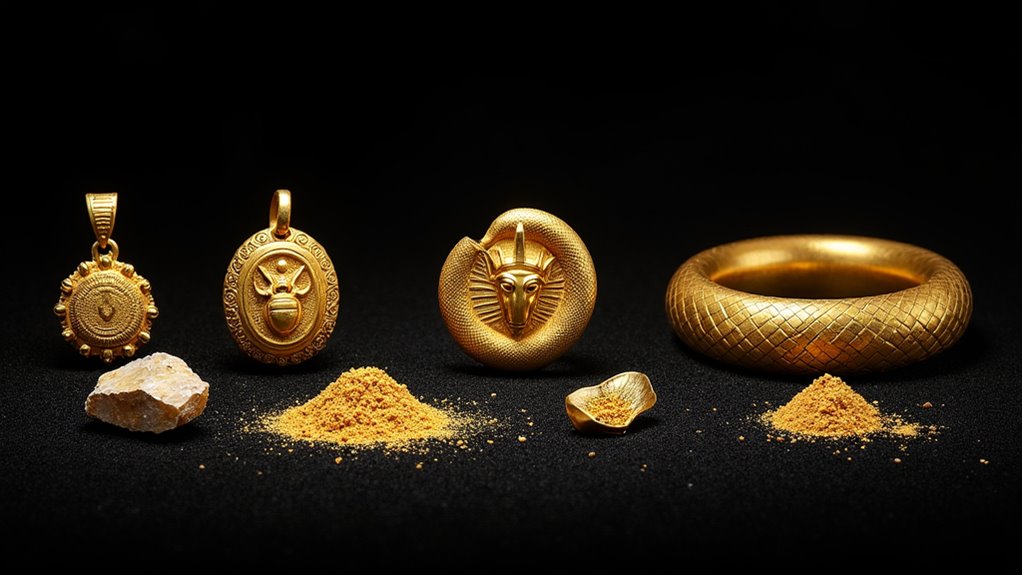
Egyptians saw it as literal god-flesh (wild, right?), while Buddhists used it to represent spiritual enlightenment and transcendence.
Hindu traditions linked gold to divine energy and cosmic power, and Christians connected it with heavenly glory and Christ’s kingship.
The Incas? They went full-solar, calling it “sun sweat” – how’s that for getting creative with your precious metals symbolism?!
Were There Specific Rituals for Mining Gold Used in Religious Ceremonies?
Ancient miners went all-in on ritual prep before extracting gold for sacred use.

Egyptian workers performed intense purification ceremonies, fasting and chanting before mining gold for Pharoahs’ tombs.
Incan miners made offerings to mountain spirits, while Ghana’s Tarkwa miners still practice libations and sacrifices today.
Some cultures even required spiritual “permits” – blessings from shamans or priests before touching ceremonial gold deposits.
Pretty intense stuff, right?
How Did Religious Institutions Verify Authenticity of Gold Donations From Worshippers?
Religious institutions employed multiple methods to authenticate gold donations.
They used magnetic scales to detect counterfeit metals, conducted density tests through water displacement, and utilized ultrasound testing to reveal hidden non-gold cores.
Advanced verification included fire assays and XRF analysis for high-value pieces.
Detailed receipts were maintained, and institutions often relied on recognized hallmarks and seals to guarantee donation legitimacy.
Some even brought in third-party experts for questionable items.