Gold fueled the Roman Empire‘s meteoric rise, serving as both a status symbol and economic cornerstone. The Romans revolutionzed gold mining through massive operations in conquered territories, while maintaining strict monetary policies that would make modern central bankers jealous. Their gold coins, particularly the aureus and solidus, dominated Mediterranean trade for centuries and kept their value unlike today’s paper currencies. The Romans’ golden legacy still echoes through modern financial markets and wealth preservation strategies.

While modern investors obsess over crypto and stocks, the Romans had their own golden fixation that puts today’s market mania to shame. The empire’s relationship with gold wasn’t just about flexing wealth – it was the backbone of one of history’s most sophisticated economic systems, anchored by two legendary coins: the Aureus, introduced by Julius Caesar in 46 BC, and its successor, the Solidus, which debuted in 312 AD.
Talk about a store of value! The Aureus commanded respect at 25 silver denarii, while the Solidus later exploded to 275,000 denarii. These weren’t just pretty pieces of metal – they were the ancient equivalent of high-powered financial instruments, greasing the wheels of an empire that stretched from Britain to Egypt. And unlike today’s endlessly printed fiat currencies, these bad boys maintained their value for centuries.
The Romans weren’t exactly sitting around waiting for gold to fall from the sky. They went after it with the same intensity as modern-day mining corporations, establishing massive operations in Hispania, Dacia, and Britain. But here’s where it gets interesting – they didn’t stop at mining. Military conquests brought in massive hauls, and subjected territories coughed up regular tributes. Even trade routes to India kept the yellow metal flowing into Roman coffers, highlighting the strategic importance of gold in their economy. This relentless pursuit of gold was akin to modern central banks’ monetary strategies, ensuring the empire’s wealth remained unparalleled.
The Romans hustled hard for their gold, combining epic mining operations with military might and strategic trade routes to keep the treasure flowing.

But the Romans weren’t just about stacking coins. They turned gold into everything from jaw-dropping jewelry to temple decorations that would make Fort Knox blush. The elite weren’t subtle about their gold game – they plastered it on ceilings, wrapped it around their necks, and even took it to their graves in the form of elaborate burial masks and ornaments. Talk about dying rich!
The discovery of massive hoards like the Bray Shallow Horde, with its mind-boggling 80,000 gold coins, proves just how much wealth was floating around the empire. These weren’t just random stashes – they were ancient emergency funds, buried during times when political stability was about as reliable as today’s crypto exchanges.
What really set the Roman gold system apart was its role in maintaining economic stability. While silver coins occasionally got debased (sound familiar, modern central banks?), gold maintained its integrity. The empire’s insistence on collecting taxes in gold or silver wasn’t just about filling treasury vaults – it was about maintaining control through financial muscle, ensuring that gold remained a core reserve asset. This reliance on gold as a monetary policy tool reinforced the empire’s financial foundation, much like modern central banks utilize gold today.
This system kept trade humming across thousands of miles of territory, funding everything from military campaigns to massive public works projects that still stand today. The Romans might not have had Bloomberg terminals or crypto wallets, but they understood something timeless about gold: its power to store wealth and facilitate trade, and project authority remains unmatched.

In many ways, they wrote the playbook that goldbugs still swear by today.
Frequently Asked Questions
How Did Roman Soldiers Get Paid With Gold During Military Campaigns?
Roman soldiers got their gold through a fascinating mix of official channels and straight-up plunder. Their stipendia (regular pay) came three times yearly, but the real gold rush? Campaign loot!
Generals would distribute captured treasure to keep troops loyal – smart move. Plus, there were those sweet donativa bonuses after victories. Higher-ups like centurions scored bigger gold portions, naturally.
Even newbies got gold signing bonuses worth 4 months’ pay – not too shabby!
What Techniques Did Romans Use to Test Gold Purity?

The Romans mastered several key methods to verify gold purity.
Touchstone testing was their go-to technique, rubbing gold samples against dark stones to compare color streaks.
They also embraced specific gravity testing, dunking gold into water to measure density (thanks, Archimedes!).
For ultimate precision, they used fire assaying with lead and bone-ash crucibles.

The cementation process helped refine impure gold into higher-quality stuff, ensuring those coins weren’t fakes!
Did Roman Women Wear More Gold Jewelry Than Men?
Without a doubt, Roman women rocked way more gold bling than their male counterparts!
Historical evidence shows ladies flaunted multiple pieces simultaneously – rings, necklaces, bracelets, the works – while men typically stuck to basic rings and maybe a torc.
Women’s jewelry was their personal property (separate from hubby’s wealth!), and they went all-in on the sparkle factor.
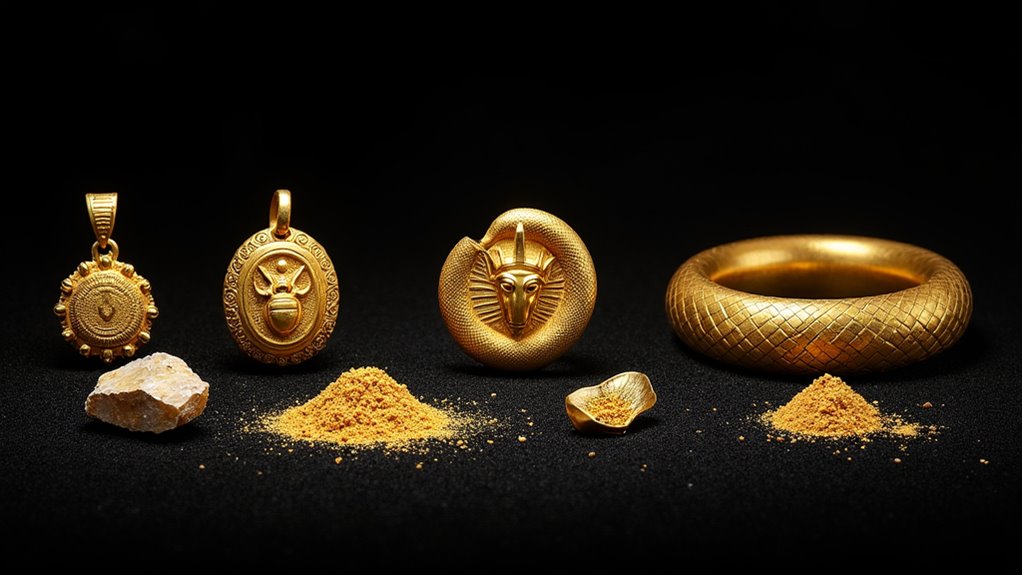
Guys? They kept it simple, usually wearing jewelry that symbolized achievements rather than pure decoration.
How Did Romans Prevent Gold Counterfeiting in Their Monetary System?
The Romans had a seriously tight grip on gold counterfeiting!
They deployed multiple defensive strategies: ultra-pure gold coins (we’re talking near 100% purity), super-detailed designs that were a nightmare to copy, and strictly controlled minting facilities that were guarded like fortresses.
Oh, and they weren’t playing around with punishments – counterfeiters faced execution!

Regular inspections and updated coin features kept those sneaky fraudsters on their toes.
Talk about hardcore quality control!
Where Did Romans Store Their Personal Gold Collections and Valuables?
Romans had several savvy spots for stashing their precious metals.
Most wealthy citizens kept gold in secret compartments built into their villa walls or underground chambers.
Temples were hugely popular too – who’d dare steal from the gods?
Some folks went old-school and buried their treasure in ceramic pots on their property.
The super-rich even had private strong rooms with guards, while others trusted public vaults n’ temple depositories for safekeeping.