In ancient Egypt, gold wasn’t just a shiny metal – it was divine authority incarnate. The pharaohs flaunted it like their supernatural business card, while common folk could barely dream of touching the stuff. Mining operations in Nubia and the Eastern Desert kept the elite’s coffers full, though annual yields rarely topped one ton. Egyptian goldsmiths turned this “flesh of the gods” into mind-blowing artifacts and jewelry that’d make modern billionaires weep. There’s way more to this glittering tale of power, prestige, and ancient bling.

Glittering across the sands of time, gold held an unshakeable grip on Ancient Egyptian society that went way beyond mere precious metal status. The gleaming metal served as the ultimate symbol of divine authority, eternal life, and supreme wealth, particularly through its association with the mighty sun god Ra. Ancient Egyptians believed gold literally constituted the flesh of their deities, making it the most sacred of all materials in their rich cultural tapestry.
The Pharaohs, those crafty intermediaries between gods and mortals, didn’t miss a beat in exploiting gold’s divine connections. They decked themselves out in golden finery and claimed fancy titles like “Golden Horus” to flex their supernatural street cred. Talk about a power move! The whole setup was practically foolproof – if you’re wearing the gods’ skin, who’s gonna question your authority? Additionally, this connection between gold and divinity mirrored the broader cultural significance of gold across various civilizations, showcasing its universal appeal. In cultures such as the Incas and Aztecs, gold was also revered for its spiritual and ceremonial importance.
Mining operations were no joke, concentrated mainly in the Eastern Desert and Nubia (which literally got its name from the Egyptian word for gold, “nbw”). Surface mining and some pretty ingenious fleece techniques helped workers extract the precious stuff from rivers and ore-bearing soils. But don’t get too excited – annual production barely hit one ton. The state kept an iron grip on the whole operation, cause obviously, you can’t have random folks running around with divine metal. The Sumerians and Babylonians also engaged in extensive mining and trade, showcasing the widespread value of gold in ancient economies.
Ancient Egyptians were serious about their gold game – mining it in desert spots while keeping production under strict royal control.

The economic impact of gold was staggering, even with such limited production. It functioned as an early form of currency and proved invaluable in diplomatic relations – nothing says “lets be friends” quite like a solid gold gift basket. While common folk rarely got their hands on the stuff, the elite flaunted it like there was no tomorrow, using it for everything from taxes to temple revenues.
Egyptian goldsmiths were basically the rock stars of their time, creating jaw-dropping pieces that would make modern jewelers weep. These artisans mastered techniques for crafting both simple and elaborately encrusted pieces, coating objects in gold leaf, and creating those iconic funerary masks we’re still obsessing over today. King Tut’s mask? That wasn’t just some fancy face covering – it was a ticket to divinity.
The social implications of gold ownership were crystal clear – if you had it, you were somebody. Period. The metal’s rarity and controlled distribution created a perfect storm of exclusivity that reinforced social hierarchies and religious authority. While peasants were stuck bartering chickens or whatever, the upper crust was literally wearing their wealth and divine connections on their sleeves (and necks, and heads, and pretty much everywhere else).
Through its use in temples, tombs, and countless religious artifacts, gold maintained its mystical significance throughout Ancient Egyptian history. It wasn’t just about looking fancy – it was about connecting with the divine, ensuring eternal life, and making darn sure everyone knew exactly where you stood in the cosmic pecking order. Additionally, the use of gold in ancient religious art played a crucial role in reinforcing the cultural and spiritual values of the society.
Frequently Asked Questions
How Did Ancient Egyptians Determine the Purity of Their Gold?
Ancient Egyptians were seriously savvy with their gold-testing game!
They rocked multiple methods – first up, fire assaying, where they’d mix gold with lead in bone ash crucibles to burn off impurities.
Then there’s the epic cupellation process, combining gold with lead, salt, and tin in heated crucibles.
They’d even eyeball color variations (bright yellow = purer gold) and use specific gravity tests.
Pretty advanced for 1500 BCE, dont’cha think?!
What Tools and Techniques Did Egyptian Goldsmiths Use to Create Intricate Designs?
Egyptian goldsmiths wielded an impressive arsenal of tools – saws, chisels, and drills for precise cutting and shaping.
They’d hammer gold into whisper-thin sheets before applying repoussé (pushing designs from behind) or granulation (tiny gold beads).

The lost-wax technique let em create stunning 3D pieces, while cloisonné work involved soldering tiny gold walls to hold colorful inlays.
Their blowpipes and furnaces reached intense temps for perfect melting and casting.
Were There Specific Laws Governing Who Could Wear Gold Jewelry?
Ancient Egypt had strict laws dictating who could rock the gold bling!
The Pharaoh and royal fam got exclusive dibs on certain pieces – especially those fancy cobra symbols. Nobles could wear gold but couldn’t touch those royal designs (tough luck!).
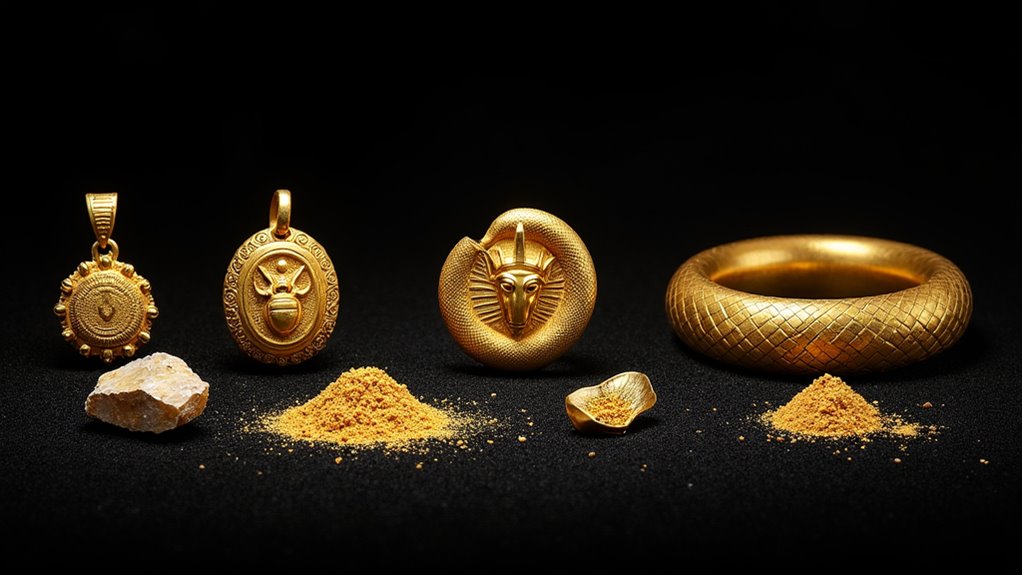
Priests? They got their own special ceremonial pieces.
And regular folks? Well, they had to settle for minimal gold jewelry – if they could afford it at all.
Talk about ancient fashion police!
How Did Egyptian Gold Trading Routes Influence Relationships With Neighboring Civilizations?
Egyptian gold trading routes were total game-changers for international relations.
These networks didn’t just move precious metal – they created a web of diplomatic ties that transformed regional dynamics. Through established routes like the Darb el-Arbain, Egypt built lasting partnerships with Nubia and Punt, exchanging not just gold but cultural influences too.

The trade routes became power corridors where Egypt flexed its economic muscle while fostering essential alliances that shaped ancient politics.
What Happened to the Vast Amounts of Gold After Tombs Were Discovered?
The fate of Egyptian tomb gold reads like a tragic heist movie!
Most treasures were mercilessly looted in antiquity, with thieves melting down priceless artifacts for quick profit.
The gold that survived faced a wild journey – snatched by invaders, redistributed to state treasuries, or smuggled into black markets.

Some lucky pieces landed in museums (looking at you, Tutankhamun’s mask!), while others got recycled into currency.
Talk about a golden disappearance act!