Gold and silver’s value relationship has been a wild ride. Medieval Europe kept things steady at 12:1 for centuries until modern markets went bonkers. While gold hit $2,936 in 2025, silver peaked at just $50 back in 1980 – talk about getting the short end of the stick! Thank Nixon for releasing chaos by ditching price controls in ’72. Today’s ratio sits at 89:93, way above historical norms. The deeper story behind these precious metals might shock you.

While modern investors obsess over crypto and meme stocks, gold and silver have been quietly dominating the currency game for literal millennia. Let’s be real – these OG precious metals were running the show when crypto bros’ ancestors were still figuring out basic math. The Egyptians were flexing with gold shekels around 1500 BC, and silver coins joined the party about 700 years later. Talk about staying power.
You wanna know what’s wild? The Roman Empire actually had to step in and set an official gold-to-silver ratio at 12:1. Fast forward to America’s early days, and they’re doing the exact same thing with the 1792 Coinage Act, bumping it up to 15:1. Some things never change – except when they do. That ratio hit a mind-blowing 125:1 during the COVID chaos of April 2020. Way to mess with tradition, modern markets.
The price swings in these metals tell a story that’d make your head spin. Gold just reached its all-time high of $2,936.17 in February 2025, while silver’s been playing catch-up since its glory days of $50 per ounce back in 1980. Remember when gold was just $34.75 in 1970? Those were the days – if you were buying, not selling. Medieval Europe saw the ratio maintain remarkable stability as it stayed within a tight range of 9.4 to 12:1 for centuries. Since 2017, there have been only three major troughs in market value for both metals, reflecting the gold to silver historical ratio over time.
From $34 gold in 1970 to nearly $3,000 in 2025 – precious metals are the ultimate long game for patient investors.

Here’s where it gets interesting – silver’s actually got a day job. While gold’s mostly sitting pretty in vaults and jewelry boxes, silver’s out there hustling in electronics, medicine, and photography. That’s why silver prices bounce around like a caffeinated kangaroo – it’s tied to industrial demand, not just investor whims.
The government couldn’t keep its hands off these metals either. They’ve been playing price-fixing games since forever. FDR decided $35 per ounce was the magic number for gold in 1933, and everyone just had to deal with it until Nixon finally said “forget it” in 1972 and let the market take the wheel. Spoiler alert: prices went nuts after that.
Today’s market is a whole different animal. While both metals still act as safe havens during economic dumpster fires, they’ve developed their own personalities. Gold’s the steady Eddie, the responsible older sibling who always shows up to family dinner on time. Silver’s more like the unpredictable cousin who might strike it rich or blow it all – but at least keeps things interesting.
The current gold-silver ratio of 89.93 is higher than the historical average, proving that even after thousands of years, these metals can still surprise us. Between economic instability, mining supply drama, and the dollar’s mood swings, their dance continues.

And while crypto might be the new hotness, these ancient assets aren’t going anywhere – they’ve outlasted every currency system humans have dreamed up. That’s not just history; that’s staying power.
Frequently Asked Questions
How Do Gold and Silver Prices React During Global Economic Crises?
During economic meltdowns, gold and silver act like financial bomb shelters – but with different attitudes.
Gold’s the steady elder, typically climbing as panic sets in. Think 2008: shot from $800 to $1,200/oz.
Silver’s more dramatic – wild price swings come standard. Both metals usually tank initially (thanks, liquidation panic!) before rebounding hard.

The Great Depression saw gold stocks soar 500%+ while silver followed suit.
History’s verdict? They’re crisis MVPs.
Which Factors Most Strongly Influence the Price Ratio Between Gold and Silver?
Economic uncertainty is the biggest driver – when markets get shaky, gold shoots up faster than silver, widening that ratio.
Industrial demand’s huge for silver (think electronics and solar), while gold’s mainly about investment.

Interest rates and inflation hit both, but gold reacts more dramatically.
Central bank buying habits matter too – they’re obsessed with gold, not silver.
Market sentiment can make the ratio go wild during crisis’s.
Are Gold and Silver Prices Affected Differently by Seasonal Market Changes?
Gold and silver dance to different seasonal rhythms – no doubt about it.
Gold starts its price party in mid-November, riding high through February thanks to holiday bling and cultural celebrations.
Silver’s a late bloomer, waiting until mid-December to make its move. But when silver finally shows up, it goes big – way bigger than gold’s seasonal gains.
After February? Silver mostly slumps while gold keeps finding random reasons to spike throughout the year.
How Do Mining Production Rates Impact Gold Versus Silver Prices?
Mining production hits these metals differently – and the numbers don’t lie.
A 1% bump in gold mining knocks gold prices down 2.2% but hammers silver even harder at 3.06%.
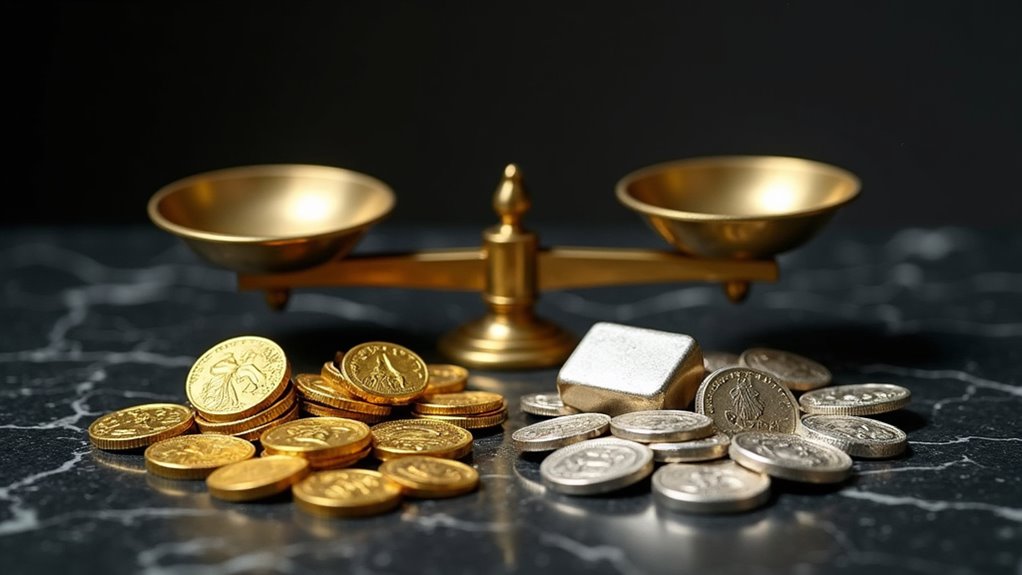
Meanwhile, silver mining increases crush both metals – dropping silver 1.72% and gold 1.88%. Talk about a double whammy!
Historically, when mining supply doubled, prices tanked. When it dropped, prices soared.
Pretty straightforward cause-and-effect here, folks.
What Role Does Industrial Demand Play in Silver Prices Compared to Gold?
Industrial demand hits silver prices like a freight train – way harder than gold.
While gold sits pretty as a safe haven asset, silver’s got its hands dirty in everything from electronics to solar panels, soaking up 55% of total demand.
Talk about commitment issues! Silver price swings are wild because factories can’t get enough of the stuff.
No central bank safety net here – when industry booms or busts, silver prices go nuts.