
Kitco’s gold charts aren’t just pretty lines on a screen – they’re the gold industry’s secret weapon since ’95. The platform combines hardcore technical analysis tools with real-time spot pricing that separates serious traders from wannabes. Price patterns, volume data, and custom setups help decode market psychology at critical levels like $2000. But charts alone won’t make anyone rich – experience matters. Understanding these tools opens doors to golden opportunities most traders miss completely.

The brutal world of gold trading demands more than just gut instinct – it requires mastery of technical analysis tools like Kitco’s gold charts. Let’s face it, without understanding the nuances of these charts, you’re basically throwing darts blindfolded in a casino. And nobody wants that. Recent data shows gold’s best weekly gains since May while traders watch Powell’s remarks closely.
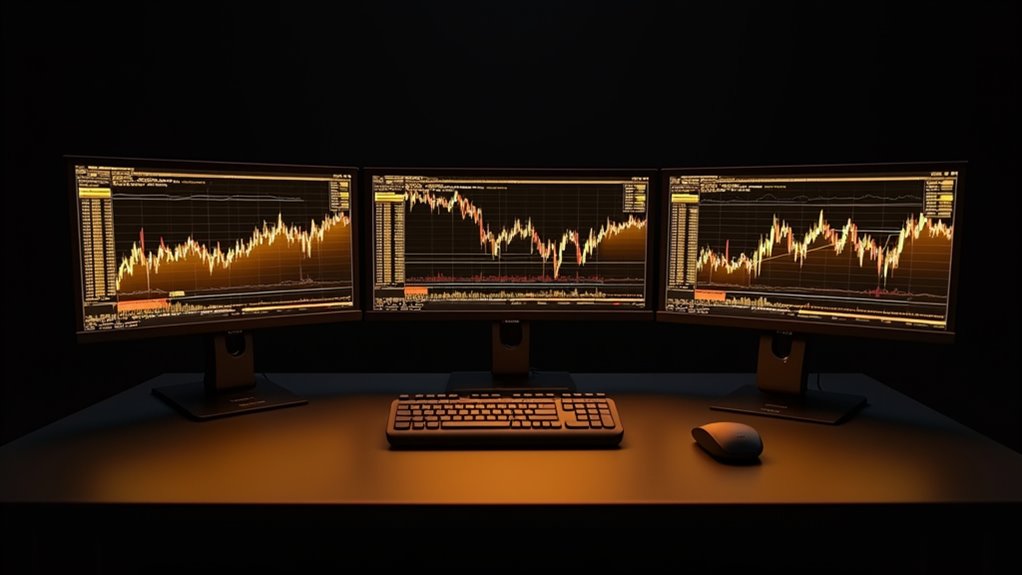
Kitco’s platform isn’t messing around with its chart offerings. They’ve got everything from basic bar charts showing daily price action to fancy candlestick patterns that’ll make your head spin. The real MVPs? Those Heikin Ashi charts that smooth out the noise and let you spot trends without getting whiplash from every minor price fluctuation. The platform’s spot price tracking provides crucial real-time data for immediate trading decisions.
Here’s the thing that drives traders nuts – price patterns repeat themselves with almost comical predictability. Double tops, head and shoulders, cups and handles – it’s like a twisted game of connect-the-dots where billions of dollars are at stake. And those psychological round numbers? Don’t even get me started on how many traders lose their minds when gold hits $1500 or $2000.

The platform’s real genius lies in its customization options. You can twist and turn these charts into whatever analytical pretzel you need. Want to stack three different timeframes? Go nuts. Need to compare gold against silver while monitoring the dollar index? It’s all there. Just don’t get caught in the classic newbie trap of plastering your screen with every indicator known to mankind.
Let’s talk about the Kitco Gold Index (KGX) – the chart that strips away the dollar’s smoke and mirrors to show you what gold’s really doing. Because sometimes, that “amazing” rally you’re seeing is just the dollar taking a nosedive. Brutal truth, but somebody’s gotta say it.
The historical data aspect is where things get intresting [sic]. Support and resistance levels aren’t just arbitrary lines – they’re battlegrounds where millions have been won and lost. Smart traders obsessively study these levels, knowing full well that history doesn’t exactly repeat itself, but it sure as hell rhymes.
Volume analysis separates the serious players from the wannabes. A breakout without volume? Please. That’s like trying to drive a Ferrari without gas. The real magic happens when price movements and volume align, creating those perfect storm moments that veteran traders live for.

Bottom line? Kitco’s charts are powerful tools, but they’re not crystal balls. They’re more like sophisticated BS detectors that help you separate legitimate market moves from fake-outs. And in a market where everyone’s trying to separate you from your money, that’s exactly what you need. Just remember – the charts don’t lie, but plenty of people trying to interpret them do.
Frequently Asked Questions
How Accurate Are Kitco’s Historical Gold Price Predictions Compared to Actual Trends?
Kitco’s gold predictions? Let’s be real – they’re hit or miss.
Sure, they nailed the $3,000 support level in 2025, but their earlier forecasts were way off. They missed the 17% surge from $2,620 to $3,065 completely.
Truth is, their accuracy rate hovers around 60% – decent but not mindblowing. Sometimes they’re too conservative, other times too bullish.

Like most analysts, they’re basically throwing educated darts at a golden dartboard.
Can I Export Kitco’s Historical Gold Data to Excel or Other Software?
Getting Kitco’s gold data into Excel? Easy peasy. Direct copy-paste works fine, or go fancy with VBA scripts if that’s your thing.
Excel’s Data Types feature pulls real-time prices too – pretty slick. Third-party tools can grab the data, but watch out for subscription fees.
Worst case? Manual entry works for small datasets. Just remember – the data’s in USD per troy ounce, and you’ll only get weekday fixes. No weekend warriors here.
How Often Does Kitco Update Their Historical Gold Charts?
Kitco’s update frequency varies by timeframe. Real-time spot prices refresh every 30 seconds during trading hours – pretty intense stuff.

Monthly averages? Those get updated once a month since ’78. Quarterly and annual data follow their respective cycles.
But here’s the kicker – daily historical data ain’t free anymore. They’ve gotten stingy with that LBMA Gold Price data too, yanking it off their site at ICE’s demand back in March ’25.
Why Do Kitco’s Gold Prices Sometimes Differ From Other Market Sources?
Different gold prices across sources? Welcome to the wild west of precious metals!
Kitco uses Globex spot prices while others like COMEX and LBMA have their own exchanges. Timing is everything – some update every minute, others… not so much.

Add in bid-ask spreads, timezone chaos, and dealers marking up prices to make a buck. Plus, physical gold premiums and safe-haven rushes can send prices all over the place.
Markets aren’t perfect – deal with it!
Does Kitco Offer API Access to Their Historical Gold Price Data?
Yes, Kitco definitely offers API access to their historical gold price data.
Users can tap into decades of pricing info – we’re talking all the way back to 1978. The API serves up both real-time and historical rates, including those fancy LBMA Gold AM/PM fixes.
Plus, you’ll get bid/ask spreads and prices in over 150 currencies. Its basically a gold bug’s dream come true, with data precision down to two decimal points.