Gold’s wild ride from a measly £3.17s per ounce in 1717 to today’s eye-popping $3,019.39 tells quite a story. For nearly two centuries, prices barely budged – then all hell broke loose. World War I killed the gold standard, the Great Depression sent prices soaring, and Nixon’s 1971 decision to ditch gold-backed currency released chaos. Now? Covid and global tensions have pushed gold to record highs. The metal’s dramatic journey has only just begun.

Gold Price History
Money talks, but gold screams. Looking at gold’s wild price journey is like watching an epic drama unfold – from its humble beginnings at a mere £3.17s. 10d. per troy ounce in 1717 to today’s mind-boggling $3,019.39.
From ancient pocket change to modern fortune, gold’s price history reads like a financial thriller that keeps getting wilder.
For nearly two centuries, gold prices were about as exciting as watching paint dry, but boy, did things change when the world went bonkers. The real fireworks started during World War I when the gold standard got tossed out the window like yesterday’s newspaper. Fixed exchange rates between countries made international trade more predictable and stable during this period, but in the backdrop, the gold price history was quietly shaping the global economy.

Then came the Great Depression, and suddenly everyone wanted their hands on some shiny yellow metal. But that was just the warm-up act. When the US finally ditched the gold standard in 1971, prices went absolutely nuts – welcome to the era of “whatever the market feels like” pricing.
Fast forward to recent times, and gold’s been showing off like a peacock at a beauty pageant. The COVID-19 pandemic sent prices soaring faster than toilet paper disappeared from store shelves. The introduction of the American Gold Eagle coin in 1986 marked a new era in gold investment accessibility.
From February 2020 to February 2025, gold prices shot up by a whopping 83%. That’s not just growth – that’s gold flexing its muscles and laughing at your savings account. Speaking of flexing, February 2025 saw gold hit an all-time high of $2,880.22 per ounce.
But hold onto your hats, folks, because by March 26, 2025, it was already strutting around at $3,019.39. That’s what happens when you mix economic uncertainty, geopolitical tensions, and inflation fears into one explosive cocktail.

Let’s get real for a second – gold’s performance makes the stock market look like it’s playing in the kiddie pool. Remember the 2008 financial crisis? While banks were crying into their spreadsheets, gold was doing victory laps.
And during the 1980s, it reached what would be worth over $3,300 in today’s money. Not too shabby for a chunk of metal that spent two centuries pretending to be a wallflower.
The truth is, gold’s been playing the long game while fiat currencies come and go like fashion trends. China’s buying it up like it’s going out of style, and technological advances in mining can’t keep up with demand.
But here’s the kicker – despite all the fancy economic theories and market analysis, gold’s still doing exactly what it’s done for thousands of years: making people lose their minds over shiny metal.
Frequently Asked Questions
Why Do Central Banks Continue to Buy and Hold Gold Reserves?
Central banks aren’t stupid – they know gold’s their ace in the hole.
It’s the ultimate insurance policy against economic disasters, inflation nightmares, and geopolitical mess-ups. Plus, it’s their way of giving the middle finger to US dollar dominance.

The numbers don’t lie: they hoarded 1,037 MT in 2023 alone. Gold doesn’t play by the markets’ rules, and that’s exactly why they love it.
It’s reliable when everything else goes sideways.
How Do Geopolitical Tensions Affect Daily Gold Price Fluctuations?
Geopolitical tensions hit gold prices like a brick – sending them soaring or plunging based on pure fear and speculation.
When conflicts erupt, smart money runs to gold faster than politicians run from accountability.

Recent examples? The Russia-Ukraine war pumped prices 10%, while Hamas’s attack on Israel triggered a 9% jump.
It’s simple really – the more chaos in the world, the more investors cling to gold like a security blanket.
What Role Does Gold Mining Production Play in Price Movements?
Gold mining’s impact on prices? Not as much as you’d think.
Despite being 90% of supply, production moves at a snail’s pace – taking decades to develop new mines. Even when prices soar, miners can’t just flip a switch and pump out more gold.
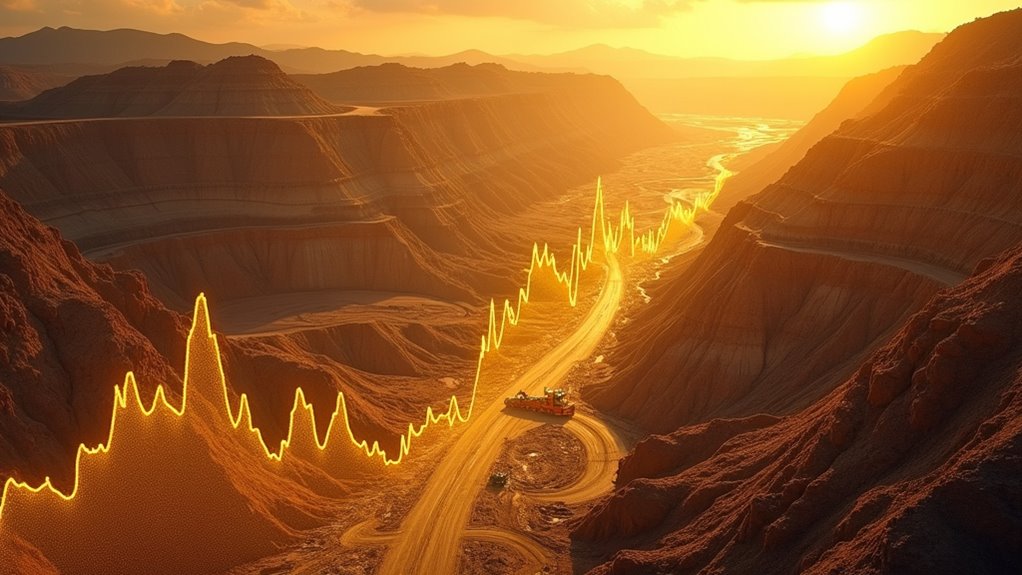
The real kicker? Production costs keep climbing ($1,276/oz in 2022!), creating a price floor.
Sure, mining matters, but it’s the slow, stubborn cousin of price dynamics.
How Do Interest Rates and Inflation Impact Gold Investments?
Interest rates and inflation play a messy tug-of-war with gold prices. When rates jump, gold typically takes a hit – after all, who wants a shiny paperweight when bonds are paying decent returns?
But here’s the kicker: inflation fears send investors running to gold like its their safety blanket. Just look at the 1970s, when gold prices went bonkers during high inflation.
Still, don’t bet your life savings on these relationships – they’re about as reliable as weather forecasts.
Why Do Gold Prices Sometimes Move Opposite to Stock Market Trends?
Gold’s contrarian dance with stocks isn’t just random – it’s pure survival instinct.
When markets tank, investors sprint to safe havens like gold faster than you can say “market crash.”
Take 2008: stocks nosedived 50% while gold smugly climbed 39%.
But here’s the kicker – it’s not a perfect relationship.
Sometimes both crash together when panic hits full throttle.
Think of gold as that friend who usually zigs when everyone else zags.