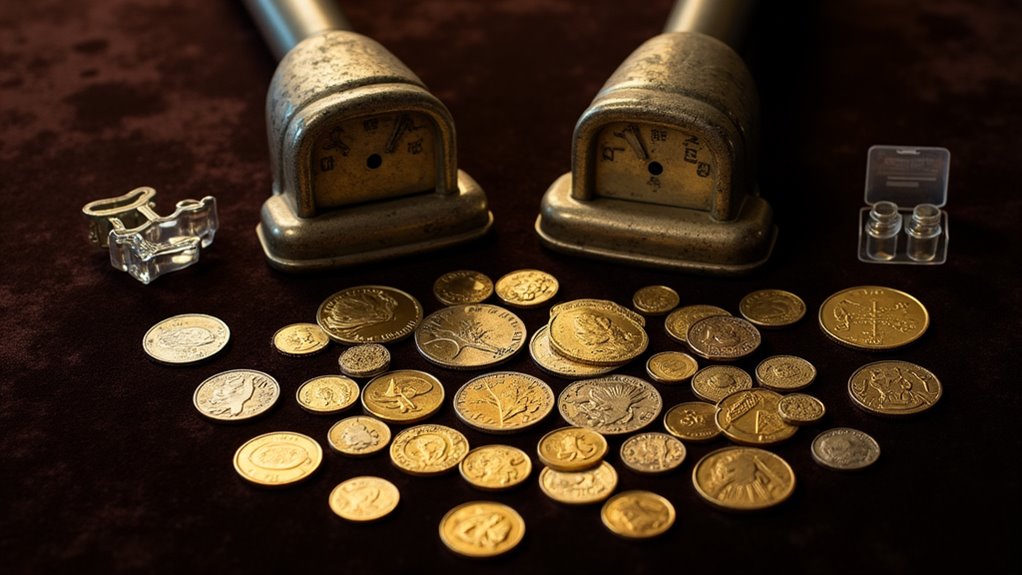
Gold’s transformation from inert wallflower to chemical matchmaker happens at the nanoscale – we’re talking 2-5 nanometers small! These tiny particles catalyze reactions with surprising vigor, especially in CO oxidation below freezing temps. The magic happens where gold meets support materials, with water molecules playing wingman to boost performance. Today’s gold nanoparticles are workhorses in vinyl production and hydrogen purification. There’s more to this precious metal’s chemical prowess than meets the eye.

While gold has long been revered for its lustrous beauty and monetary value, its true superpower lies in something far more fascinating – its remarkable abilities as a catalyst in chemical reactions. When gold is reduced to nanoparticles between 2-5 nanometers, it transforms from an inert noble metal into a highly active catalyst that’s revolutionizing industrial processes and environmental solutions. Recent studies utilizing high-energy X-ray spectroscopy revealed crucial insights into oxygen activation. Gold’s unique properties as a conductor enhance its ability to participate in these catalytic processes.
These tiny gold particles are absolute beasts at catalyzing CO oxidation, especially at temperatures below freezing, with turnover frequencies that’ll make your head spin (around 1 reaction per second). What’s really wild is how these nanoparticles completely flip the script on everything we thought we knew about bulk gold. The smaller the particle, the more reactive it becomes – it’s like watching David take down Goliath in the molecular world. The catalyst’s effectiveness is enhanced by reducible metal oxides that serve as support materials.
Gold nanoparticles shatter expectations, becoming catalytic powerhouses at microscopic sizes – proving that in chemistry, smaller means mightier.
The catalyst’s sweet spot happens right at the perimeter sites, where gold meets its support material. Here’s where things get juicy – add a little water to the mix, and BAM! The catalytic activity goes through the roof. The H2O molecules act like molecular matchmakers, helping oxygen molecules get their groove on at those all-important perimeter sites. It’s basically a chemical party, and everyone’s invited. Furthermore, innovations in gold mining technology are paving the way for more sustainable methods of producing this precious metal for catalytic applications. Ethical gold mining practices are becoming increasingly important in ensuring that gold is sourced responsibly and sustainably.

Gold catalysts are making waves in real-world applications, particularly in vinyl chloride monomer production (goodbye, toxic mercury!) and hydrogen purification for fuel cells. They’re like the Swiss Army knife of catalysts – they work in both oxidative and reductive processes, tolerate various functional groups, and can be recycled more times than your favorite coffee mug. Plus, they’re stable in air and water, which is pretty much a catalyst’s way of saying “I’m low maintenance.”
The prep work for these catalysts is getting easier too. Scientists have cracked the code with a new method using acetone as solvent (who knew it could be that simple?). The key is getting those gold particles dispersed just right – too big and they lose their mojo, too small and they might not stick around long enough to do their job. It’s a delicate balance, but when you nail it, it’s pure chemical magic.
Looking ahead, gold catalysis is poised to tackle some serious challenges. We’re talking mercury-free industrial processes, deuterium oxide production, and maybe even helping break down those pesky waste plastics that are clogging up our oceans. The potential is huge, and researchers are working overtime to optimize these catalysts with new ligands and support materials.
But here’s the kicker – we’re probably just scratching the surface of what these golden wonders can do. With ongoing research into asymmetric reactions and complex molecule synthesis, gold might just be the key to revealing chemical processes we haven’t even dreamed of yet. Not bad for a metal that most people just think looks pretty in jewelry, eh?
Frequently Asked Questions
How Does the Cost of Gold Catalysts Compare to Other Catalyst Materials?
Gold catalysts ($225-$575/unit) offer compelling value compared to platinum group metals.
While pure gold trades at $3,047/oz, its catalysts often use minimal amounts (1-3%), keeping costs manageable.

Platinum ($979/oz) and palladium ($985/oz) catalysts typically demand higher loadings.
Rhodium’s eye-popping $5,750/oz makes gold look like a bargain.
Plus, gold’s superior selectivity at low temps helps offset initial costs through reduced energy consumption.
Can Gold Catalysts Be Recycled After Use in Chemical Reactions?
Gold catalysts show impressive recyclability across multiple reaction cycles.
Using methods like COF-based recovery and solvent extraction, these precious catalysts can be effectively recovered and reused. Recovery rates often exceed 99% from both industrial processes and e-waste sources.
The reclaimed gold maintains its catalytic prowess in subsequent reactions – from vinyl acetate production to CO₂ conversion. This recyclability makes gold catalysts more economically viable despite their high initial cost.
What Are the Environmental Impacts of Using Gold as a Catalyst?
Gold catalysts present a complex environmental trade-off. While they reduce energy consumption, operate at lower temperatures, and enable greener chemical processes, the mining of gold itself carries severe ecological costs.
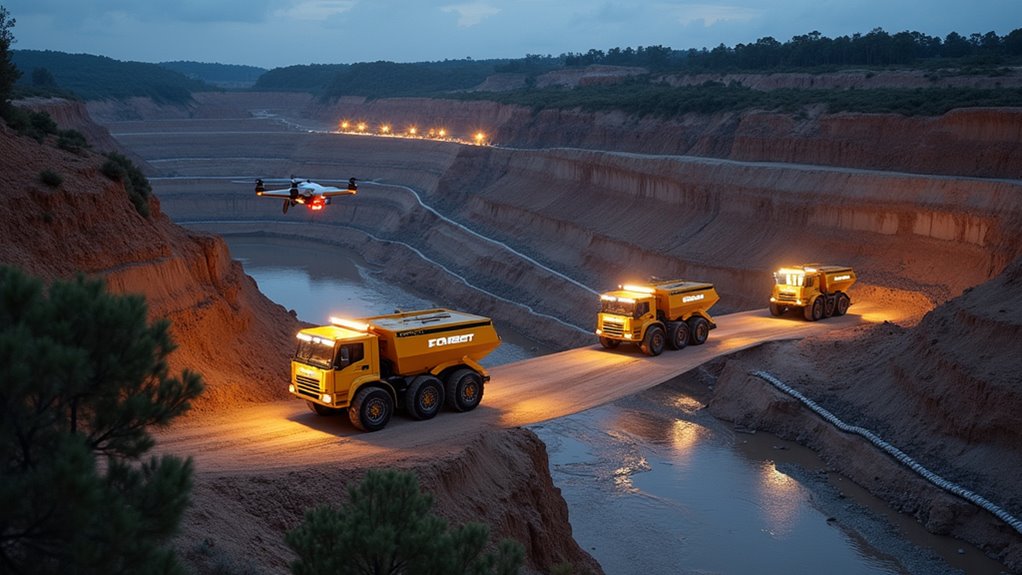
The extraction process contaminates water with cyanide and mercury, generates massive waste (20 tons per ring!), and devastates natural habitats. About 75% of mines overlap with conservation areas, threatening biodiversity and pristine forests.
It’s a classic catch-22 situation.
Does the Purity of Gold Affect Its Catalytic Performance?

Gold’s purity considerably impacts its catalytic performance.
Higher purity levels (99.99%) deliver enhanced catalytic activity by providing better control over particle size and shape.
Those pesky impurities? They’re notorious for interfering with active sites on catalyst surfaces, disrupting the reaction process.
Ultra-pure gold enables the creation of stable single-atom catalysts and shows improved selectivity in hydrogenation reactions.

Even trace impurities can dramatically alter gold’s catalytic behavior.
How Long Does a Gold Catalyst Typically Remain Effective in Industrial Applications?
Gold catalysts are remarkably long-lasting workhorses in industrial settings, typically maintaining their effectiveness for 1-3 years before replacement.
Some formulations have shown minimal activity loss even after 1000+ hours of continuous operation. Their lifespan varies based on reaction conditions – higher temps accelerate aging, while proper support materials extend life.
In acetylene hydrochlorination, these catalysts keep trucking for 4000+ hours, proving their industrial staying power.