The United States sits atop the global gold throne with a jaw-dropping 8,133 tonnes of the yellow metal – that’s nearly $628 billion worth of shiny goodness! Germany trails far behind in second place with 3,351 tonnes, while Italy and France duke it out for third with roughly 2,450 tonnes each. Uncle Sam’s massive stash makes up 79% of its total reserves, with half tucked away in Fort Knox‘s legendary vaults. The story behind these golden mountains gets even juicier.

The global gold game has a clear heavyweight champion, and it ain’t even close. The United States sits atop the gold throne with a staggering 8,133 tonnes of the yellow metal, valued at roughly $628 billion. That’s more than double what its closest competitor, Germany, has stashed away in its vaults. The iconic Fort Knox in Kentucky serves as the main storage facility for America’s massive gold holdings. Gold is considered a core reserve asset for central banks, enhancing its strategic importance. Additionally, central banks around the world are increasingly recognizing gold’s role in financial stability as they adjust their reserves. Furthermore, global gold reserves can significantly influence international relations and economic policies. In fact, the reliance on gold as a financial hedge has been a growing trend among nations looking to safeguard their economies. The accumulation of gold reserves reflects both historical trends and current geopolitical dynamics.
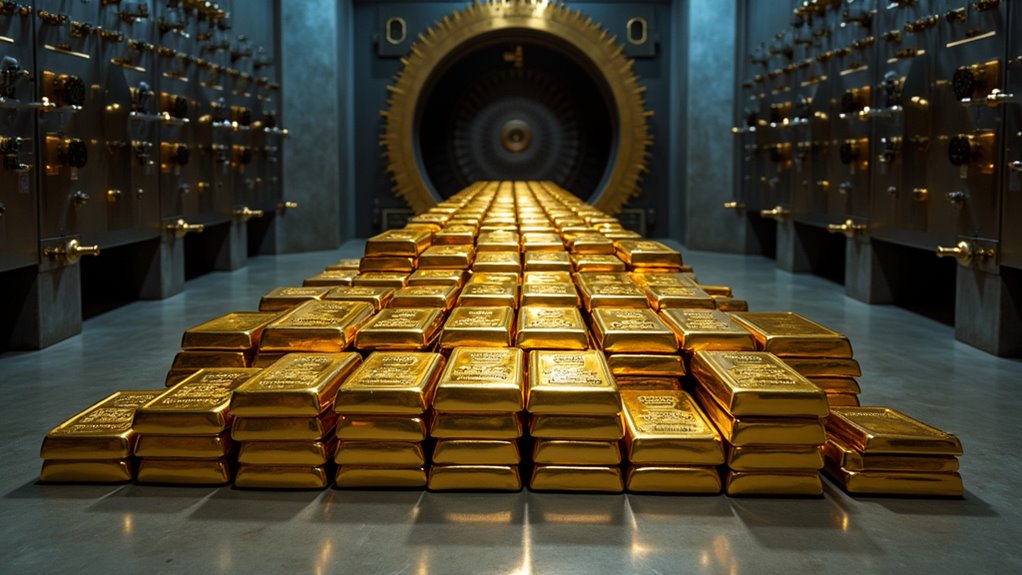
When it comes to hoarding gold, America’s playing in a league of its own, sitting pretty with a mind-boggling $628 billion stockpile.
Speaking of Germany, they’re holding onto 3,351 tonnes, which is pretty impressive but still looks like pocket change compared to Uncle Sam’s holdings. The Germans have been busy lately, bringing their gold home from foreign vaults – a move that’s got everyone talking about trust issues in the international financial system (wink, wink).
Italy and France are practically neck-and-neck in this precious metals race, with 2,452 and 2,437 tonnes respectively. It’s like watching two pasta-loving cousins fighting over the last piece of garlic bread – except we’re talking about billions in bullion here. Both countries keep most of their gold close to home, which honestly makes a lot of sense given today’s geopolitical shenanigans.

Russia’s been climbing the charts like a metal band on steroids, now sitting pretty at fifth place with 2,295.4 tonnes. Since 2014, they’ve been gobbling up gold like it’s going out of style – clearly not a fan of keeping all their eggs in the U.S. dollar basket. Can’t blame ’em, right?
China’s doing its own thing (as usual) with 1,948.3 tonnes, making it the sixth-largest holder. But here’s the kicker – that’s only 3.3% of their foreign reserves! They’ve been quietly adding to their stash month after month since 2019, like a squirrel preparing for the world’s longest winter. After 18 consecutive months of steady purchases, they’ve recently hit pause on their buying spree.
Switzerland rounds out our golden tour with 1,040 tonnes, which might not sound like much compared to the big boys, but hold your horses – they’ve got the highest gold reserves per capita. Not bad for a country known more for chocolate and fancy watches!
But let’s circle back to the main event – America’s mammoth pile of gold. With 79% of its total reserves in gold and half of it chillin’ in Fort Knox, Kentucky, the U.S. has been the undisputed heavy-weight champion for decades. It’s like they’re playing Monopoly while everyone else is stuck with Candy Land.

The fascinating thing about these numbers isn’t just their size – it’s what they say about each country’s economic strategy and trust in the global financial system. Some are diversifying away from the dollar, others are bringing their gold home, but nobody’s giving up on the shiny stuff completely. After all, when the economic stuff hits the fan, gold’s still golden.
Frequently Asked Questions
How Is Gold Purity Measured in National Reserve Holdings?
National gold reserves are primarily measured using the fineness system, tracking purity in parts per thousand.
While LBMA’s Good Delivery standard demands minimum 995 fineness, central banks often hold varying purities.
Fort Knox’s gold averages 916.7 fineness (equivalent to 22 karat), while some reserves include coin bars at 899-917.

X-ray fluorescence and selective assaying verify purity, though full-scale audits are surprisingly rare in many national vaults.
What Security Measures Protect National Gold Reserves From Theft?
National gold reserves employ multi-layered security systems that’d make Ocean’s Eleven cry.
We’re talking fortress-level protection: reinforced vaults buried deep underground, biometric scanners that know your eyeballs better than your mother, and armed guards who dont mess around.
Multi-ton doors with time-locks keep the shiny stuff extra safe, while 24/7 surveillance catches every sneeze.

Two-person rules mean nobody’s going solo near those bars!
Can Countries Trade Their Gold Reserves for Other Currencies?
Countries can absolutely trade their gold reserves for other currencies through international markets.
Central banks routinely convert gold to obtain foreign exchange, especially during economic pressures. It’s an essential liquidity tool – just look at Turkey’s recent gold selloff to prop up their struggling lira!
The process involves standardized procedures through major bullion banks, tho the timing and scale of trades can shake up global markets.

Pretty wild how a single gold trade can send ripples worldwide!
How Often Do Countries Audit Their Gold Reserve Stocks?
Gold reserve auditing varies dramatically by nation.
While the Bank of England conducts yearly checks, most major economies follow less frequent schedules. The ECB verifies its stash every five years, with their latest count wrapped in 2021.
The U.S. does partial audits throughout the year but hasn’t done a full-blown inspection since ’53!
Some countries like China and Russia keep their audit schedules under wraps – because, ya know, secrecy is golden.
Why Do Some Nations Store Their Gold Reserves in Foreign Countries?
Nations stash their gold overseas for rock-solid reasons: superior security and risk management.
Top-tier vaults in financial powerhouses like London and New York offer state-of-the-art protection that’s hard to match. Plus, it’s just smart business – keeping gold near major trading hubs makes transactions smoother and cheaper.
Historic factors play in too; NATO allies parked their precious metals in the US during Cold War tensions. It’s basically insurance against domestic turmoil.