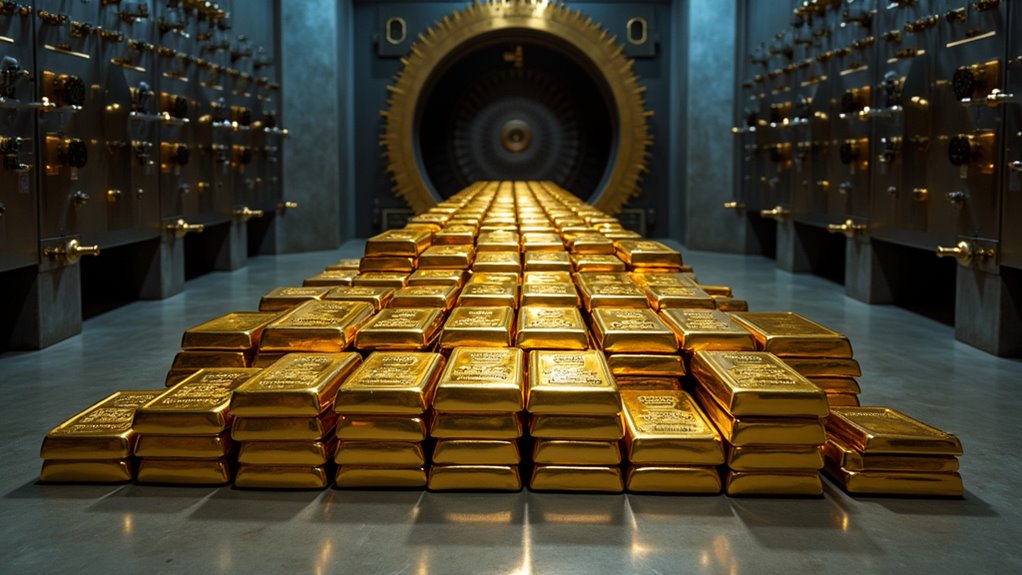
A national gold reserve serves as a financial fortress for a country’s economic stability. Central banks stack these precious metal holdings as a hedge against economic chaos, currency meltdowns, and geopolitical nightmares. Gold’s got serious street cred – it’s the OG safe haven that never goes out of style! Currently, central banks worldwide are hoarding about 34,000 tons of the shiny stuff, with the U.S. sitting pretty on 8,133 metric tons. There’s way more to this glittering story than meets the eye.

Security sits at the heart of every nation’s monetary system, and nothing embodies that quite like the glittering hoards of national gold reserves. These precious stockpiles, measured in troy ounces or metric tons, represent far more than just shiny metal sitting in heavily-guarded vaults – they’re the backbone of national financial stability and international credibility. The role of gold as a core reserve asset is crucial for central banks in navigating economic uncertainties. In today’s monetary landscape, central banks also utilize gold to hedge against inflation and bolster financial confidence. Countries often strategize their gold holdings based on national security concerns, ensuring they can withstand global economic shifts. Furthermore, higher gold reserves can lead to improved sovereign credit ratings that enhance a country’s borrowing power.
The concept of national gold reserves took center stage during the gold standard era, when currencies were directly backed by the yellow metal. Though the U.S. abandoned this system in 1933 and completely severed the dollar’s tie to gold in 1971, the importance of these reserves hasn’t diminished. In fact, central banks worldwide currently hold approximately 34,000 tons of gold, with the United States maintaining the largest stash at a whopping 8,133 metric tons. Emerging economies have shown increased interest in gold acquisition as a means of achieving portfolio diversification.
Gold reserves serve multiple critical functions in today’s economic landscape. They act as a financial safety net, providing a buffer against economic turmoil and currency fluctuations. When markets go haywire or inflation starts eating away at paper money, gold typically maintains its value – or even appreciates. It’s like having an insurance policy that actually looks good in a vault. These reserves serve as collateral for loans in times of economic necessity.

The geopolitical significance of gold reserves can’t be overstated. They’re fundamentally a country’s “war chest,” ready for deployment during severe economic crises. Nations with substantial gold holdings often wield more influence in international financial discussions, and there’s nothing quite like a massive gold reserve to boost a country’s economic street cred.
Modern reserve management is a complex dance of security, strategy, and skepticism. Central banks regularly audit their holdings (though conspiracy theorists love to question these numbers), and many countries are actively increasing their gold stockpiles. Some keep their gold scattered across multiple locations – because putting all your eggs in one vault is never a smart idea.
However, maintaining gold reserves isn’t without its challenges. Critics point to the opportunity cost of holding a non-yielding asset, and the volatility of gold prices can make reserve values fluctuate wildly. Some economists even advocate for a return to the gold standard, though most financial experts view this as about as practical as using Pokemon cards for currency.
The global landscape of gold reserves continues to evolve, with countries like Germany (holding 3,359 metric tons) and even the International Monetary Fund (with 2,814 metric tons) maintaining significant positions. On average, gold represents about 17% of central banks’ total reserves worldwide – a demonstration of its enduring role in the international financial system.

Despite occasional market turbulence and changing economic theories, national gold reserves remain a cornerstone of monetary policy and financial sovereignty in our modern world.
Frequently Asked Questions
How Do Countries Secretly Transport Large Quantities of Gold Between Reserves?
Countries move gold reserves through a multi-layered web of secrecy – it’s wild stuff!
They’ll use unmarked armored trucks, decoy convoys, and even military aircraft for those mega-shipments. Think Operation Fish style – $60B in gold moved during WWII without a hitch!
Modern transfers mix old-school armed guards with high-tech GPS tracking and encrypted comms.

Sometimes they’ll even split shipments into smaller chunks to stay under the radar. Pretty sneaky, eh?
Can a Nation’s Gold Reserve Be Seized by Other Countries?
Seizing a nation’s gold reserves is legally complex and historically rare. While international law generally shields sovereign assets, exceptions exist for enforcing legal judgments or sanctions.
The current freeze of Russian reserves is unprecedented – it’s huge! Recent G7 talks explored using frozen asset profits rather than outright seizure.
Most nations are hesitant due to potential retaliation risks and fears of undermining the global financial system‘s stability. It’s a tricky balance!
Which Private Companies Help Central Banks Manage Their Gold Reserves?
Major financial institutions work hand-in-glove with central banks’ gold operations. JPMorgan Chase and HSBC handle trading, while behemoths like BlackRock and State Street provide strategic advice.

On the nitty-gritty side, PAMP and Valcambi refineries prep those shiny bars to spec, while private security firms keep the precious metal safe n’ sound.
Tech companies contribute too, offering specialized software for tracking and managing those glittering hoards.
How Often Do Countries Perform Independent Audits of Their Gold Reserves?
Regular independent audits of national gold reserves are surprisingly rare.
While some countries like the UK perform annual checks through their National Audit Office, most nations keep their verification processes shrouded in mystery.

The U.S. hasn’t had a full-blown audit since the 1950s – yikes!
Germany and Austria made headlines by actually checking their stashes in the 2010s, but they’re the exception.
Most central banks stick to internal “trust us” inspections… if they do them at all.
What Happens to a Country’s Gold Reserve During Wartime?
During wartime, national gold reserves become critical strategic assets. Countries typically beef up their holdings, knowing gold’s role as crisis insurance.
Some nations frantically move reserves to secure locations – like Britain shipping gold to Canada in WW2. Governments might restrict civilian gold ownership or use reserves to finance military operations.
Sometimes, invading forces straight-up loot gold vaults (looking at you, Nazi Germany). The shiny metal becomes a lifeline when regular finance breaks down.