The United Kingdom’s gold stash sits at a respectable 310.29 tonnes – valued at a cool $20.7 billion and ranking 17th globally. Not too shabby, but hardly the Fort Knox-level holdings of its glory days! The Bank of England‘s vaults are actually home to way more gold than that, housing around 400,000 bars worth over £200 billion for other nations. Today’s reserves represent just 11% of Britain’s total reserves, but there’s quite a story behind those shiny bars.

The United Kingdom’s gold stash might seem modest by global standards, but don’t let those 310.29 tonnes fool you – it’s still worth a whopping $20.7 billion. Ranking 17th globally in central bank reserves, the UK’s precious metal holdings consist mainly of 24-carat gold bars, with some older pieces sporting 22-carat or 900 purity ratings. This glittering pile represents roughly 11% of the nation’s total reserves, a far cry from its historical peak. During World War II, the UK executed Operation Fish to protect its gold by secretly transferring it to Canada. This historical reliance on gold as a reserve asset reflects its strategic importance for economic stability and security, underscoring how central bank reserves can influence a nation’s economic policies. Effective gold reserve management strategies can enhance the security and liquidity of these assets, while the UK’s approach illustrates the significance of diversifying reserve assets.
Speaking of history – oh boy, has the UK’s relationship with gold been a wild ride. Back in 1950, Britain was sitting pretty on 2,543 tonnes of the yellow stuff. Then came the great selloffs: first in 1970, which slashed reserves in half, followed by Gordon Brown’s infamous fire sale between 1999-2002 that halved them again. Since 2010, the UK’s been keeping it steady at around 310-314 tonnes, like a cautious poker player who’s done raising the stakes. The UK’s approach to gold reserves reflects a broader trend of central banks’ strategies in maintaining gold as a key asset in their portfolios.
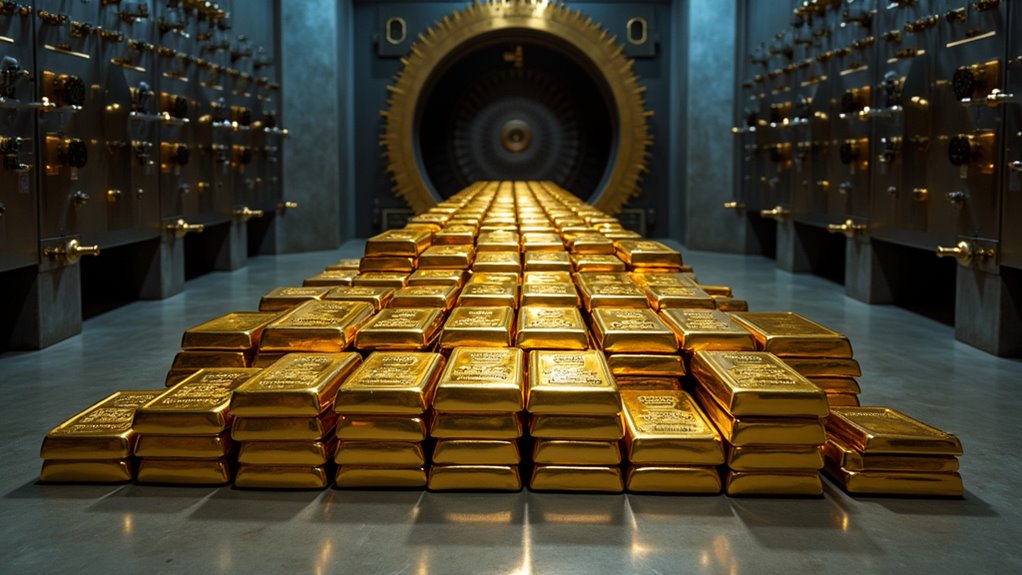
While the UK’s own gold pile might seem underwhelming, the Bank of England‘s role as global gold keeper is anything but. Those underground vaults are absolutely stuffed with roughly 400,000 gold bars worth more than £200 billion, making it the world’s second-largest gold custodian after the New York Fed. Ten massive vaults spread across two basement levels span approximately 3,000 square metres – talk about your ultimate basement renovation! The recent total reserves of 177.9 billion USD demonstrate the country’s substantial financial cushion against economic uncertainty.

The global gold game puts things in perspective: the USA’s massive 8,133.46 tonnes makes everyone else look like amateur collectors, while Germany (3,352.31 tonnes), Italy (2,451.84 tonnes), and France (2,436.91 tonnes) round out the top four. Meanwhile, recent market activity has been absolutely bonkers, with London vaults seeing their biggest outflow in nearly a decade – 4.9 million troy ounces vanishing in January 2025 alone.
The bigger picture shows UK’s total international reserves sitting at $186,435 million gross and $94,203 million net as of January 2025, with a tidy increase of $2,112 million in net reserves during that month. Total reserves, including both gold and currencies, amount to $178 billion, securing the UK’s spot as the world’s 19th-largest holder of reserves.
Her Majesty’s Treasury manages these golden assets with all the care you’d expect for a national treasure trove. The reserves serve as both economic stabilizer and rainy-day fund, tucked away in those legendary Bank of England vaults.
While the current holdings might not match historical highs, they represent an essential piece of Britain’s financial foundation – proof that sometimes it’s not about how much gold you’ve got, but how smartly you manage what you have.
Frequently Asked Questions
Where Is the Uk’s Gold Physically Stored?
The Bank of England‘s massive underground vaults in London’s financial district house the UK’s gold reserves.

Built in the 1930s, these nine subterranean chambers span two basement levels, covering a whopping 300,000 square feet.
While it’s not the world’s biggest gold stash (that’d be NY Fed), it’s still pretty epic – we’re talking state-of-the-art security, biometric scans, and enough space to stack 400,000 gold bars worth £200+ billion!
How Does the Uk’s Gold Reserves Compare to Other European Nations?
The UK’s gold stash looks pretty modest compared to its European neighbors.
At just 310 tonnes, it’s dwarfed by Germany’s massive 3,352 tonnes and Italy’s impressive 2,451-tonne hoard.

Even smaller players like the Netherlands (612 tonnes) and Portugal (382 tonnes) have got more glitter in their vaults!
Spain’s the only major economy with slightly less at 281 tonnes.
Pretty wild considering Britain’s economic clout, but that’s what happens when you sell off the family jewels!
When Did the UK Start Accumulating Its Gold Reserves?
The UK began building its gold reserves when the Bank of England was established in 1694, marking the start of its precious metals journey.

But the real turning point came in 1717, when Sir Isaac Newton (yep, that gravity guy!) set the gold standard. Talk about a golden legacy!
The Bank started stockpiling gold to back its banknotes, and by the late 17th century, Britain’s vaults were already gleaming with the yellow metal.
How Often Does the UK Government Audit Its Gold Holdings?
The UK maintains a rigorous audit schedule for its gold holdings, though specifics aren’t publicly broadcasted.
What we do know? The Bank of England conducts regular inventory reconciliations, with thorough audits happening periodically.

The most recent published audit from April 2022 checked everything from bar serial numbers to weighing procedures. Spoiler alert: everything checked out perfectly!
The process includes physical verification, security assessments, and custody arrangement reviews.
Can Private Citizens Buy Gold Directly From the Bank of England?
Private citizens cannot purchase gold directly from the Bank of England – full stop.
The central bank’s massive gold vaults (stuffed with about 400,000 bars!) are strictly reserved for national reserves and other countries’ holdings.
Since the early 1930’s, the public hasn’t been able to swap their banknotes for that sweet, sweet bullion.
Instead, Brits looking to get their gold fix must turn to dealers, the Royal Mint, or legitimate marketplaces.