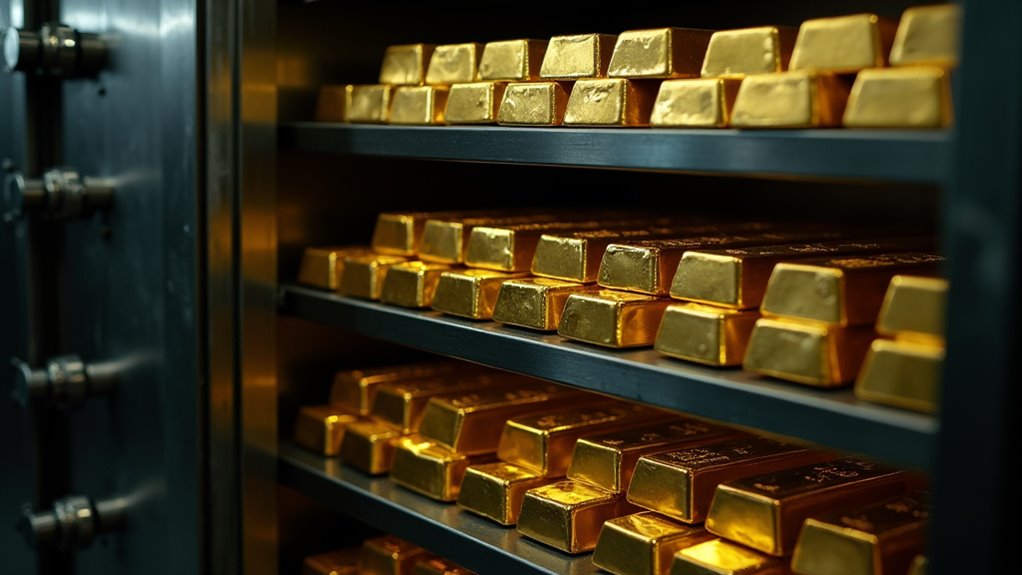
The global gold reserve rankings read like a who’s who of economic heavyweights! The United States dominates with a staggering 8,133.5 metric tons – that’s 76% of their foreign reserves, mostly chillin’ in Fort Knox. Germany follows with 3,352 tons (they’re bringing it all home), while Italy sits pretty at 2,451.8 tons. France maintains 2,436.9 tons, and Russia rounds out the top five with 2,333 tons. The real story lies in how these nations wield their golden power.

Five powerhouse nations collectively hoard over 18,700 metric tons of gold in their vaults – that’s enough shiny metal to make even Midas blush. The United States stands supreme, clutching a staggering 8,133.5 metric tons of the yellow stuff, representing 76% of its foreign reserves. Most of this glittering fortune lies beneath the legendary Fort Knox in Kentucky, where it’s been chillin’ since the Bretton Woods days. During periods of global economic uncertainty, gold has proven to be a reliable hedge against crisis. National gold reserves serve as a critical component of a country’s economic strategy and financial security, and they often reflect a nation’s geopolitical power. Moreover, these reserves can also enhance a nation’s monetary stability, providing further reassurance to investors and citizens alike. Notably, the accumulation of gold reserves often correlates with a nation’s economic strength, as central banks recognize gold’s role in maintaining financial security during turbulent times.
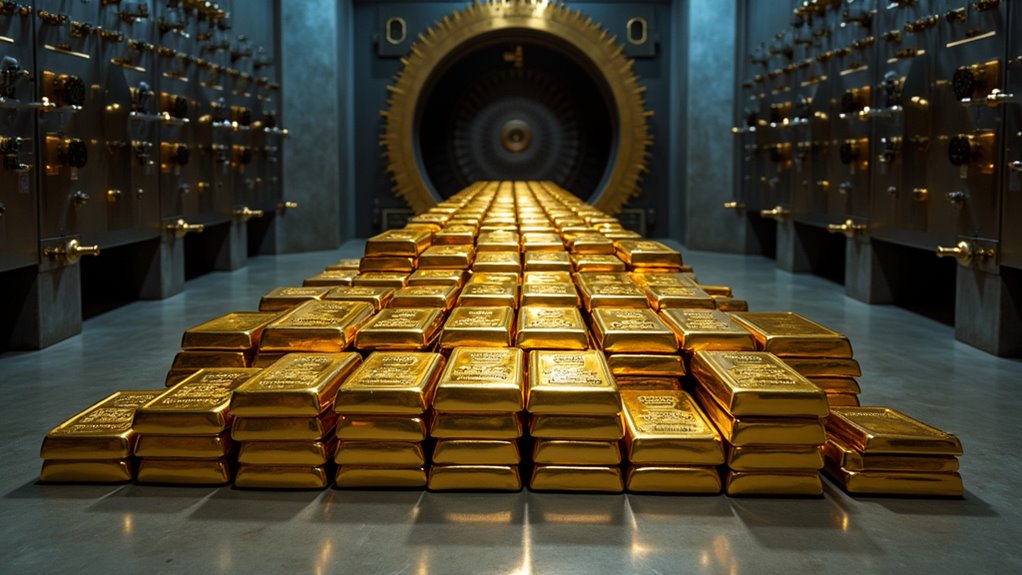
A mind-boggling mountain of gold sits locked away in five nations’ vaults, with Uncle Sam hoarding the biggest slice.
Germany follows with a respectable 3,352.0 metric tons, which ain’t too shabby considering their post-war recovery. The Germans have been playing it smart lately, slowly but surely bringing their gold back home from various international storage locations. They’ve learned the hard way that keeping all your eggs in someone else’s basket isn’t always the brightest idea.
Italy, despite its occasional economic hiccups, sits pretty with 2,451.8 metric tons. The Italians stayed strong during the eurozone crisis, giving a firm “hell no” to suggestions about selling their precious stash. Most of their gold chills in the Bank of Italy‘s vaults, with some vacation homes in the U.S., Switzerland, and the UK.

France comes in fourth with 2,436.9 metric tons, barely trailing behind Italy. The French keep most of their gold close to home in Paris, treating it like a strategic asset that’s too precious to mess with. They’ve basically adopted a “don’t touch it” policy, with their holdings remaining stable for years.
Russia rounds out the top five with 2,333.0 metric tons, while China‘s sitting at sixth place with 2,264.0 metric tons. But here’s where it gets interesting – China’s been going on a gold shopping spree lately, snatching up more faster than a bargain hunter at a Black Friday sale. Their strategy? Diversify those foreign exchange holdings and boost the yuan’s international street cred. These reserves provide economic insurance against potential currency collapse.
The whole game’s changed since 2010, when central banks switched from being net sellers to net buyers. It’s like they all suddenly remembered gold’s appeal as the ultimate insurance policy against economic chaos. These days, emerging markets are jumping on the bandwagon, stashing away gold like squirrels before winter. They’re clearly not putting all their faith in the mighty dollar anymore.
Managing these massive reserves ain’t no joke – we’re talking Fort Knox-level security, regular audits to make sure nobody’s pulled a fast one, and using the stuff as collateral for international loans. It’s basically like having a really expensive security blanket that the whole world agrees is valuable.

And let’s be real – nothing says “we’ve got our act together” quite like a few thousand tons of gold in the vault. Just don’t expect these countries to start showing off their stash anytime soon – some things are better kept under wraps, literally.
Frequently Asked Questions
How Deep Do Mining Companies Typically Dig to Find Gold Deposits?
Mining companies dig for gold at widely varying depths, from surface operations scraping just 100 meters deep to monster mines plunging 4,000 meters into Earth’s crust.
Most productive underground mines operate between 1,000-3,000 meters down – where things get seriously hot and sketchy.
South Africa’s legendary Mponeng mine takes the cake, reaching a mind-boggling 4km depth where temps soar and rock pressure’s enough to make your knees wobble!
What Environmental Impact Does Large-Scale Gold Mining Have on Local Ecosystems?

Large-scale gold mining devastates local ecosystems through multiple brutal impacts.
Massive open pits and underground tunnels fragment wildlife habitats, while toxic chemicals like mercury and cyanide poison water sources.
The industry dumps millions of tons of waste annually, contaminating soil and groundwater.
Acid mine drainage leaches heavy metals into rivers, killing aquatic life.

Deforestation and soil erosion complete the assault, leaving behind scarred landscapes that take decades to recover – if ever.
How Do Geologists Identify Potential Gold-Rich Areas Before Mining Begins?
Geologists employ a multi-layered approach to sniff out potential gold deposits. They analyze geological indicators like rock colorations and quartz veins, while deploying high-tech geophysical tools – magnetic surveys and gravity measurements that reveal what’s lurking below.
Geochemical sampling of soil, rocks, and water helps pinpoint anomalies, while cutting-edge tech like satellite imaging and AI crunches massive datasets to identify promising zones.
It’s like detective work, but with rocks!
What Percentage of Discovered Gold Reserves Is Technically Recoverable?

Gold recovery rates pack some serious variance, typically landing between 70-95% of discovered reserves, depending on essential factors like deposit type and extraction methods.
Economic conditions, technological capabilities, and environmental regs all play their part in determining what’s actually recoverable.
The deeper the deposit, the trickier (and pricier) recovery becomes.
When gold prices surge, previously uneconomic deposits suddenly become fair game – funny how that works!
How Long Does It Take to Develop a New Gold Mine?
Gold mines take an average of 15.2 years to develop from discovery to production – slightly faster than other metals!
The journey’s a wild ride: 11.9 years vanish into exploration and studies, while construction eats another 1-3 years.
Location’s everything tho – U.S. projects crawl at 29 years, while Ghana sprints at just 10-15.
Buckle up, because underground mines actually move quicker than open pits, despite what you’d think!