The Federal Reserve’s relationship with gold was a wild ride that shaped America’s monetary destiny! Established in 1913, the Fed initially maintained a 40% gold reserve requirement against currency issuance, linking every dollar to precious metal. But the Great Depression changed evrything – Roosevelt suspended the gold standard in 1933, and Nixon finally killed it in 1971. Today’s Fed runs on fiat currency, free from those golden shackles. The story of why they broke up is even juicier.

Money’s eternal dance with gold took center stage when the Federal Reserve entered America’s financial arena in 1913, creating a fascinating – and sometimes turbulent – relationship that would define U.S. monetary policy for decades. The Fed emerged with gold literally woven into its DNA, required to maintain a hefty 40% gold reserve against its currency issuance. Talk about a golden handcuff! Nearly 10,000 banks failed during the tumultuous period of the Great Depression. This reliance on gold as a core reserve asset made the Fed’s policies deeply intertwined with global economic conditions. At the time, the gold standard was seen as essential to ensuring trust in currency and preventing inflation. Moreover, the Federal Reserve’s gold holdings were not just a symbol of wealth; they were crucial for maintaining confidence in the U.S. dollar. The IMF’s role in gold management further underscored the importance of gold in stabilizing global economies.
The U.S. had already been rocking the gold standard since 1879, linking every dollar to a specific amount of the shiny stuff. This wasn’t just some glittery show – it was serious business that gave the greenback real muscle in international markets. But here’s the kicker: while it provided stability and fixed exchange rates, it also put the Fed in a seriously tight spot. Additionally, gold served as a vital tool for currency support, ensuring that monetary stability could be maintained.
The gold standard made the dollar a global heavyweight, but those fixed exchange rates had the Fed dancing on a tightrope.
Picture this: whenever gold started flowing out of the country, the Fed had to jack up interest rates faster than a cat chasing a laser pointer. This whole setup created a wild balancing act between protecting gold reserves and keeping the domestic economy from face-planting. The 1920 monetary contraction? Ouch! The Fed chose gold over growth, and boy did that decision come back to bite them.

The marriage between gold and the dollar hit rocky times during the Great Depression. By 1933, President Roosevelt was like “enough is enough” and suspended the gold standard faster than you can say “economic crisis.” The Federal Reserve watched its gold-exchange authority vanish into thin air, and the Gold Reserve Act of 1934 rewrote the rules of the game completely. The system’s demise was inevitable as advanced economies abandoned the gold standard throughout the early 1930s.
Then came the plot twist nobody saw coming (okay, maybe some did). The Bretton Woods system in 1944 tried to keep the gold-dollar relationship on life support, but by 1971, Nixon pulled the plug entirely. Suddenly, the Fed found itself in uncharted territory – no more golden shackles, just pure fiat freedom baby!
Without gold calling the shots, the Federal Reserve could finally spread its wings. Open market operations became their new best friend, and they could actually focus on domestic economic objectives without constantly looking over their shoulder at gold reserves.
Sure, some folks still dream about bringing back the gold standard – like that ex you just can’t forget – but most economists say “thanks, but no thanks.”

Today’s Fed might not have that golden glow, but it’s found other ways to keep prices stable. They’ve swapped rigid gold rules for inflation targeting, proving you don’t need a precious metal to make precious decisions about monetary policy.
Though let’s be real – the debate over whether ditching gold was genius or madness still rages on in certain circles, kinda like arguing whether pineapple belongs on pizza. (Spoiler alert: it totally does, fight me!)
Frequently Asked Questions
How Did the Gold Standard Affect International Trade During the Great Depression?
The gold standard severely restricted international trade during the Great Depression. As countries desperately clung to their gold reserves, they implemented devastating protectionist policies.
The Smoot-Hawley Tariff sparked a global trade war, with nations retaliating through tariffs and import quotas. U.S. exports plummeted from $5.2B to $1.7B between 1929-1933.

Countries that abandoned the gold standard earliest, like the UK in 1931, recovered faster than those who stubbornly held on.
What Role Did Private Banks Play in Maintaining Gold Reserves?
Private banks played an essential role in the gold standard era by maintaining substantial gold reserves to back their issued currency.
They were required to hold specific amounts of gold to guarantee note convertibility, fundamentally promising to exchange paper money for physical gold on demand.
These banks carefully managed their reserves, adjusting holdings based on economic conditions and regulatory requirements.

The system worked until the Federal Reserve’s establishment gradually centralized reserve management.
Could the Gold Standard Ever Make a Comeback in Modern Economics?
The debate around returning to the gold standard continues to spark passionate discussions among economists, politicians, and financial experts. While this monetary system once served as the backbone of the global economy, its potential revival in today’s complex financial landscape raises important questions and concerns.
The gold standard, abandoned by the United States in 1971, linked the value of currency directly to gold. This system provided stability and prevented governments from printing money arbitrarily. During its peak from 1871 to 1914, it helped maintain fixed exchange rates between participating countries and controlled inflation effectively.
Proponents of returning to the gold standard argue that it could restore fiscal discipline. They suggest it would limit government spending, prevent currency devaluation, and provide a more stable monetary foundation. The system could theoretically protect against the kind of runaway inflation that concerns many economists today.

However, the challenges of implementing a modern gold standard are substantial. The U.S. economy, valued at approximately $25 trillion, dramatically exceeds its gold reserves worth about $543.5 billion. This disparity would require either a massive increase in gold prices or a significant expansion of reserves – both presenting their own complications.
Moreover, most economic experts oppose returning to the gold standard. They argue that it would severely restrict monetary policy flexibility, particularly during economic crises when adaptability is essential. The system could potentially trigger deflation, creating hardships for debtors and limiting economic growth.
The gold standard also faces practical challenges in today’s interconnected global economy. Supply shocks in the gold market could create unexpected volatility, and the system’s rigidity might prove unsuitable for managing modern financial complexities.
Looking forward, while the gold standard’s principles of fiscal discipline remain attractive, its implementation appears highly unlikely. Current monetary policies, though imperfect, offer more flexibility and tools for managing economic challenges. The consensus among economists and central bankers suggests that alternative approaches to monetary stability are more appropriate for our contemporary economic landscape.
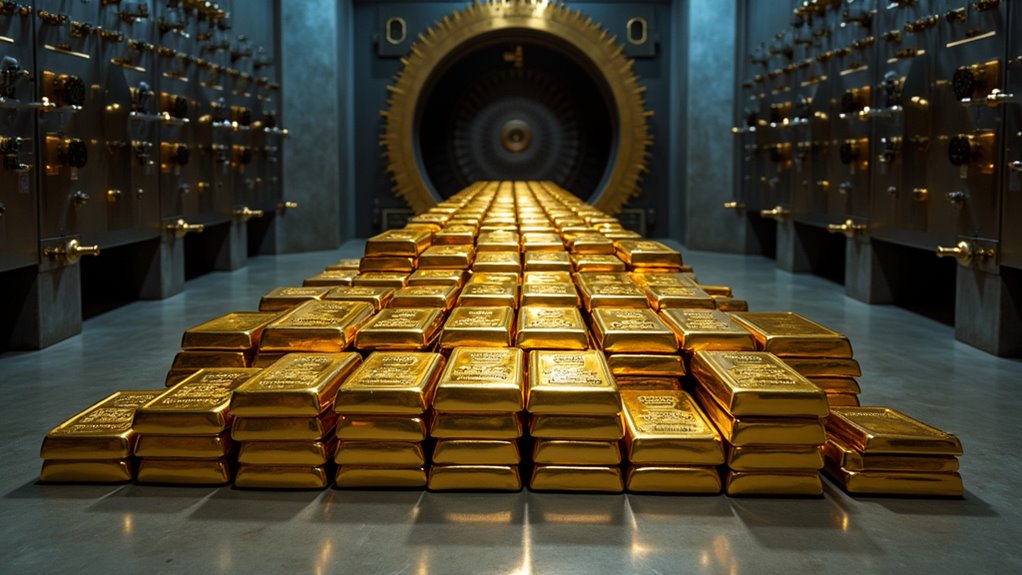
In conclusion, while the gold standard represents an important chapter in economic history, its revival faces significant practical and theoretical obstacles. The focus might better be placed on improving current monetary systems rather than attempting to resurrect a standard from the past.
This historical perspective reminds us that while seeking economic stability is vital, solutions must evolve with the times. The gold standard served its purpose in a different era, but modern economics requires modern solutions.
How Did Other Countries Respond to the US Abandoning Gold Standard?
The global response to America’s gold standard exit was chaotic and dramatic. Major economies quickly jumped ship – the Deutsche Mark and yen went floating and skyrocketed in value.
France, particularly ticked off, called it “America’s exorbitant privilege” and grabbed $191M in gold before the party ended. Switzerland snagged $50M too, while Britain’s attempted $3B gold grab basically forced Nixon’s hand.
The aftermath saw nations experimenting with independent monetary policies and floating exchange rates.
What Alternatives to Gold Were Considered Before Establishing the Federal Reserve?
Several alternatives competed with gold before the Fed’s creation. The silver standard gained massive support, especially after the controversial “Crime of ’73” demonetized silver.
Clearinghouse certificates emerged as emergency currency during panics, proving surprisingly effective.
The “Real Bills Doctrine” proposed backing money with commercial paper, while the Aldrich Plan suggested a hybrid system using both commercial assets and gold – ultimately inspiring the Fed’s final design.