The United States sits atop the global gold pyramid with a staggering 8,133.5 tonnes – that’s more than double Germany’s second-place stash of 3,351.53 tonnes! Most of America’s glittering hoard rests in Fort Knox, representing 77.5% of total foreign reserves. Germany, Italy, and France round out the top European players, while Russia and China have been aggressively building their reserves. The numbers tell only part of this precious story.

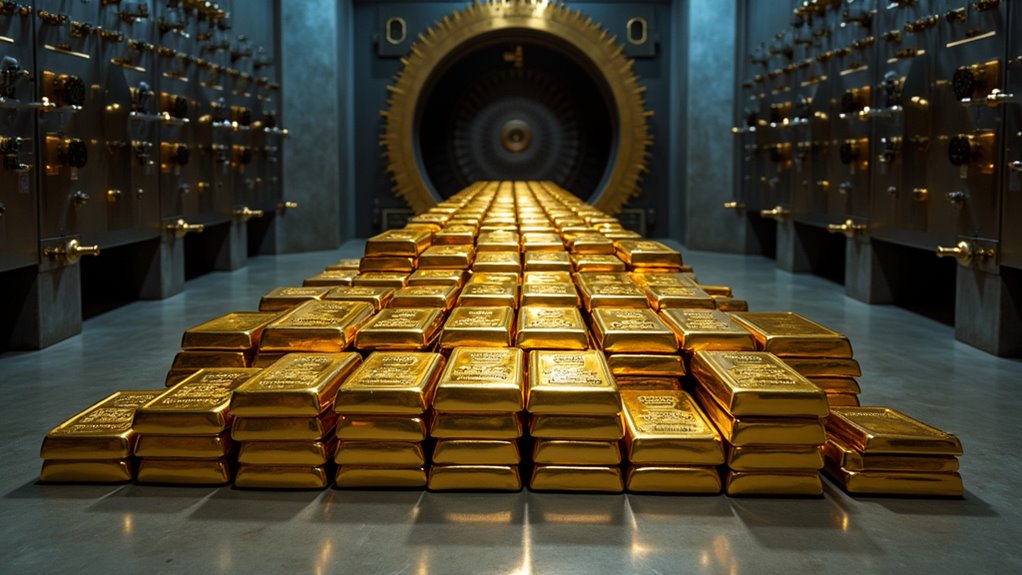
Precious metal powerhouse United States leads an elite club of nations hoarding massive gold reserves, with its mind-boggling 8,133.5 tonnes stashed primarily in Fort Knox‘s legendary vaults. That’s a whopping 77.5% of their foreign reserves – talk about putting your money where your vault is! The rest is scattered across various U.S. Mints and depositories, because hey, why keep all your golden eggs in one basket? The state of Texas has even created its own Bullion Depository for investors. These reserves help the U.S. maintain its position as a global economic leader. Additionally, the U.S. employs effective gold reserve management to balance security and liquidity. Gold reserves play a crucial role in stabilizing the financial system during economic fluctuations.
Coming in at a distant but still impressive second place is Germany, flexing its financial muscles with 3,351.53 tonnes. Those clever Germans have spread their precious cargo across Frankfurt, New York, London, and Paris. After their 2017 repatriation program (fancy word for “bringing the gold home”), they’ve got bragging rights as the country with the most gold per capita. Not too shabby for Europe’s economic powerhouse!
Italy, despite its occasional economic hiccups, sits pretty in third place with 2,451.84 tonnes. During the eurozone crisis, when everyone was screaming “Sell! Sell! Sell!”, the Italians just smirked and held onto their glittering stash. Most of it’s split between the Bank of Italy and some cozy spots in the United States, with the leftovers chillin’ in Switzerland and the UK.

France isn’t far behind, clutching 2,436.94 tonnes in its Banque de France vaults. They’ve been playing it cool since 2004, when they stopped selling their precious metal – and haven’t budged an ounce since 2012. That’s what we call a committed relationship!
Russia’s been on an absolute tear, muscling its way into fifth place with 2,333 tonnes. In 2017 alone, they snatched up 224 tonnes – talk about a shopping spree! With Western sanctions breathing down their neck, they’ve been ditching dollars faster than a hot potato and going full gold-bug.
China might be sixth with 2,192 tonnes, but don’t let that fool you – they’re the world’s biggest gold producer AND consumer. Since 2015, they’ve been showing their cards monthly, which is pretty transparent for a country that usually plays things close to the chest. Though gold only makes up a tiny 3.3% of their reserves, they’re definitely eyeing a bigger role for the yellow metal in their financial future.
Switzerland rounds out our golden seven with 1,040 tonnes. Sure, it might seem modest compared to the big boys, but pound for pound (or person for person), these folks are sitting on more gold than anyone else. Plus, they’re basically the switchboard operators of the global gold trade, especially when it comes to dealing with Hong Kong and China. Not bad for a country smaller than some U.S. states!
Frequently Asked Questions
How Do Countries Protect and Secure Their National Gold Reserves?
National gold reserves get the Fort Knox treatment worldwide.

Countries protect their precious metal behind layers of serious security: underground vaults sealed with massive steel doors, armed guards 24/7, and tech that’d make James Bond jealous.
Multi-person access protocols mean no lone-wolf heists, while sophisticated surveillance systems keep watch.
Climate-controlled storage prevents deterioration, and handling procedures are meticulous – down to wearing gloves when touching bars.
What Factors Influence a Country’s Decision to Increase Gold Holdings?
Countries boost their gold stash for a cocktail of reasons that’d make any economist’s head spin!

Economic defense tops the list – think inflation shields and portfolio diversification (yawn, but essential).
Then there’s the geopolitical chess game: dodging sanctions, flexing sovereign muscle, and giving the US dollar side-eye.
Oh, and let’s not forget market timing – some central banks fancy themselves gold traders, jumping in when prices look juicy.
It’s quite the golden party!
Can Citizens Invest in Their Country’s National Gold Reserves?
Citizens can’t directly invest in their country’s national gold reserves – that’s strictly off-limits! These holdings are exclusively managed by central banks for national financial stability.

However, plenty of indirect options exist: gold ETFs, sovereign bonds, and mining stocks let investors get their gold fix without touching the national stash.
Some governments even run special programs like India’s Gold Bond scheme, giving citizens a taste of that sweet, sweet sovereign gold action.
How Often Do Countries Audit Their Official Gold Reserves?
Most nations audit their gold reserves annually, though practices vary wildly.
The big players – like the U.S. – typically check 5% of holdings each year, completing full audits over decades (yep, decades!).

Europe’s central banks are obsessive, conducting yearly verifications, while some countries are… let’s say, less transparent.
Security concerns and massive quantities make thorough audits a logistical nightmare, but modern tech‘s making the process less painful.
Why Do Some Countries Store Gold Reserves in Foreign Nations?
Countries stash their gold abroad for a buffet of strategic reasons.
First up: security through diversification – spreading those shiny bars across multiple locations helps dodge geopolitical drama. Major financial hubs offer exceptional storage facilities with state-of-the-art protection, plus easy access for international dealings.
Some nations simply lack proper domestic vaults, while others leverage foreign storage to boost their creditworthiness and secure better loan terms.
It’s basically risk management 101!