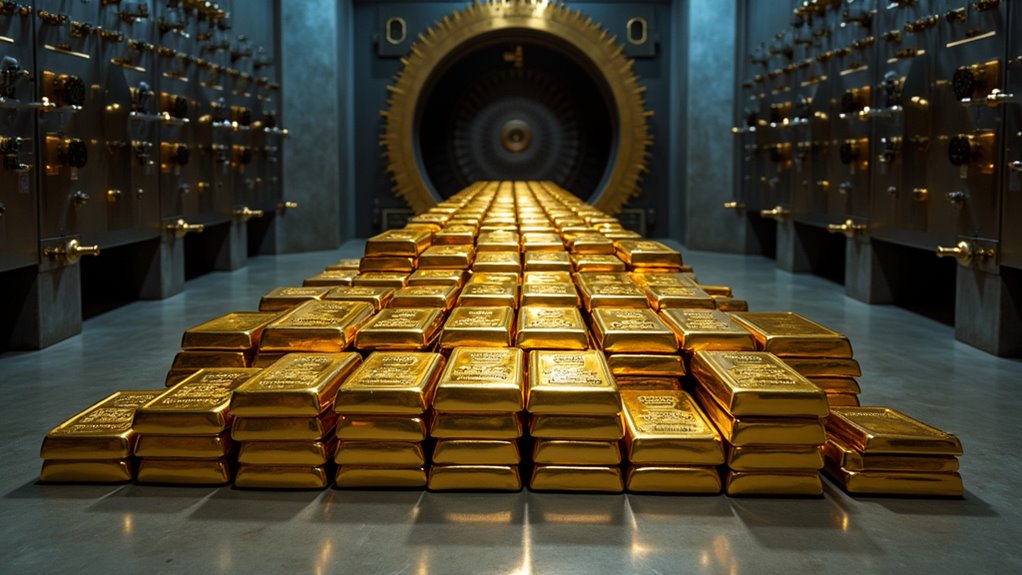
The Federal Reserve Bank of New York’s vault, nestled 80 feet below Manhattan’s streets, cradles a staggering 6,331 metric tons of gold worth $452 billion! This fortress of wealth, resting on bedrock and guarded by a 90-ton steel cylinder, holds mostly foreign-owned gold – a whopping 98% belongs to 36 different nations. Only 2% is Uncle Sam’s stash. Getting inside? You’ll need three Fed staffers, multiple locks, and nerves of… well, gold. There’s more beneath this concrete colossus than meets the eye.

A glittering fortress of wealth lies beneath the bustling streets of Manhattan, where the Federal Reserve Bank of New York guards the world’s largest known cache of monetary gold. Nestled 80 feet below street level and 50 feet below sea level, this massive vault houses an astounding 6,331 metric tons of gold bars – that’s roughly $452 billion worth of the precious metal as of 2024. Built atop solid Manhattan bedrock to support its immense weight, the facility was completed in 1924, with an eastern extension added in 1935. Construction required 99 concrete piers extending down to bedrock to support the tremendous weight of the vault and its contents.
The vault’s security measures are nothing short of extraordinary. A 90-ton steel cylinder protects the single entry point, while 24-hour video surveillance and motion sensors keep watch over the precious cargo. Three Fed staff members must be present to access the vault, and each compartment is secured with a padlock, two combination locks, and an auditor seal. A robotic system handles the movement of gold bars, while Federal Reserve police and trained marksmen stand guard. Staff must undergo Top Secret clearance level background checks before being granted access to the facility.
Fortress-like security protocols and multiple locks safeguard the world’s largest gold repository, with armed guards maintaining constant vigilance.
Inside the vault, approximately 497,000 gold bars are stored in 122 separate compartments, each bar weighing about 28 pounds. What’s fascinating is that 98% of this gold belongs not to the United States, but to central banks of 36 foreign nations. The U.S. government and international organizations own just 2% of the stored gold, with America’s share being approximately 13.4 million troy ounces. This significant amount highlights the global gold reserves held by various nations and their implications on international finance. The importance of gold as a core reserve asset ensures that central banks continue to value it highly in their holdings, underscoring its role as a hedge against inflation in turbulent economic times. Additionally, many central banks view gold as an important financial safeguard against currency fluctuations and geopolitical instability, as it serves as a trusted reserve asset in their monetary policy.

The facility’s historical significance cannot be understated. It emerged as a major financial hub during and after World War I, and by 1927, it held 10% of the world’s official gold reserves. The vault witnessed the largest gold transfer in history during its initial stocking, and its importance in post-WWII international finance earned it landmark status in 1966.
Today, the vault continues to serve as a vital facilitator of international trade and debt settlements. The Fed charges a modest $1.75 per gold bar moved, providing secure storage for foreign governments and central banks. No individuals or private sector entities are permitted to store their gold here – this exclusive club is reserved for sovereign nations and select international organizations.
While the actual vault compartments remain off-limits, the Fed offers free public tours where visitors can view a display sample of gold. Tens of thousands of curious minds pass through annually, learning about central banking and monetary policy. The facility’s five basement levels and 14 above-ground stories stand as a demonstration of America’s role in global finance.
The vault holds between 5-10% of the world’s gold reserves, making it an indispensable pillar of the global financial system. Its presence beneath Manhattan’s streets serves as a reminder of gold’s enduring value and the complex web of international financial relationships that keep the modern economy running. Despite digital currencies and evolving payment systems, this underground fortress remains as relevant today as when it first opened its massive doors nearly a century ago.
Frequently Asked Questions
How Much Gold Is Currently Owned by Foreign Countries at FRBNY?
Based on current FRBNY data, foreign nations hold approximately 6,204 metric tons of gold in those legendary underground vaults – that’s a whopping 98% of the total 6,331 metric tons stored there!
The remaining 2% belongs to Uncle Sam himself.

With 36 countries stashing their precious metal beneath Manhattan’s streets, it’s like an exclusive gold club where membership requires some serious bullion cred.
Talk about keeping your treasure close but your frenemies closer!
What Security Measures Protect the Gold Stored in the Vault?
The vault’s security is mind-blowingly intense!
We’re talking 80 feet underground with walls thicker than your average panic room.

The star of the show? A 90-ton steel door that’d make Fort Knox jealous.
Triple authentication’s required – biometrics, pins, voice checks – and no single person knows all the combos.
Plus, there’s 24/7 surveillance, armed guards, and robotic systems moving those sweet, sweet gold bars around.
Talk about Fort Knox on steroids!
Can Private Citizens Store Their Gold at the Federal Reserve?

No way, folks – private citizens can’t stash their gold at the Fed!
The New York Fed’s vault is strictly off-limits to individual investors, no matter how much they’re willing to pay.
It’s an exclusive club for foreign central banks and governments, who own about 98% of the stored gold.
The remaining 2%? That’s split between Uncle Sam and organizations like the IMF.

Regular folks gotta look elsewhere – think private vaults or bank deposit boxes.
How Often Is the Gold Audited and by Whom?
The U.S. gold reserves get quite the VIP treatment when it comes to audits!
The Treasury’s Office of Inspector General (OIG) conducts meticulous annual checkups every September 30th. They’re not messing around – in 2013, they ran 367 tests on 34,201 gold bars!
While independent outside auditors occasionally join the party, it’s mostly an internal affair.
The Fed’s vault stays locked tight – no private sector bean counters allowed in this exclusive club.
What Happens if Gold Bars Are Damaged During Storage?
Based on available docs, there’s a frustrating lack of transparency about damaged gold procedures at the NY Fed.
While they charge handling fees and report discrepancies to customers, specific protocols for damaged bars remain shrouded in mystery.
What we do know: they use hydraulic lifts and conveyor systems, require steel-toe boots, and staff work in shifts to minimize accidents.
But when damage happens? That’s kept under wraps tighter than their 90-ton vault door!