The gold reserve landscape reveals an elite club of nations hoarding massive precious metal stockpiles. The U.S. reigns supreme with 8,133.46 tonnes, while Germany trails with 3,351.53 tonnes. Italy, France, and Russia round out the top five, each clutching over 2,000 tonnes. These powerhouse nations’ vaults reflect their economic might and strategic thinking – though China’s recent buying spree might shuffle these rankings faster than you’d think.
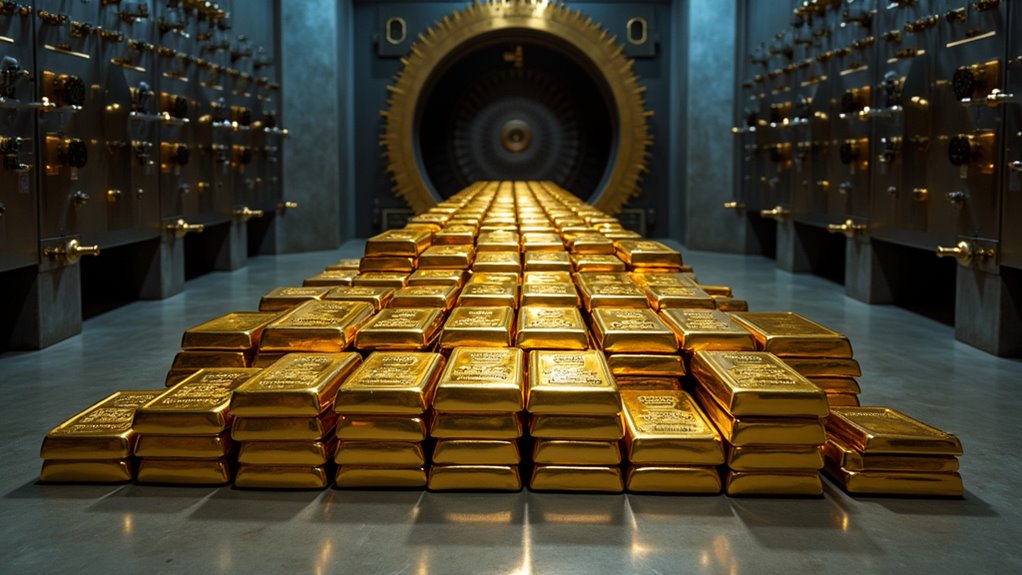
Seven nations sit atop the world’s gold-hoarding throne, each clutching their precious yellow metal like dragons guarding ancient treasure. Leading the pack with a staggering 8,133.46 tonnes is the United States, whose Fort Knox facility has become synonymous with impenetrable security. That’s a whopping 77.5% of their foreign reserves, and lets be honest, it’s enough to make other nations’ stockpiles look like pocket change. The country maintains its Nevada Gold Mines as a major operational hub for production, contributing to its status as a leader in global gold reserves. Furthermore, the U.S. utilizes gold as a core reserve asset to enhance its financial stability, reflecting a long-standing strategy of protecting economic interests.
Germany claims the silver medal with 3,351.53 tonnes, spreading its glittering wealth across Frankfurt, New York, London, and Paris. After years of playing “where’s my gold?” Germany finally got serious about bringing its precious metal home, repatriating significant amounts from foreign vaults. Smart move, considering how the economic winds blow these days.
Germany’s gold-hoarding saga shows that even economic powerhouses want their treasure close to home in uncertain times.
Italy, that boot-shaped guardian of 2,451.84 tonnes, stands firm at third place. During the eurozone crisis, while others were selling their gold like hot potatoes, Italy stood its ground. The Italians kept their reserves split between domestic vaults, the U.S., and a sprinkling in Switzerland and the UK – because who doesn’t love a good diversification strategy?

France follows close behind with 2,436.94 tonnes, managed by the ever-vigilant Banque de France. The French have always had a thing for gold, treating it like their economic insurance policy. Can’t blame them – when markets go crazy, gold keeps its cool. The 20% price surge in 2024 proved their strategy wise.
Russia’s been playing catch-up, muscling its way to fifth place with 2,335.85 tonnes. They’ve been stockpiling like there’s no tomorrow, clearly giving the U.S. dollar the side-eye while building their golden fortress.
Meanwhile, China sits at sixth with 2,264.32 tonnes, though that only accounts for a measly 4.91% of their foreign reserves. They’re playing it cool, but everyone knows they’re quietly amassing more.
Switzerland rounds out our top seven with 1,040 tonnes, proving size isn’t everything. These savvy Swiss have the highest gold reserves per capita globally, and they’ve turned their country into Europe’s golden hub. Their vaults have seen more action than a Black Friday sale, especially with Hong Kong and China throwing their weight around the precious metals market.

What’s fascinating is how these nations use their gold reserves like chess pieces in a global economic game. Some, like the U.S., maintain their historical dominance, while others, like Russia and China, are clearly plotting their next moves. The gold game isn’t just about who has the most anymore – it’s about who can play their cards right in an increasingly unpredictable world economy.
Frequently Asked Questions
How Do Countries Protect Their Gold Reserves From Theft or Natural Disasters?
Nations protect their precious metal stashes like paranoid dragons!
Underground fortresses with bomb-proof walls and massive steel doors guard these golden hoards, while elite security teams (armed to the teeth!) maintain 24/7 watch.
High-tech surveillance systems, biometric scanners, and time-locks keep sticky fingers away.

But here’s the real kicker – they spread their gold across multiple locations, cause y’know, never keep all your eggs in one vault!
What Happens to a Country’s Gold Reserves During Times of War?
During wartime, countries typically take drastic measures to protect their gold reserves. They often relocate precious metals to secure underground vaults or ship them to neutral nations for safekeeping.
Some governments might use their gold to finance military operations or stabilize their currency.
History shows that invading forces frequently target gold reserves – just look at Nazi Germany’s notorious gold grab during WWII.

It’s a high-stakes game of hide-and-seek with billion-dollar consequences!
Can Citizens Invest Directly in Their Country’s National Gold Reserves?
No, citizens typically cannot invest directly in their country’s national gold reserves.
Central banks jealously guard these shiny strategic assets, keeping them firmly under government control.
While the public’s locked out of this exclusive gold club, they’re not totally outta luck – plenty of other ways exist to get that golden fix: ETFs, mining stocks, physical bullion, futures contracts.
Some countries offer special programs, but direct access to national reserves? Fuhgeddaboudit!
How Often Do Countries Audit Their Gold Reserve Inventories?
Gold reserve audit frequency varies dramatically by nation, with no global standard in place.
While some countries like Switzerland conduct yearly external audits, others keep their verification process shrouded in secrecy.
The U.S. hasn’t done a complete audit since 1953 (yikes!), settling for annual 5% spot-checks.
Germany made waves in 2013 with a full audit, while Netherlands sneaks in regular secret counts.
Most nations keep their audit schedule close to the vest.
Which Countries Have Sold the Most Gold Reserves in Recent Decades?
Several European powerhouses dominated the gold-selling spree in recent decades.
Switzerland takes the crown, dumping a massive 1,300 tonnes between 2000-2008. The Netherlands wasn’t far behind, shedding 1,100 tonnes from ’92-’08.
The UK’s infamous “Brown Bottom” saw 395 tonnes sold at rock-bottom prices, while France ditched 589 tonnes.
Canada and Australia went all-in, with Canada selling its entire 500-tonne stash and Australia dumping 167 tonnes in ’97.