The fire assay method cuts through the BS when testing gold purity. It’s brutal but effective: crush the material, mix with flux agents, and heat to a scorching 1,000°C. The process forces precious metals to separate from worthless junk through a metallurgical tango with lead oxide. A final cupellation step burns off remaining impurities, leaving behind pure gold that’s measurable down to 0.01 grams per tonne. There’s way more to this ancient-meets-modern technique than meets the eye.

While modern technology keeps churning out fancy new ways to test gold purity, the fire assay method remains the undisputed champion of precious metal analysis. Dating back centuries, this tried-and-true technique hasn’t lost its edge – and for good reason. When you’re dealing with precious metals worth millions, you can’t afford to mess around with second-rate testing methods. Quality control measures established by LBMA ensure consistent results across testing laboratories worldwide.
The process kicks off with some serious sample prep work. Technicians crush and grind the gold-bearing material into a fine powder, weighing it with obsessive precision. They mix it with flux agents like borax and soda ash – yeah, the same stuff your grandma used for laundry. But don’t let that fool you. This isn’t some backyard science experiment; it’s a carefully orchestrated dance of chemistry that’s been perfected over generations. The addition of silver and lead helps ensure accurate binding of base metals during the process, and the use of flux materials improves the separation of precious metals from their ores.
Fire assay isn’t your grandma’s kitchen chemistry – it’s a precision dance of crushing, grinding, and mixing that’s centuries in the making.
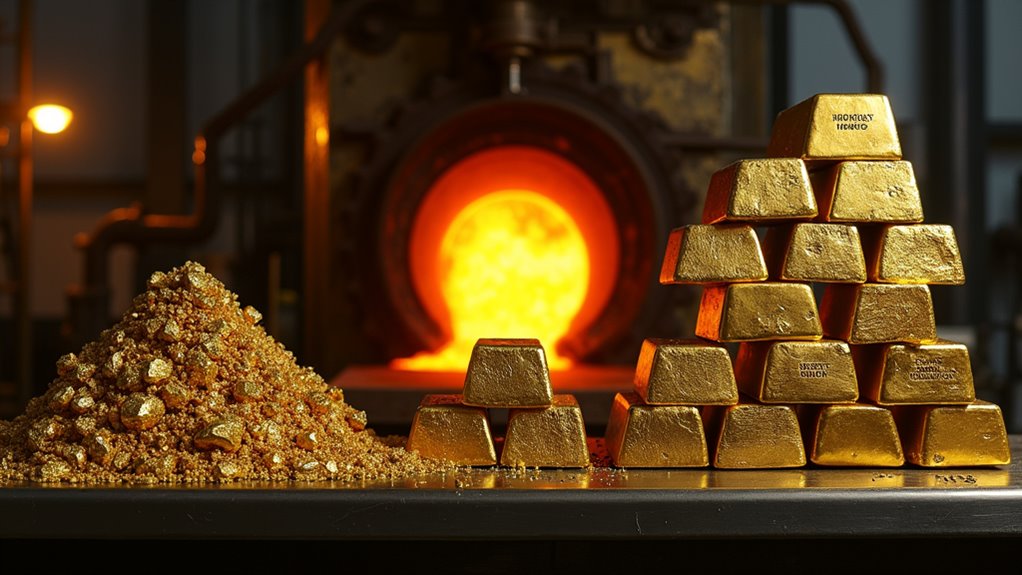
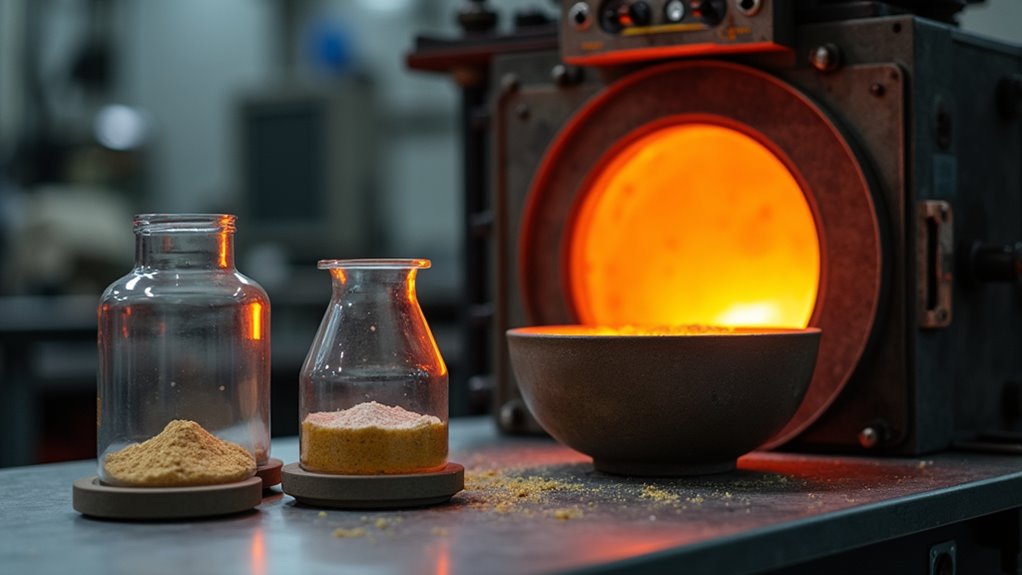
Then comes the fun part – cranking up the heat to a whopping 1,000°C. The sample gets cozy with lead oxide and silica in a furnace hot enough to make Satan sweat. As everything melts together, the impurities get absorbed by the flux, forming slag, while the precious metals buddy up with lead or nickel. It’s like a metallurgical high school dance, where the cool kids (gold and silver) stick together while the losers (impurities) get left behind.

The real magic happens during cupellation. The lead button – now containing our precious metals – gets heated again in a porous cupel. The lead oxidizes and gets sucked into the cupel like water into a sponge, leaving behind nothing but a tiny bead of pure precious metals. It’s basically nature’s way of separating the wheat from the chaff, except way more expensive.
When it comes to measuring the results, these folks don’t mess around. They’ve got everything from simple weighing techniques to fancy-pants methods like Atomic Absorption Spectroscopy and Inductively Coupled Plasma analysis. This isn’t just about getting numbers – it’s about getting numbers you can bet your company’s future on.
The fire assay method can detect gold content as low as 0.01 grams per tonne. That’s why over 80% of mining companies swear by it, despite all the shiny new alternatives out there. It’s essential for everything from mining feasibility studies to verifying that fancy engagement ring isn’t just glorified brass.
Sure, it’s not the cheapest or fastest method around, but when millions are on the line, who’s counting pennies? The fire assay method has earned its reputation as the gold standard of gold testing – pun absolutely intended. In a world of shortcuts and quick fixes, sometimes the old ways really are the best ways.
Frequently Asked Questions
How Long Does a Complete Fire Assay Test Typically Take?
A complete fire assay test isn’t a quick affair – it’s a marathon that typically runs 3-4 hours from start to finish.
And that’s if everything goes smoothly! Breaking it down: sample prep takes about an hour, fusion needs another hour, cupellation eats up another hour-plus, and final analysis adds another 60 minutes.

Sure, labs batch samples to save time, but there’s no rushing this beast of a process.
What Safety Certifications Are Required to Perform Fire Assay Testing?
Fire assay testing isn’t for casual hobbyists – you need serious creds to handle this stuff. HAZWOPER certification is non-negotiable since you’re dealing with hazardous materials.
Throw in mandatory fire safety, chemical handling, and PPE training. Don’t forget furnace operation certification – cause nobody wants an untrained person playing with 2000°F temperatures.
First aid and CPR are must-haves too. Most labs also require OSHA compliance and waste management training.
Can Fire Assay Testing Be Performed on Gold-Plated Items?

Fire assay testing is a terrible choice for gold-plated items – period.
It’s like using a sledgehammer to hang a picture frame. The method completely destroys the sample by melting it down, making it useless for analyzing just the plating.
Smart testers use non-destructive techniques like XRF or SEM instead.
These methods actually tell you about the plating thickness and purity without turning your item into an expensive puddle of molten metal.
What Is the Minimum Sample Size Needed for Accurate Results?

bigger samples = better accuracy.
And dont forget – finer grinding means more precise results, especially when dealing w/tricky materials.
How Much Does a Professional Fire Assay Test Usually Cost?
Professional fire assay testing ain’t cheap – expect to shell out $30-100 per sample for basic analysis.
Want the fancy detailed breakdown? That’ll set you back $50-150.
Sure, bulk discounts exist if you’re testing multiple samples, but rush services will cost ya extra.
Labs love tacking on fees too – sample prep ($10-30), shipping, handling hazardous materials, fancy reports.
Location and turnaround time affect pricing.
The whole thing’s a bit of a racket, honestly.