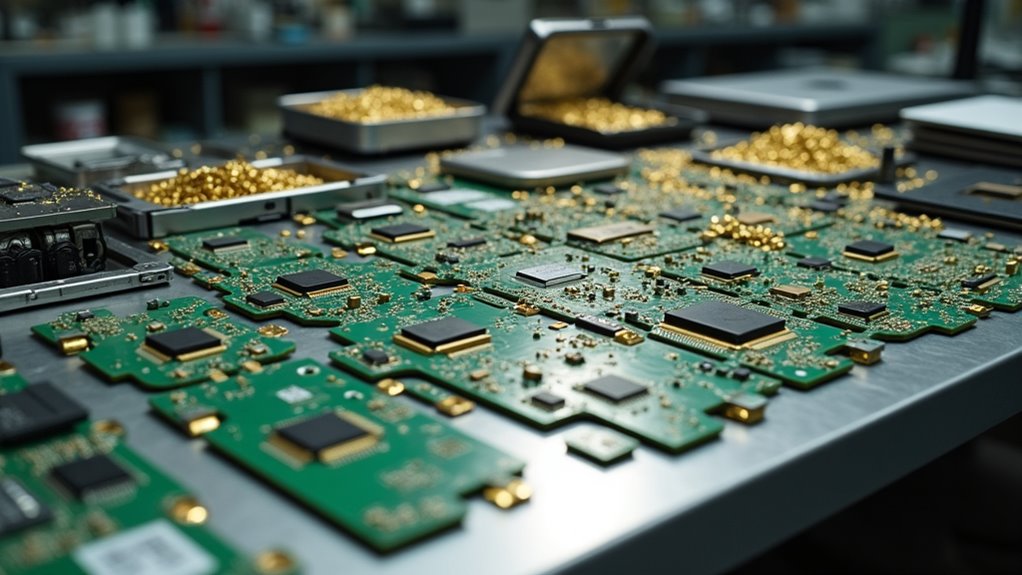
The circular economy is revolutionizing gold’s journey from mine to market – and it’s about damn time! Recycled gold‘s identical to fresh-mined stuff, but with way less environmental drama. Major players like Atlantic Copper and JX Nippon are jumping on the e-waste bandwagon, while traditional miners scramble to clean up their act. Despite only 20% of e-waste getting recycled (seriously, people?), the industry’s shifting towards sustainable practices. There’s more to this golden transformation than meets the eye.

While traditional gold mining continues to ravage ecosystems worldwide, the precious metals industry is finally waking up to circular economy practices – and it’s about damn time. The environmental toll of conventional gold mining is staggering, with toxic chemicals seeping into groundwater and pristine habitats being bulldozed for that precious yellow metal.
But here’s the kicker: we don’t actually need to keep digging up Earth’s guts to get our gold fix.
Enter recycled gold jewelry – the unsung hero of sustainable bling. It’s literally identical to newly mined gold (because, duh, it’s still gold), but without the whole ecosystem-destroying baggage. We’re talking about serious carbon emission reductions here, folks. The best part? Most gold recycling follows what’s called the “short loop” process, which is basically taking existing gold products and transforming them into new ones. It’s like magic, except it’s actually just smart metallurgy. Supporting recycled gold helps protect critical wildlife habitats from destructive mining operations. The industry’s focus on circulating materials at their highest value has revolutionized how gold is processed and reused. Overcoming challenges in gold recycling is essential to ensure that this process becomes more efficient and effective.
Recycled gold: same shine, zero destruction. Smart metallurgy transforms existing gold into fresh bling while Mother Nature breathes easier.

The industry giants aren’t sleeping on this trend either. Companies like Atlantic Copper are going all-in on e-waste recycling in Spain, while JX Nippon Mining & Metals is doing some seriously cool stuff with lithium-ion battery recovery. Even Vale’s getting creative, turning iron ore waste into sustainable silica – because why waste anything when you can turn it into something valuable?
But let’s not kid ourselves – there’re still some major hurdles to jump. Only about 20% of e-waste gets recycled globally (yikes!), and collecting end-of-life consumer goods is about as easy as herding cats. Plus, there’s the whole organized crime thing in informal mining sectors, which is… problematic, to say the least.
The future’s looking interesting though (intentional typo). Investors are practically foaming at the mouth for companies with solid ESG credentials, and consumers are demanding more sustainable options. Regulatory pressure is pushing the industry toward circular practices faster than a gold bug chasing a price spike. The potential for gold to contribute to climate change mitigation is actually pretty impressive, assuming we can get our act together.
The circular economy isn’t just some trendy buzzword – it’s transforming how we think about gold use from mine to market to recycling bin and back again. Mining companies are finally getting serious about reducing waste, using renewable energy, and optimizing water usage. They’re even trying to regenerate closed mine sites, which is kinda like apologizing to Mother Nature for the mess.

Bottom line? The gold industry is slowly but surely embracing its circular future. It’s not perfect – nothing ever is in this biz – but it’s a hell of a lot better than continuing to punch holes in the planet while pretending there’s no tomorrow. And for once, what’s good for the environment might actually be good for business too. Imagine that.
Frequently Asked Questions
How Does Gold Recycling Impact Local Communities and Job Markets?
Gold recycling creates jobs in e-waste processing and tech development, while potentially disrupting traditional mining communities.
The shift generates ~£12m GVA per recycled tonne, but impacts millions of miners across 70 countries.
Some mining regions are adapting by repurposing sites for tourism, renewable energy projects, and eco-restoration.

The change brings both challenges and opportunities – communities must balance economic benefits with social costs as recycling reshapes local job markets.
What Role Do Blockchain Technologies Play in Tracking Recycled Gold?
Blockchain tech is revolutionizing recycled gold tracking with unbreakable digital fingerprints. Every gram gets its own digital passport, complete with QR codes that spill the tea on where it’s been.
Smart contracts are crushing it, automating the boring stuff while slashing costs. The real MVP? Transparency. Buyers can finally know their bling’s genuine recycled status.
Sure, there’re still some growing pains – scalability’s a beast, and different systems need to play nice together.
Can Gold Lose Its Quality Through Multiple Recycling Processes?

Gold stands as nature’s ultimate recycling champion – it simply doesn’t degrade through repeated recycling.
When properly processed, gold maintains its physical properties and purity indefinitely. Unlike most metals that deteriorate over time, gold’s atomic structure remains stable through countless melting cycles.
However, poor handling during recycling can introduce impurities or cause contamination. But that’s human error, not gold’s fault – the metal itself stays pristine when recycled correctly.
Which Countries Are Leading Innovations in Gold Circular Economy Practices?
Sweden and Finland are crushing it in gold recycling tech, with Stockholm’s Royal Institute of Technology pioneering hydrometallurgical processes that’re shaking up the industry.
Meanwhile, the Dutch are flexing their circular muscle with advanced urban mining projects – they’re literally extracting gold from e-waste like nobody’s business!
China’s no slouch either, implementing massive-scale precious metal recovery systems that’ve got everyone’s attention.
Switzerland’s refineries remain the gold standard (pun intended) for recycling efficiency.
How Do Insurance Policies Differ for Recycled Versus Newly Mined Gold?
Insurance for recycled gold typically comes with lower premiums and simpler underwriting, reflecting its reduced environmental risks.
Meanwhile, newly mined gold demands heftier coverage due to extraction hazards and potential environmental liabilities.

What’s interesting? Recycled gold policies zero in on authenticity and market value, while newly mined coverage requires strict mining standards compliance and often includes reputational damage protection.
Both face similar theft risks, but their paths to protection couldn’t be more different.