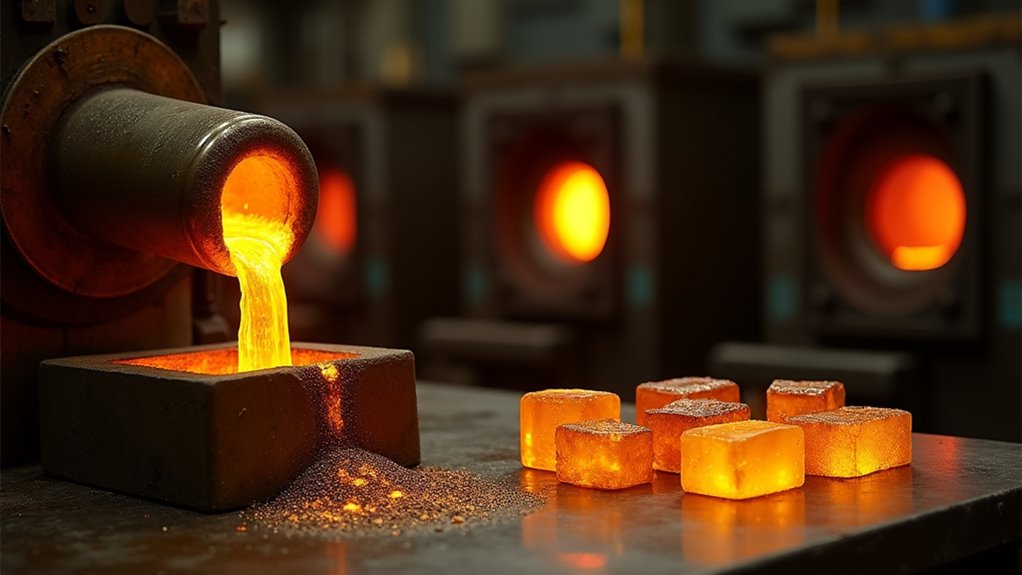
Gold-germanium alloy packs quite the punch with its 88-12 composition ratio. This eutectic powerhouse melts like clockwork at 356°C, delivering the goods for high-stakes electronics. Its thermal conductivity (44 W/m·K) and tensile strength (0.18 MPa) might not break records, but who needs brute force when you’ve got finesse? Perfect for semiconductor applications where failure isn’t an option – and there’s way more to this metallic marvel than meets the eye.

The marriage of gold and germanium creates an alloy that’s nothing short of scientific wizardry. This remarkable combination, typically consisting of 88% gold and 12% germanium, exhibits properties that make engineers and metallurgists absolutely giddy. Its eutectic nature means it melts and solidifies at a precise temperature of 356°C – no messy in-between states here, folks. And let’s be honest, who doesn’t love a metal that knows exactly what it wants?
The mechanical prowess of this alloy is fascinating, though perhaps not earth-shattering. With a tensile strength of 0.18 MPa, it’s not exactly winning any weightlifting competitions, but it’s got enough muscle to handle most applications. What’s truly impressive is how this seemingly modest material transforms from soft, pure gold into something substantially harder when germanium joins the party. It’s like watching a wallflower suddenly become the life of the metallurgical dance.
While not the strongest metal around, this gold-germanium alloy transforms from wallflower to powerhouse when its elements unite in perfect harmony.
When it comes to thermal properties, this alloy is a real showoff. Boasting a thermal conductivity of 44 W/m·K, it’s basically the express train of heat transfer. This characteristic makes it invaluable in electronics, where keeping things cool is literally hot stuff. The material maintains its composure through repeated heating and cooling cycles, like a seasoned professional who’s seen it all and refuses to crack under pressure. Moreover, the use of gold’s conductivity enhances heat transfer efficiency, making it ideal for various applications. Gold’s unique properties, such as its resistance to tarnish, further contribute to the longevity of electronic components. Interestingly, the presence of gold in smartphones highlights its reliability and conductivity in compact tech.

The electrical properties are where this alloy really struts its stuff. Its exceptional conductivity makes it a superstar in the semiconductor world, where it’s basically the cool kid everyone wants to work with. The homogeneous structure guarantees consistent performance – no surprise mood swings here. It’s like the reliable friend who always shows up on time and never cancels plans.
In practical applications, this alloy has found its way into some seriously high-tech scenarios. From soldering delicate electronic components to creating thin films in sophisticated devices, it’s the go-to material when precision and reliability are non-negotiable. Its resistance to oxidation and corrosion means it can handle harsh environments without throwing a tantrum, making it perfect for aerospace and military applications where failure isn’t an option.
The eutectic behavior of this alloy is particularly significant. It shifts from liquid to solid with the precision of a Swiss watch, making it ideal for manufacturing processes where control is essential. This characteristic reduces thermal stress in components and results in higher-quality bonds – because nobody likes a flaky connection, whether in relationships or electronics.
Additionally, the use of gold in the alloy contributes to its critical role in semiconductor technology, enhancing performance and stability in microchips. Storage and handling require some basic precautions, but compared to more temperamental materials, this alloy is relatively low-maintenance. Just keep it sealed and well-ventilated, and it’ll be your loyal metallic companion for years to come.
Frequently Asked Questions
What Temperature Range Is Ideal for Storing Gold Germanium Alloys?
The ideal storage temperature for gold-germanium alloys sits comfortably between room temperature (20°C) and about 250°C – well below its critical 300-365°C annealing range.
Experts recommend keeping these precious compounds in cool, dry environments to prevent any unwanted structural changes.

While the alloy can handle brief exposure to higher temps, long-term storage should stay far away from that spicy 356°C melting point.
Talk about keeping your cool!
Can Gold Germanium Alloys Be Recycled Effectively?
Gold-germanium alloys rock the recycling scene with impressive recovery rates – we’re talking 90%+ for gold and 76% for germanium. Pretty slick!
Advanced treatment tech makes it possible to separate and reuse these metals infinitely without losing their mojo.

Sure, there’re some hurdles (collecting scrap can be a pain), but the environmental and economic payoff is huge.
The process isn’t perfect – some germanium gets lost along the way – but it’s remarkably efficient overall.
How Does Radiation Exposure Affect Gold Germanium Alloy Performance?
Radiation exposure considerably impacts gold-germanium alloy’s structural integrity and performance.
Fast neutrons create nasty defects in the crystalline structure, while ionizing radiation disrupts electrical conductivity – not exactly what you want in high-tech applications!

The material can experience swelling, increased brittleness, and altered electrical properties.
Though shielding helps mitigate damage, prolonged exposure definitely takes its toll, affecting everything from corrosion resistance to semiconductor functionality.
It’s a rad problem that needs careful management!
Are Gold Germanium Alloys Safe for Medical Implant Applications?
Gold-germanium alloys show promising safety profiles for medical implants, thanks to gold’s exceptional biocompatibility and germanium’s structural benefits.
Research indicates minimal risk of toxic effects when properly manufactured. However, patient-specific testing remains essential, as some individuals may show sensitivity.

While generally MRI-conditional, these alloys require careful screening. The FDA’s rigorous review process has found them suitable for various implant applications when manufactured to spec.
What Cleaning Methods Are Recommended for Gold Germanium Alloy Surfaces?
Several effective cleaning methods exist for gold germanium alloy surfaces.
Mild detergents mixed with warm water work well for basic cleaning, while spectroscopic-grade acetone removes stubborn stains and watermarks.
Soft, lint-free cloths and gentle brushes prevent surface damage. It’s essential to avoid harsh abrasives and ultrasonic cleaning.

For best results, start with compressed air to remove debris, then use damp microfiber cloths in circular motions, followed by thorough drying.