Gold wasn’t just shiny stuff for Pre-Columbian societies – it was their cosmic hotline to the divine domain! These ancient American civilizations mastered advanced metalworking techniques as early as 1500 BCE, with Colombian artisans becoming absolute legends at lost-wax casting. From Peru to Mexico, gold functioned as spiritual tech, with priests and rulers decking themselves out in solar-powered bling to channel divine authority. The deeper story of gold’s cultural grip awaits beneath the surface.
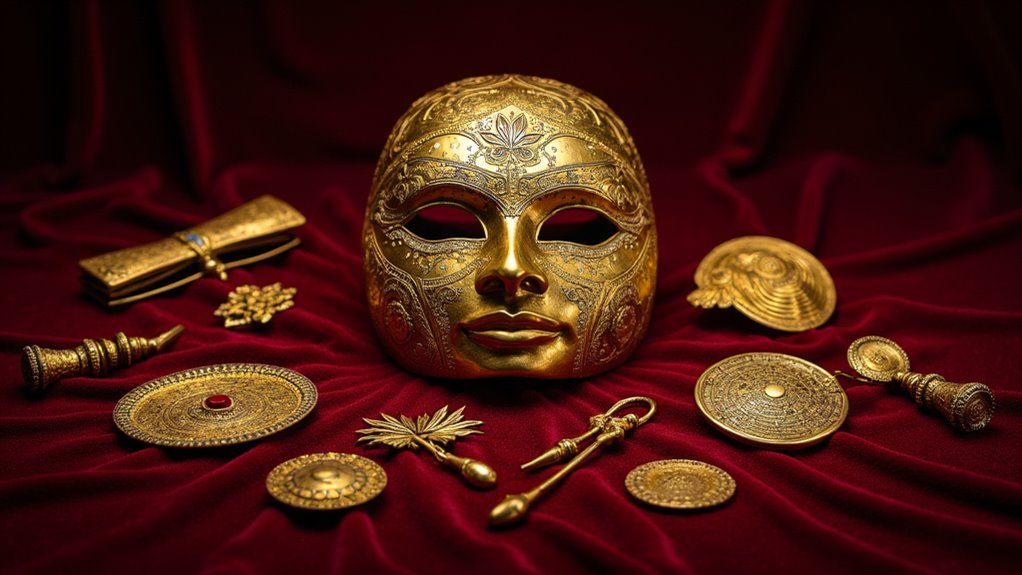
Glitter and glory – the story of gold in pre-Columbian civilizations transcends mere precious metal status. Ancient Americans didn’t just mine and craft gold; they infused it with cosmic significance, viewing it as a bridge between earthly existence and divine domains. This gleaming metal, resistant to tarnish and decay, became the perfect metaphor for immortality and sacred power, especially through its connection to the sun’s radiance.
The technical evolution of goldworking is a reflection of human ingenuity. Starting with simple hammering of native metals, artisans developed increasingly sophisticated methods. By 1500 BCE, South American craftsmen were turning out intricate sheet metal works, while the lost-wax casting technique emerged around 400 BCE in Colombia and Ecuador. These innovations spread northward like wildfire, riding trade routes and cultural exchanges across the Americas. Many of these techniques highlighted environmentally responsible mining practices that respected the natural resources, which were crucial in shaping sustainable gold mining industry practices.
Regional variations tell a fascinating tale of cultural priorities. While Classic Maya showed relatively modest interest in gold, their southern neighbors went absolutely bonkers for it. Peruvian cultures like Cupisnique were cranking out mind-blowing artifacts by 700 BCE, while Colombian artisans basically wrote the book on lost-wax casting. The La Tolita craftsmen of Ecuador-Colombia took things to a whole new level, experimenting with alloys that would make modern metallurgists jealous.

But here’s where it gets really interesting – gold wasn’t about wealth hoarding or economic power. These societies used gold to express deep spiritual connections and maintain social order. Elite figures draped themselves in golden regalia not just to flex their status but to manifest divine authority. Priests and rulers wore elaborate masks and ornaments that literally caught the sun’s rays, recharging their spiritual mojo in plain sight of their awestruck subjects.
Trade networks spread these golden innovations like a sophisticated game of telephone. Colombian seafarers became the unlikely metallurgical influencers of Mesoamerica, while regions rich in gold deposits transformed into production powerhouses. These weren’t simple commodity exchanges – we’re talking about complex networks where gold artifacts were traded for other precious materials like jade, creating intricate webs of value and meaning.
The archaeological record shows just how deep this golden obsession ran. Burial sites across the Americas reveal gold objects carefully positioned to maintain the deceased’s spiritual connections in the afterlife. These weren’t just grave goods – they were spiritual technology, designed to bridge the gap between worlds. The Aztecs and Mixtecs took this concept and ran with it, creating movable ornaments that combined cutting-edge craftsmanship with profound symbolic meaning. Gold in ancient Egypt served as a powerful reminder of the divine significance attributed to this precious metal across cultures.
In the end, pre-Columbian gold wasn’t just about the shine – it was about the divine.
Frequently Asked Questions
How Did Ancient Americans Determine the Purity of Their Gold?
Ancient Americans mastered three key methods for testing gold purity.

The touchstone technique left telltale streaks that revealed gold content through color comparison.
Fire assaying, though destructive, gave precise results by melting samples with lead.
And for those precious pieces they couldn’t melt? Specific gravity testing did the trick – dunking gold in water to measure density.
Pretty clever for folks working without modern labs, wouldn’t ya say?
What Tools Did Pre-Columbian Goldsmiths Use to Create Their Artifacts?
Pre-Columbian goldsmiths wielded an impressive arsenal of tools. Stone hammers (often magnetite) and anvils formed their basic kit, while specialized copper and gold implements handled delicate work.

They’re rocking everything from basic stone chisels to fancy metal tools – talk about resourceful!
Surface treatment? These artisans crushed it with cold hammering, sand polishing, and some killer granulation techniques.
Lost-wax casting and repoussé methods let em’ create those jaw-dropping detailed pieces we’re still drooling over today.
Were There Specific Religious Ceremonies Associated With Gold Mining?
Pre-mining rituals were serious business!

Indigenous miners performed elaborate ceremonies to appease Earth deities before breaking ground. They’d fast, make offerings of coca leaves, and pour chicha (fermented corn beer) into the ground.
Some tribes believed gold was the “sweat of the sun” and required special prayers at dawn. Local shamans led these rituals, burning sacred herbs while workers chanted – all to guarantee safe extraction and the deity’s blessing’s.
How Did Different Tribes Trade Gold Across Long Distances?
Tribes navigated complex networks of rivers, coastal routes, and mountain paths to trade gold across vast distances.
The Amazon and Mississippi served as liquid highways, while coastal traders skimmed shorelines in small vessels.
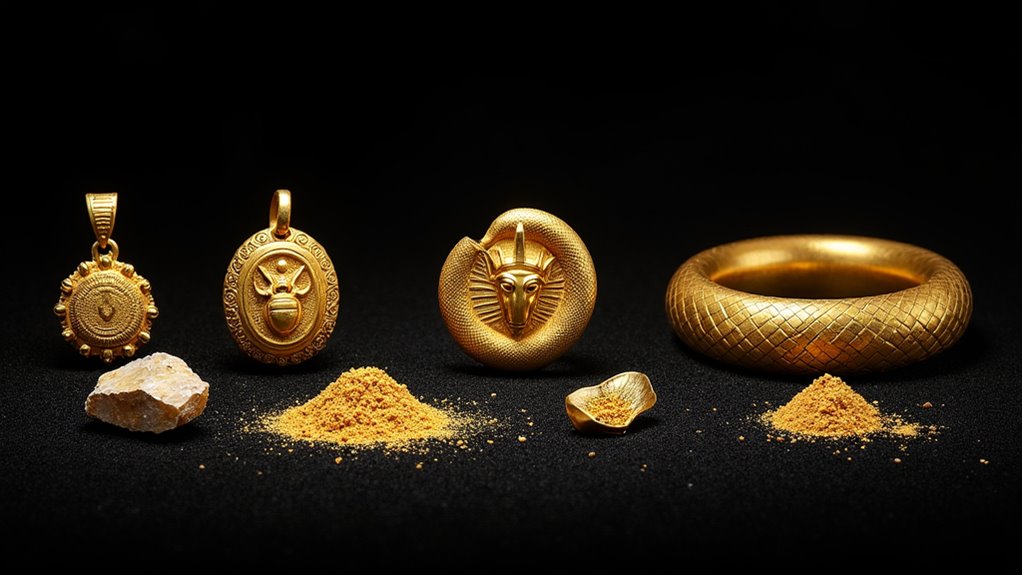
In the Andes, llama caravans hauled precious cargo through treacherous terrain.
Porters hoofed it through Mesoamerica, carrying lightweight gold items like sheets and ornaments.
These intricate trade routes weren’t just about gold – they fostered cultural exchanges too.
What Happened to Most Pre-Columbian Gold Artifacts During Spanish Colonization?
The Spanish colonizers systematically destroyed most Pre-Columbian gold artifacts, melting them down into transportable ingots for shipment back to Spain.

Sacred objects, ceremonial pieces, and intricate jewelry were ruthlessly converted into raw gold bars. The Crown demanded up to 20% in taxes on melted profits, which intensified the destruction.
Only a tiny fraction of these masterpieces survived – mostly items hidden by indigenous peoples or buried in remote locations.