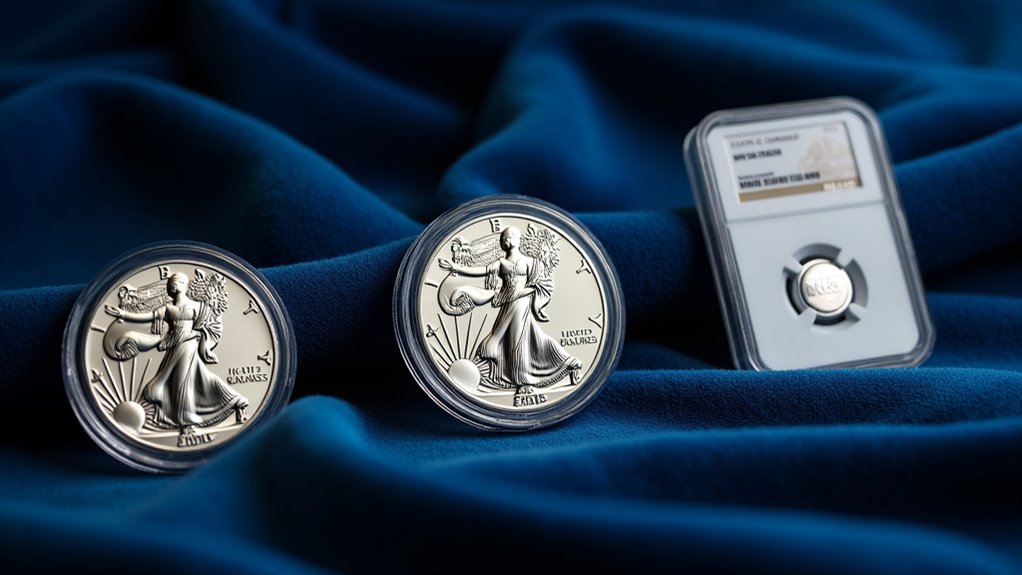
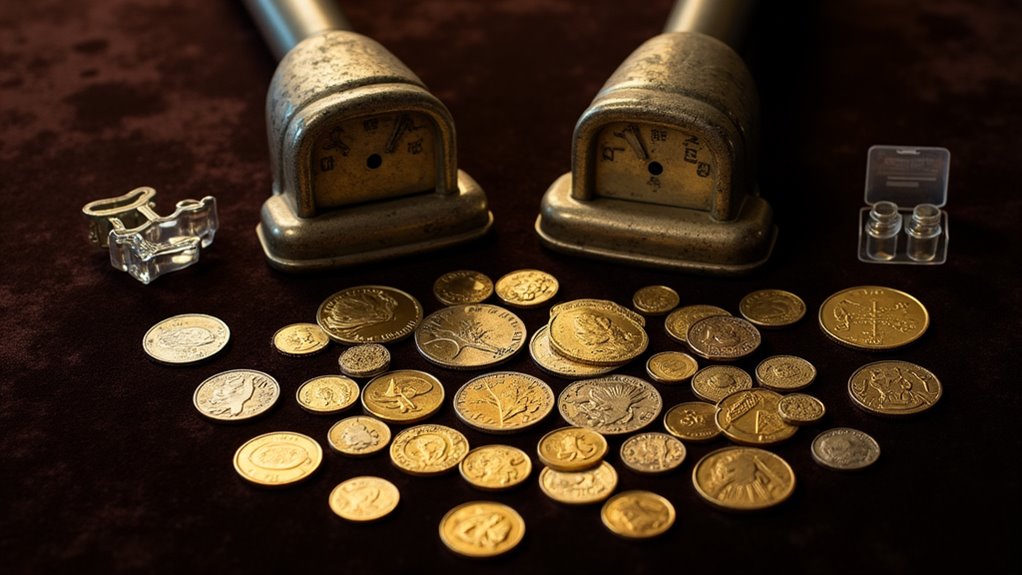
Gold coins burst onto the scene in ancient Lydia around 600 BCE, when King Croesus minted those first electrum staters with roaring lions. The innovation spread like wildfire – Greeks, Persians, and Romans all jumped on the golden bandwagon, minting their own prestigious pieces. Medieval times saw the bezant and ducat dominate trade routes, but by the 20th century, gold coinage took a backseat to paper money. Today’s bullion coins? Pure investment plays, baby – there’s way more to this glittering story.

While ancient civilizations had long treasured gold as a precious metal, it wasn’t until around 600 BCE that the Kingdom of Lydia revolutionized commerce by minting the world’s first standardized gold coins. Under King Croesus, the Lydians produced electrum staters featuring a roaring lion design, setting off a chain reaction that would transform the ancient world’s economic landscape.
Ancient Lydia changed history forever by creating standardized gold coins, sparking an economic revolution that shaped civilizations for millennia to come.
The Greeks quickly caught on, with Athens leading the charge by introducing their own gold staters in the 5th century BCE. When Persia conquered Lydia, they didn’t just grab territory – they snatched up the whole concept of gold coinage, churning out those gleaming drams that served both as currency and royal gifts.
The Romans, never ones to be left behind, jumped on the gold coin bandwagon with their aureus in 46 BCE. Talk about a power move – these coins weren’t just money, they were mini billboards showcasing imperial might!

Medieval times saw gold coins really hit their stride, despite being about as rare as honest politicians. The Byzantine solidus (later known as the bezant) became the medieval world’s MVP of international trade, while Islamic dinars spread faster than gossip in a market square. Not to be overlooked, Canadian Maple Leaf gold coins later emerged as a symbol of purity and investment confidence, reflecting how gold’s role in monetary systems has evolved over centuries. Interestingly, nations like the United States and Germany currently hold significant gold reserves to bolster their financial stability.
Then came Europe’s golden boys – the Florentine florin and Venetian ducat, which basically wrote the rulebook for Renaissance commerce. The discovery of New World gold sent European mints into overdrive. Spanish doubloons started popping up everywhere like mushrooms after rain, while the British got fancy with their perfectly-weighted Guineas.
Those 16th and 17th century mint masters weren’t messing around – they developed techniques that made their coins tougher than a two-dollar steak. But here’s where things get intresting (sic) – the 19th century marked the beginning of the end for everyday gold coins.
The gold standard made them kings of international trade, but the Great Depression hit like a financial hurricane. Suddenly, everyone was clutching their gold coins tighter than a miser with his last penny. By the early 20th century, most nations were saying “sayonara” to gold coinage, with the U.S. even dropping its bombshell 1933 executive order banning private gold ownership.
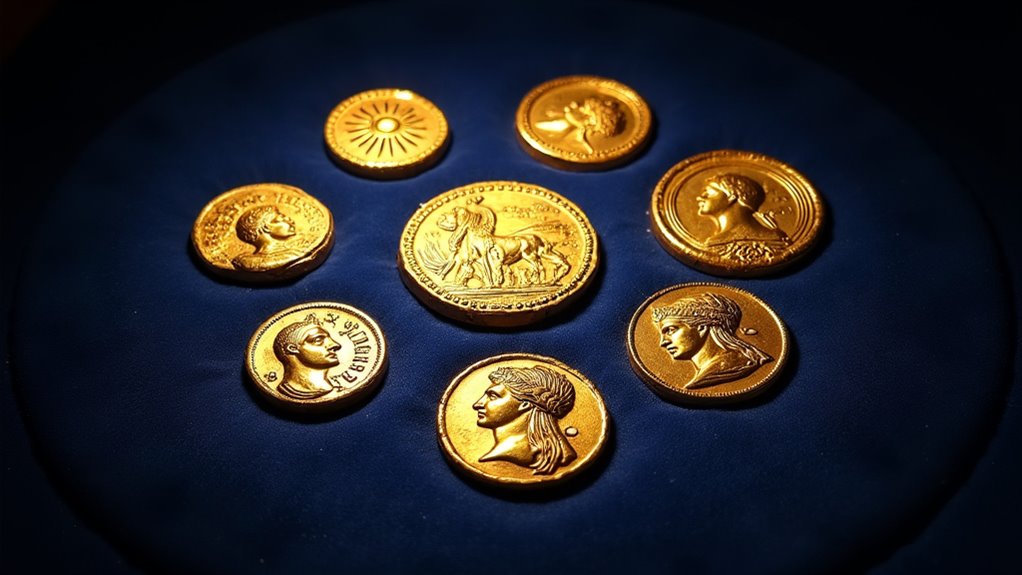
Fast forward to 1967, and South Africa’s Krugerrand crashed onto the scene, ushering in the modern era of bullion coins. These newcomers weren’t your grandfather’s spending money – they were pure investment plays, joined later by heavy hitters like the American Gold Eagle and Canadian Gold Maple Leaf.
Today’s gold coins might not buy your groceries, but they’re still turning heads in investment portfolios worldwide, proving that humanity’s fascination with these shiny discs is far from over. Notably, gold’s role in monetary policy has remained significant, as it continues to serve as a hedge against inflation and a source of financial confidence.
Frequently Asked Questions
How Can I Determine if a Gold Coin Is Genuine or Fake?
Verifying a gold coin’s authenticity requires multiple tests.
Visual inspection checks for design accuracy and edge irregularities, while physical tests include the classic ping test and magnet check (real gold’s non-magnetic, folks!).

Weight and dimensions must match official specs exactly.
For hardcore verification, there’s high-tech solutions like Bullion DNA and VERISCAN.
But here’s the kicker – buying from reputable dealers beats amateur sleuthing every time.
What Is the Most Valuable Ancient Gold Coin Ever Sold?
The Panticapaeum Gold Stater smashed records in May 2023, fetching an insane $6 million at Zurich’s Numismatica Ars Classica auction.
Talk about a jaw-dropper! This Greek beauty from 340-325 BCE, once chillin’ in Stalin’s Hermitage Museum stash, features a satyr and griffin design that’s basically ancient coin royalty.

Its pristine condition and uber-rare status made collectors go absolutley nuts, cementing its spot as the priciest ancient coin ever sold.
Can I Legally Own Ancient Gold Coins in My Country?
The legality of owning ancient gold coins varies by country and depends heavily on cultural property laws.
Generally, coins obtained through reputable dealers with proper documentation of legal export are permitted.
However, some nations like Italy enforce strict regulations on artifacts found within their borders.

Collectors should verify local regulations and guarantee their purchases have clear provenance – cause nobody wants their precious coins confiscated by customs!
How Should I Properly Store and Handle Antique Gold Coins?
Proper storage of antique gold coins demands serious attention to detail.
Store them in cool, dry places using acid-free holders – never pile ’em up!
Handle coins only by their edges while wearing cotton gloves (those pesky fingerprints are a nightmare).

Avoid cleaning attempts that’ll wreck their value faster than a market crash.
For ultimate protection, climate-controlled depositories w/ surveillance beat that shoebox under the bed everytime!
Why Do Some Gold Coins Have Different Colors or Tints?
Gold coins showcase different colors primarily due to their alloy compositions.
Pure gold’s too soft for coinage, so mints mix it with copper (creating rosy hues) or silver (producing greenish tints).
Environmental factors also play a role – exposure to air makes copper in the alloy oxidize, causing orange tones.
Some sketchy dealers artificially color coins (hello, “Cheeto Orange”!), but that’s a major no-no in serious collecting circles.