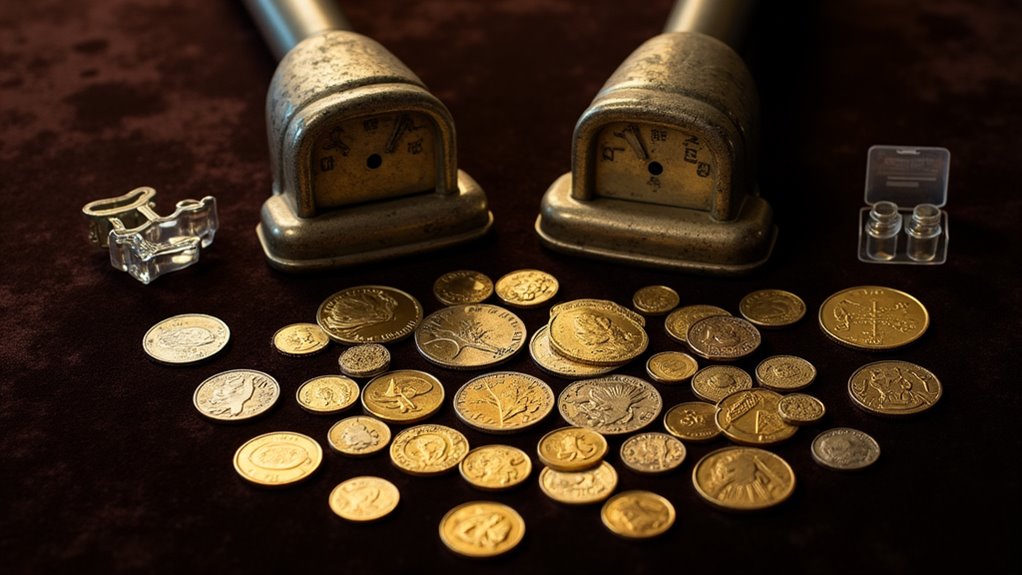
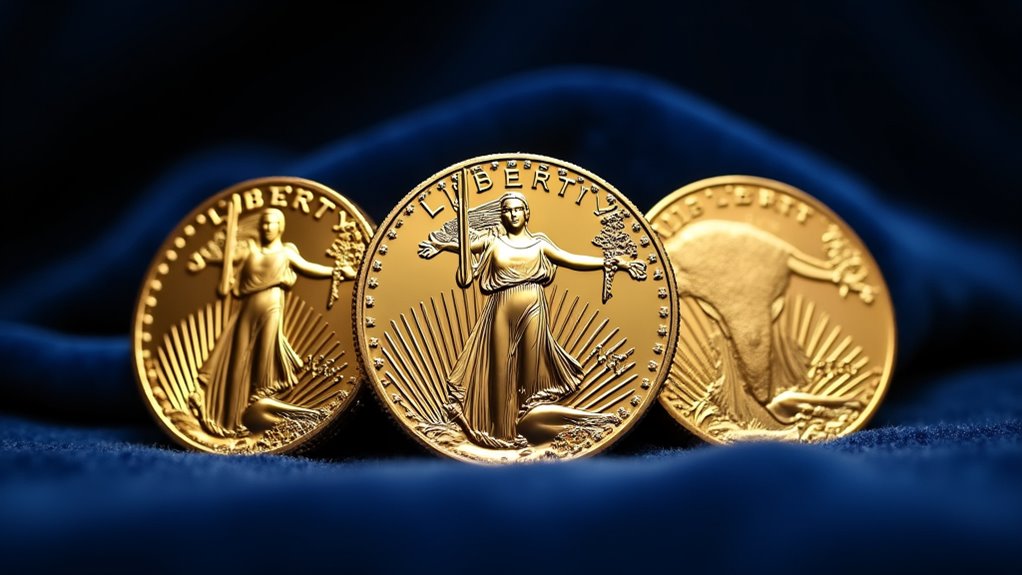
U.S. gold coins pack serious investment and historical punch. Modern American Eagles (1986-present) offer flexibility with their 22-karat composition, while Buffalos flex pure 24-karat muscle. Pre-1933 Liberty designs survived the great gold melt, making them rare treasures. Each type brings unique appeal – Eagles for stackability, Buffalos for purity, and vintage pieces for historical swagger. The collecting landscape sparkles with possibilites beyond just the gold content. 🔍
While gold has always captivated collectors, U.S. gold coins stand in a league of their own as some of the most sought-after pieces in numismatics. The story begins in 1795 when the first U.S. gold coins were minted, following the groundbreaking Coinage Act of 1792 that established denominations like the Eagle, Half Eagle, and Quarter Eagle. These early coins laid the foundation for what would become an incredible legacy in American monetary history.
The pre-1933 era represents a golden age in U.S. coinage, quite literally. The Liberty Head, Saint-Gaudens Double Eagle, and Indian Head designs emerged as iconic pieces that continue to command serious attention (and serious cash) in today’s market. But here’s the kicker – many of these beauties were melted down after the Gold Reserve Act of 1934, making surviving specimens incredibly rare and valuable. The Krugerrand’s legacy as the first modern gold bullion coin influenced global gold investment trends and parallels the American experience. Furthermore, the environmental impact of gold mining has prompted many to seek sustainable practices in the industry.
Pre-1933 U.S. gold coins represent pinnacle artistry and rarity, with many masterpieces lost forever to Roosevelt’s sweeping gold melt.
Modern collectors have their pick from three main heavy-hitters: American Gold Eagles, introduced in 1986 with their 22-karat composition; American Gold Buffaloes, the pure 24-karat newcomers that burst onto the scene in 2006; and those gorgeous pre-1933 classics that somehow escaped the great melt. Each type brings its own appeal – Eagles with their investment flexibility, Buffaloes with their pristine purity, and vintage pieces with their historical gravitas. Collectors often appreciate how these coins serve as both investment vehicles and pieces of history.

Smart collectors approach these treasures through various strategies. Some chase specific years, others hunt rarities like they’re tracking unicorns. The truly ambitious attempt complete sets, while others focus on particular mint marks – because let’s face it, a Carson City mark can make hearts race faster than a caffeinated day trader.
Valuation in this game isn’t just about gold content – though that’s certainly essential. Condition grades, ranging from MS-60 to the mythical MS-70, can make prices skyrocket. Rarity factors in heavily, especially for those pre-1933 pieces that survived Roosevelt’s gold recall. Historical significance? That’s the cherry on top that can turn a valuable coin into an absolute knockout investment.
The appeal of U.S. gold coins lies in their dual nature – they’re both historical artifacts and inflation hedges wrapped in one glittering package. Their global recognition means liquidity isn’t usually an issue, and some, like Gold Eagles, can even find their way into IRAs. Understanding your investment choices regarding bullion versus numismatic coins can help guide your collection strategy.
But collectors beware – authenticity challenges lurk around every corner in this market. The stakes are high, and counterfeits are getting craftier by the day.

These coins aren’t just chunks of precious metal; they’re time capsules of American economic history, each one telling a story of the nation’s monetary evolution. Whether you’re drawn to the classic elegance of a Saint-Gaudens or the modern precision of a Buffalo, collecting U.S. gold coins offers a tangible connection to the past while potentially securing your financial future.
Frequently Asked Questions
How Do I Safely Store My Gold Coin Collection at Home?
Gold collectors need to get serious about storage – no messing around!
A quality fireproof safe, anchored to the floor or wall, is absolutely essential. Keep those beauties in individual protective capsules and handle with cotton gloves only (oils from hands are a no-go).
Stash the safe somewhere sneaky – not the master bedroom, that’s way too obvious!
And for pete’s sake, zip those lips about the collection. Security’s everything!
What Tools Do I Need to Examine Gold Coins Properly?
Proper gold coin examination requires a solid toolkit.
Essential gear includes a quality jeweler’s loupe (10x-20x) for spotting tiny details and a digital caliper for precise measurements. Smart collectors add a reliable gram scale and neodymium magnet for authenticity checks.
Protection matters too – white cotton gloves prevent fingerprints and oils from damaging surfaces.

For serious numismatists, a stereo microscope reveals the finest details that basic tools might miss.
Are Proof Gold Coins Worth More Than Regular Strikes?
Proof gold coins typically command higher premiums than regular strikes – it’s not even close.
Their mirror-like finish, limited mintages, and meticulous double-striking process make them irresistible to collectors.
While regular strikes might fetch 5-6% over spot, proofs often demand 9% or more.

But here’s the kicker: that fancy packaging and certificate of authenticity doesn’t always translate to better returns.
The premium’s larger, but liquidating can be trickier.
How Can I Tell if My Gold Coin Has Been Cleaned?
Spotting a cleaned gold coin ain’t rocket science! The telltale signs are pretty obvious – those pesky hairline scratches criss-crossing the surface like a spiderweb.
The natural mint luster? Gone baby gone, replaced by an unnaturally bright shine that screams “I’ve been polished!”

Pro tip: roll that coin under good lighting and watch for weird reflections. Those sneaky cleaning residues love hiding in the nooks n’ crannies of letters and designs.
Which Gold Coin Varieties Are Considered the Rarest and Most Valuable?
The 1849 Double Eagle stands alone as America’s rarest gold coin – just one exists, chillin’ at the Smithsonian!
Right behind it, the 1933 Saint-Gaudens Double Eagle‘s got serious swagger, with one specimen recently nailing $18.9M at auction.
The legendary Brasher Doubloon ain’t too shabby either, fetching $9.36M in 2021.
And don’t sleep on those Carson City pieces – particularly the 1876 Half Eagle that’s worth up to $780k!