Global gold holdings are dominated by powerhouse nations, with the US flexing its muscles at 8,133 tonnes – talk about a gold flex! Germany and Italy follow with 3,352 and 2,452 tonnes respectively. The International Monetary Fund and World Gold Council track these precious stockpiles in metric tonnes, while central banks keep reshaping the landscape with their buy-and-sell dance. And boy, is the market hot – gold’s already up 17.53% this year! The real treasure lies in understanding what drives these golden giants.

Glitter and power – that’s what drives the world’s appetite for gold. The precious metal’s allure has central banks worldwide hoarding massive stockpiles, with the United States leading the pack at a whopping 8,133 tonnes. That’s no small chunk of change, folks. Germany trails behind with 3,352 tonnes, while Italy rounds out the top three with 2,452 tonnes of the shiny stuff.
Gold’s not just glitz – it’s raw economic muscle, with nations stockpiling thousands of tonnes in a high-stakes power game.
But here’s where it gets juicy – central banks aren’t just passive collectors. Australia currently dominates with largest gold reserves globally. They’re actively reshaping the global gold landscape, accounting for roughly 20% of all historically mined gold. Jordan has maintained its strong position with 71.65 tonnes of reserves. Recent months have seen some serious moves in the market. China’s been quietly beefing up its reserves, adding 16 tonnes in December 2024 alone. Not to be outdone, India jumped from 854 to 876 tonnes, while Turkey muscled its way up to 615 tonnes. Central banks continue to adjust their gold reserves management strategies based on economic conditions and forecasts, highlighting the strategic importance of gold as a reserve asset. This ongoing accumulation reflects a growing recognition of gold’s role as a financial security measure during turbulent times, as many countries understand the value of holding gold reserves during economic downturns.
The way we track these golden hoards is pretty fascinating (and sometimes messy). The International Monetary Fund keeps tabs on official reserves, while the World Gold Council throws out regular updates that gold bugs devour like candy. Everything’s measured in metric tonnes because, well, somebody had to pick a standard, right? The top ten gold reserve nations hold a significant portion of the world’s gold, influencing global markets and investment strategies.

Speaking of standards, gold’s been on an absolute tear lately, surging 17.53% since 2025 kicked off. As of March 2025, it’s trading at a cool $3,022.77 per troy ounce. Some folks are betting it’ll hit $3,181.48 in a year’s time – but let’s not get ahead of ourselves here. We’ve seen plenty of “sure things” crash and burn.
The consumption patterns tell their own wild tale. Jewelry still gobbles up half of global gold production, while investment demand snags another 40%. Those numbers shift like desert sands when economic uncertainty kicks in, sending investors scrambling for their favorite safe haven. India and China lead the jewelry charge, with the US, Turkey, and Saudi Arabia not far behind.
Here’s the kicker – measuring these reserves isn’t just about counting bars in a vault. It’s a complex dance of reporting requirements, international standards, and sometimes… creative accounting. The percentage of gold in a country’s total reserves can tell you plenty about their monetary strategy. Some nations go all-in on gold, while others keep it as just another item in their financial toolbox.
The gold game never really changes – it just finds new players. Whether it’s central banks loading up during uncertain times or emerging economies flexing their financial muscles, gold remains the ultimate power move in the global monetary chess match. And that’s exactly how we like it – unpredictable, fascinating, and always worth watching.
Frequently Asked Questions
How Does Gold Purity Affect Its Market Value and Trading Potential?
Gold purity dramatically impacts its market mojo. Higher-purity gold (24k, 22k) typically commands premium prices and trades more smoothly in global markets.
But it’s not always that simple – some regions prefer specific purities (Asia loves 24k, India’s hot for 22k).

While investment-grade bars need 99.5% purity minimum, lower-karat pieces still have their place, especially in jewelry where durability matters.
Market sentiment? Pure gold usually wins the popularity contest.
What Security Measures Do Central Banks Use to Protect Their Gold Reserves?
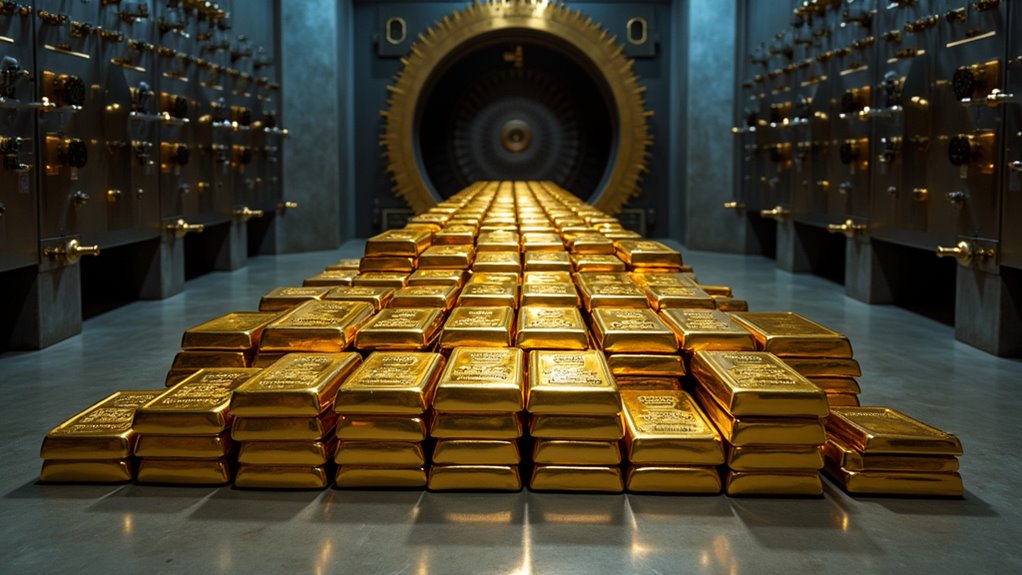
Central banks employ multi-layered security that’d make Fort Knox jealous.
We’re talking heavy-duty vault walls reinforced with bomb-proof materials, biometric scanners that’d reject your evil twin, and 90-ton rotating steel cylinders (yes, really!).

Guards with expert marksmanship keep watch while time-locks and motion sensors work 24/7.
The whole setup can lock down in 25 seconds flat if someone gets frisky – now thats what we call serious protection!
Can Individuals Invest in the Same Gold Holdings as Governments?
Individuals can’t directly access government-style gold holdings – that’s just not how it works!
While central banks stack massive gold reserves in ultra-secure vaults, regular folks have different options.

Think ETFs, mining stocks, or physical gold through dealers.
Sure, you can buy gold, but you’ll never match the scale or security of government holdings.
It’s like comparing a backyard pool to the Pacific Ocean – same water, totally different ballgame!
How Often Are National Gold Reserves Independently Audited?
National gold reserves rarely face truly independent audits – a fact that drives conspiracy theorists wild!
Most countries stick to internal checks, while full external audits are about as common as a gold bar in your breakfast cereal. The U.S. hasn’t done a complete Fort Knox audit since 1953 (yikes!), though they do annual “continuing audits” on portions.

Security risks, massive logistics, and geopolitical sensitivities make thorough audits a huge headache for most nations.
Why Do Some Countries Choose to Store Gold Reserves Abroad?
Countries stash their gold abroad for a cocktail of compelling reasons.
World War II sparked the trend – nations scrambled to protect their precious metal from sticky-fingered invaders.
Today, it’s all about practicality: major financial hubs offer Fort Knox-level security and seasoned expertise in bullion management.
Plus, keeping gold overseas makes international transactions smoother and provides a safety net against domestic turmoil.
It’s like having a golden insurance policy with global benefits.